When does the Earth achieve its lowest orbital speed during its orbit around the Sun?
Answer
Around July (aphelion).
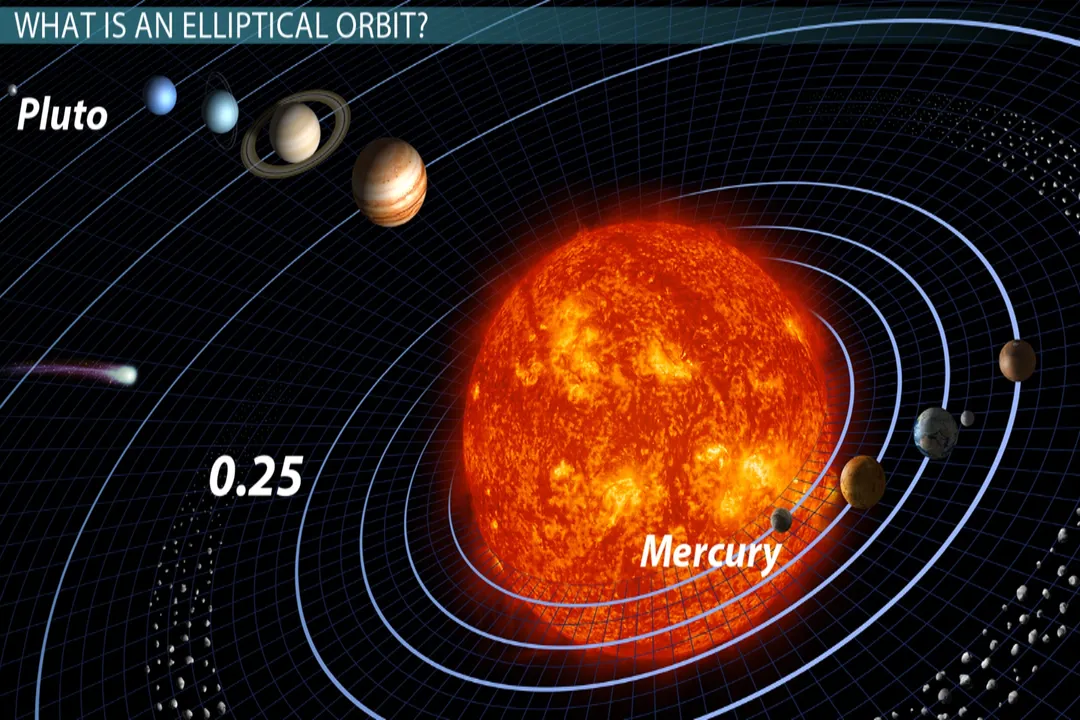
The Earth's orbit possesses a slight eccentricity, approximately 0.0167, meaning its distance from the Sun varies throughout the year. According to the principles derived from Kepler's Second Law, the orbital speed is inversely related to the distance from the central body. The Earth reaches perihelion (closest approach to the Sun) around January, where its speed is highest. Conversely, the Earth reaches aphelion (farthest distance from the Sun) around July. At this farthest point, the gravitational pull is weakest, and consequently, the orbital speed drops to its lowest point during the annual cycle.
#Videos
Elliptical Orbits - Brain Waves - YouTube
Related Questions
What is the eccentricity ($e$) value defining a perfectly circular orbit path?What is the deliberate purpose of the high eccentricity in a Molniya orbit design?How does Kepler's Second Law describe object speed in an elliptical path near periapsis?Which eccentricity value ($e$) is associated with an orbit classified as a parabola?When does the Earth achieve its lowest orbital speed during its orbit around the Sun?What is the fundamental property that quantifies an orbit's deviation from circularity?In an idealized two-body problem, what makes an elliptical orbit unstable compared to a circular orbit?Which term is listed as a straightforward alternative name for an elliptical orbit?What visual characteristic defines an orbit when its eccentricity ($e$) approaches 0.9?How does the long, slow arc near apoapsis impact mission planning for spacecraft in HEOs?Which parameters are incorporated in the vis-viva equation to calculate velocity along an ellipse?