In an idealized two-body problem, what makes an elliptical orbit unstable compared to a circular orbit?
Elliptical orbits are not inherently less stable; both are stable if $e < 1$.
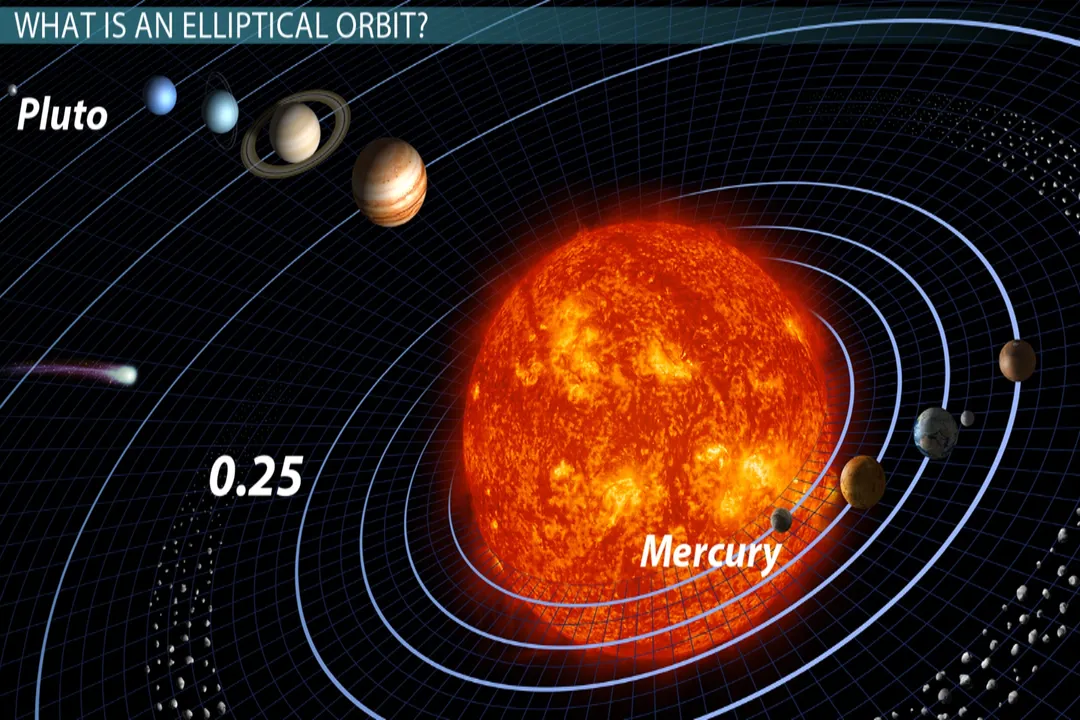
When analyzing orbital mechanics under the idealized assumption of only two interacting bodies (the two-body problem), both circular orbits ($e=0$) and elliptical orbits ($0 < e < 1$) are considered perfectly stable, closed paths. The geometry itself does not introduce inherent instability. Instability only arises when external factors, known as perturbations, are introduced—such as the gravitational influence of a third body or the non-spherical mass distribution of the primary body. In fact, a perfectly circular orbit is sometimes viewed as an unstable equilibrium because any minute impulse will immediately induce an eccentricity, pushing the path into an ellipse, whereas the ellipse is already in a dynamic, stable state unless a large perturbation pushes $e$ past the threshold of one.
#Videos
Elliptical Orbits - Brain Waves - YouTube