What is another name for an elliptical orbit?
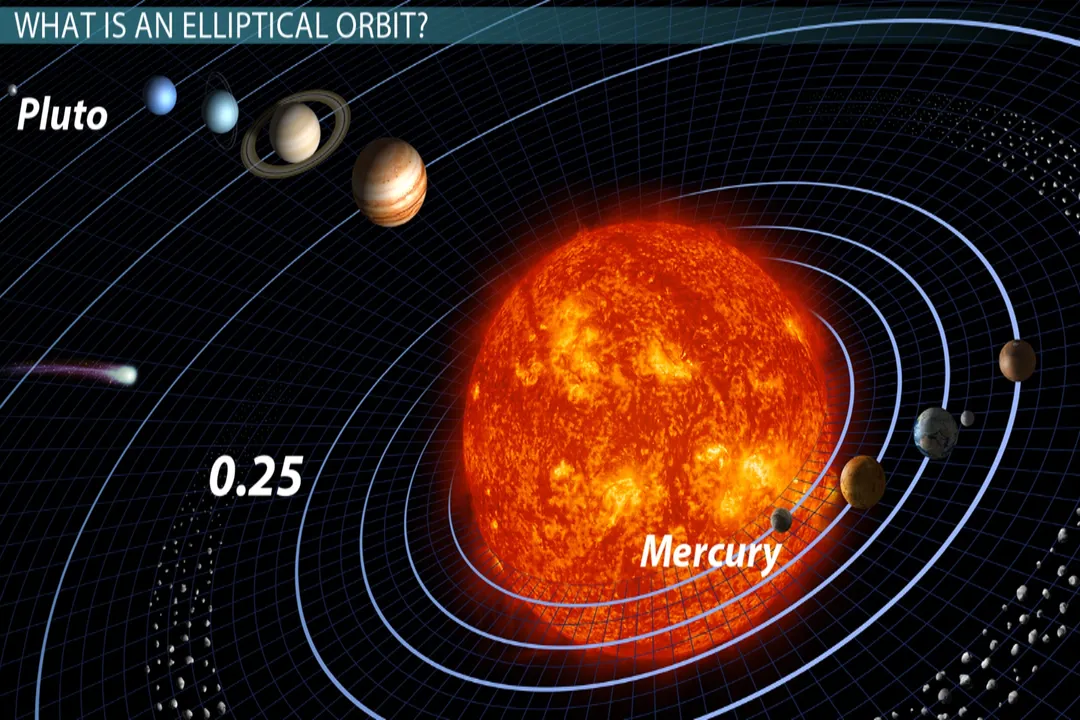
The description of a celestial path that deviates from a perfect circle often leads to a search for alternative terminology. While elliptical orbit is the standard, precise scientific term, several other names are used interchangeably or to describe specific conditions of that same shape. For instance, the most straightforward alternative is simply the term elliptic orbit. Other synonyms found in general usage might include terms like elongated orbit or describing the path as ovoid. In the context of mathematics and physics, however, the defining characteristic used to categorize and discuss these orbits is not the name of the shape itself, but the degree to which it deviates from circularity.
# Shape Measure
The fundamental property that distinguishes an elliptical orbit from a circular one is its eccentricity, symbolized by the letter . Eccentricity is a unitless parameter that quantifies how much the orbit deviates from being a perfect circle. A perfect circle is defined by an eccentricity of exactly zero (). As the eccentricity increases toward one, the ellipse becomes more stretched out or elongated. An orbit where is less than one defines an ellipse, while an orbit where equals one is a parabola, and an orbit where is greater than one is a hyperbola—these last two are typically considered escape trajectories rather than bound orbits.
There is a subtle distinction in terminology that can sometimes cause confusion. While eccentricity is the mathematical measure, the word ellipticity sometimes appears. In some contexts, ellipticity is mathematically related to eccentricity, often defined in terms of the ratio of the semi-minor axis to the semi-major axis, or sometimes used synonymously with eccentricity itself, depending on the field or the specific source. For general purposes in orbital mechanics, however, eccentricity remains the preferred, unambiguous descriptor for the shape.
To better grasp how the value of eccentricity translates to the visual shape of the path, consider the relationship between the value and the visual representation:
| Eccentricity () Value | Orbit Type Description | Path Appearance |
|---|---|---|
| Circular | Perfectly round, constant distance from focus | |
| Nearly Circular | Very slight oval shape | |
| Typical Ellipse | Noticeable elongation (e.g., Earth's orbit is ) | |
| Highly Elliptical | Significantly elongated, long major axis | |
| Parabolic | Open path, object just escapes the central body's gravity |
Understanding this range is key; an orbit that is technically elliptical might have an eccentricity so close to zero that for many practical purposes, it is treated as circular, but mathematically, it remains an ellipse.
# Orbit Class
When discussing celestial bodies or spacecraft, orbits are frequently classified based on their eccentricity values, which gives rise to more specific names than just "elliptical orbit." The term Highly Elliptical Orbit (HEO) is one such classification. An HEO is characterized by a high eccentricity, meaning it has a significant difference between its closest point (periapsis) and its farthest point (apoapsis) from the central body.
A classic example of a designed HEO is the Molniya orbit, which is crucial for specific communication and surveillance satellites, particularly those serving high northern latitudes. These orbits typically have an eccentricity of around $0.72$. The purpose of this high eccentricity is deliberate: the satellite spends a disproportionately large amount of time near its apoapsis, remaining visible over a specific region of the Earth for many hours. This high-altitude dwell time is only possible because the orbit is highly elliptical, contrasting sharply with the near-constant altitude of a geosynchronous orbit (). While the Molniya orbit is an ellipse, its common name reflects its operational profile rather than just its geometric shape.
# Speed Dynamics
The non-uniform nature of an elliptical orbit directly dictates the orbital speed of the object tracing it. This behavior is fundamentally described by Kepler's Second Law of Planetary Motion. This law states that a line segment joining a planet and the Sun sweeps out equal areas during equal intervals of time. In practical terms, this means that an object moving in an elliptical path moves faster when it is closer to the central mass (at periapsis) and slower when it is farther away (at apoapsis).
For the Earth orbiting the Sun, its speed varies throughout the year. It achieves its highest speed around January (perihelion) and its lowest speed around July (aphelion). This variation in speed is a direct consequence of the slight eccentricity of Earth's orbit.
If one were tracking a spacecraft in an orbit that was deliberately designed to be highly eccentric, this speed variation becomes a major engineering factor. For instance, if a probe is heading toward a distant planet or the edge of a star system, the time it takes to traverse the long, slow arc near apoapsis will consume the vast majority of its orbital period.
This dynamic property provides a moment for practical consideration: When planning observations or communication passes for satellites in HEOs, mission controllers must account for the long periods of slow movement, which translate to extended coverage windows, followed by rapid, brief transits when the object swings close to perigee. The planning often revolves around maximizing observation time during the slower, higher altitude phase, even if it means waiting many hours between useful contact windows. A key analytical difference between a circular and elliptical path isn't just the static shape, but the continuous change in the object's kinetic energy distribution relative to its potential energy as it coasts along the curve. The specific velocity at any point along the ellipse can be calculated using the vis-viva equation, which incorporates the semi-major axis and the distance from the focus, confirming the mathematical dependency of speed on the elliptical path's dimensions.
# Stability Context
While the geometry of an elliptical orbit is well-defined mathematically—it is a closed, stable path provided only two bodies are interacting (the two-body problem)—the term sometimes arises in discussions about stability relative to other types of paths. For example, are elliptical orbits inherently more stable than circular ones? The answer, in an idealized model, is no; both are perfectly stable as long as the eccentricity is less than one. Instability arises not from the shape being elliptical, but from external perturbations, such as the gravitational influence of other celestial bodies (like Jupiter affecting an asteroid's path) or non-spherical mass distribution of the primary body.
When comparing the elliptical path to the circular path, the difference in "stability" usually comes down to how the orbit reacts to a small nudge. A circular orbit has zero eccentricity, meaning any small impulse will likely induce an eccentricity, making the path elliptical. Conversely, a highly elliptical orbit already possesses large variations in speed and distance; a small perturbation might cause the apoapsis or periapsis to shift, but the orbit remains fundamentally elliptical unless the perturbation is large enough to push the eccentricity over the threshold of . Therefore, the name doesn't dictate stability; the magnitude of external forces relative to the central gravitational force does. A common conceptual shorthand in amateur astronomy circles is that a perfectly circular path is an unstable equilibrium waiting to be disturbed into an ellipse, whereas the ellipse is a more general, dynamic state of orbital motion.
#Videos
Elliptical Orbits - Brain Waves - YouTube
Related Questions
#Citations
ELLIPTICAL ORBIT Synonyms: 77 Similar Words & Phrases
Video: Elliptical Orbits Definition, Equations & Example - Study.com
What is the difference between the two terms named 'Eccentricity ...
Highly elliptical orbit - Wikipedia
"elliptic orbit": An orbit shaped like ellipse.? - OneLook
What is another word for elliptical? - Answers.com
Elliptical Orbits - Brain Waves - YouTube
Elliptical Orbit - an overview | ScienceDirect Topics
Are elliptical orbits any more stable than circular orbits? - Reddit