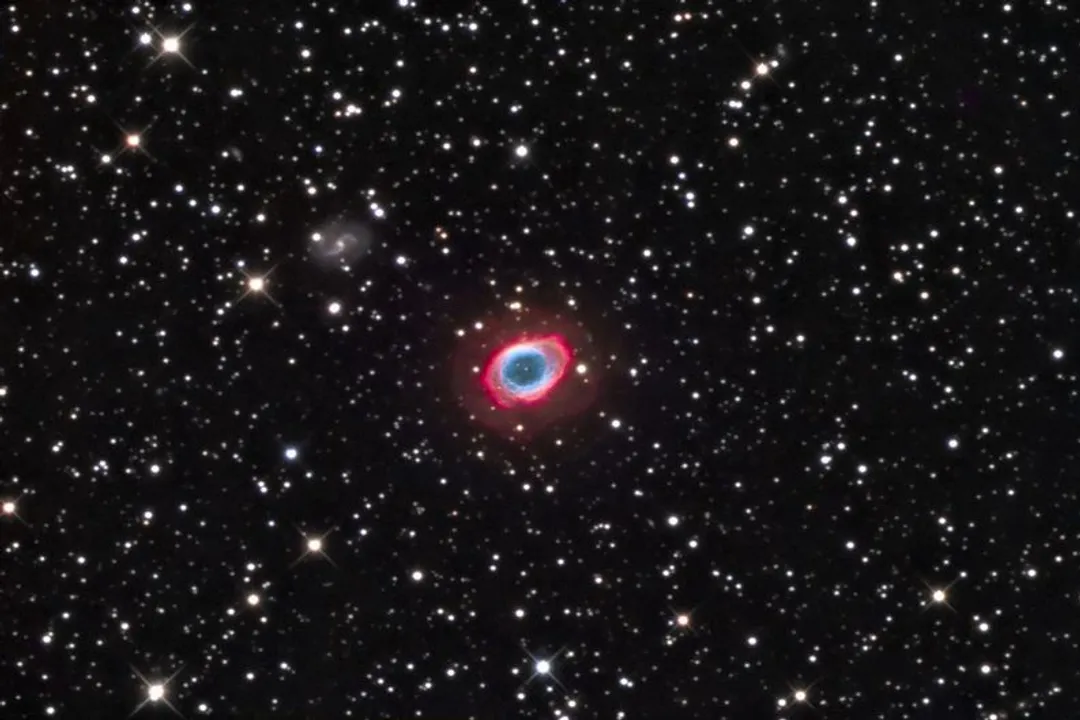
What distinction in visual experience occurs when comparing viewing the Ring Nebula visually versus through a long-exposure photograph?
The photograph reveals distinct blue and green tones that the naked eye cannot perceive under dim conditions.
The difference between visual observation and long-exposure astrophotography highlights the limitations of the human eye versus cumulative light capture. When viewing the Ring Nebula, for example, the light levels are insufficient to stimulate the cone cells, resulting in a pale, monochromatic appearance, perhaps a smoke-ring-shaped disc of grey or white light. A long-exposure photograph, however, gathers photons over minutes or hours, accumulating enough energy to fully stimulate the sensors (or cones, if processed for color display). This cumulative exposure allows the camera to register the subtle hues—such as the blue and green light emitted by certain ionized gases—that the human eye simply cannot detect instantaneously under the faint viewing conditions.
#Videos
NASA's Images of Nebulae Have a Glaring Problem - YouTube