What characterizes the dominant stellar population found in ancient Globular Clusters?
Answer
Smaller, cooler, longer-lived stars such as red giants
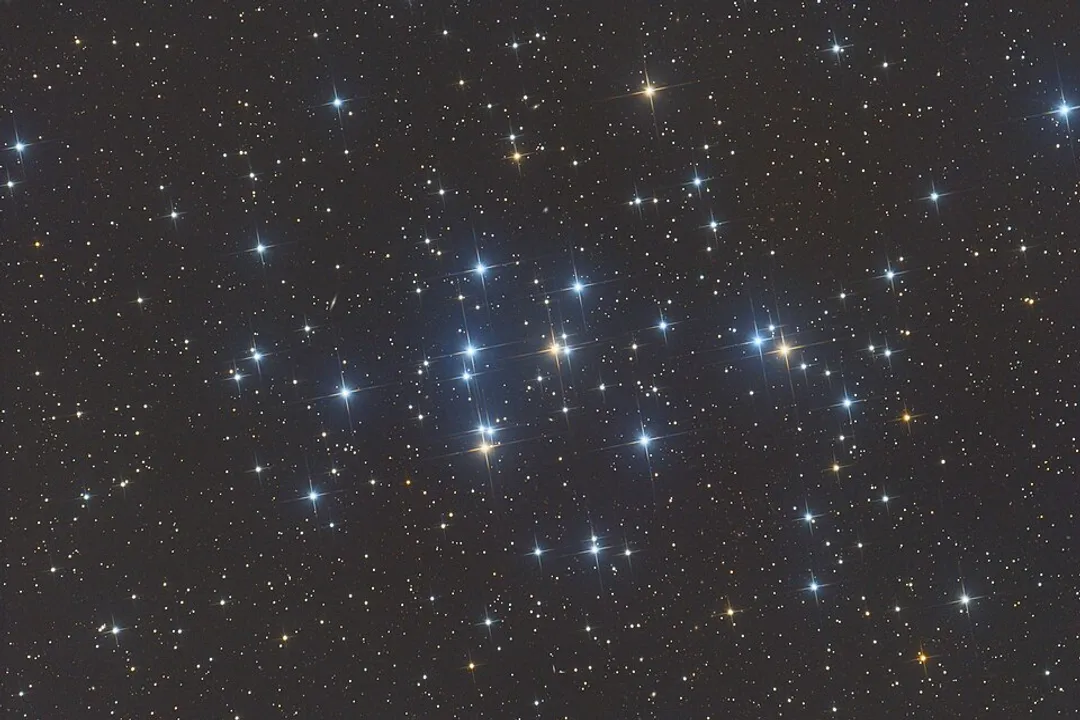
Globular Clusters are extremely old, dating back 8 to 13 billion years. Because such vast amounts of time have passed, the most massive and hottest stars that were present at the cluster's formation have already completed their lives, either exploding as supernovae or evolving into remnants like white dwarfs. What remains is a population dominated by the stars that burn their fuel slowly—the lower-mass, cooler stars, including red giants, which have much longer inherent lifetimes. This contrasts sharply with young Open Clusters, which are often still populated by their initial short-lived, bright blue members.
Related Questions
What single variable explains the vast differences observed in stellar state within a star cluster?Where are younger, less densely packed Open Clusters typically located within a galaxy like the Milky Way?What characterizes the dominant stellar population found in ancient Globular Clusters?What observational pattern plotted on the Hertzsprung-Russell (HR) diagram is called an isochrone?What significant structural revelation about the Milky Way was provided by Harlow Shapley's globular cluster mapping?How does main-sequence fitting utilize well-calibrated nearby open clusters?In testing evolutionary models, how does fixing the age of a star cluster constrain the required physics parameters?What fundamental conclusion did the age conflict between early Hubble Constant estimates and Globular Cluster ages establish?How do astronomers track the chemical enrichment history of the Galaxy by comparing cluster types?What evidence in our Solar System suggests the Sun formed in a crowded, clustered birth environment?