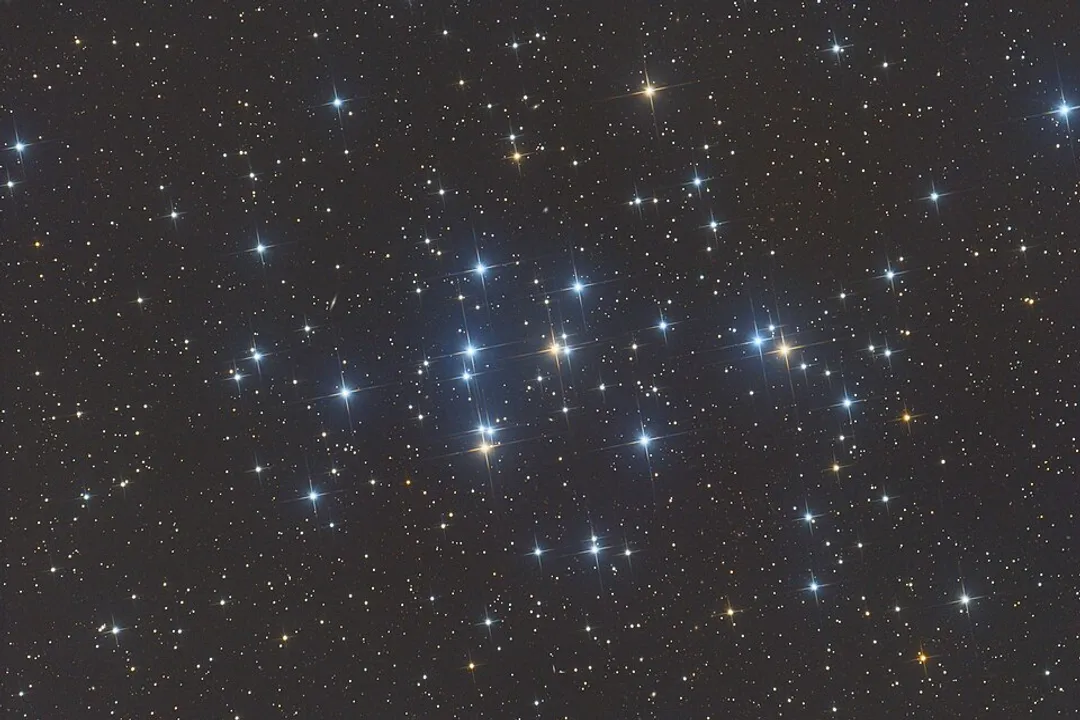
In testing evolutionary models, how does fixing the age of a star cluster constrain the required physics parameters?
It forces the modeler to match the entire observed distribution using only one set of mass-dependent evolutionary tracks against fixed initial conditions.
When testing theoretical astrophysics models for stellar evolution, observing a single star presents ambiguity because a model mismatch could be resolved by adjusting either the assumed mass or the assumed age. Star clusters resolve this ambiguity because they enforce the assumption of a single, fixed age and a single initial chemical composition for the entire group. Consequently, the modeler is mathematically constrained: they must use only *one* set of mass-dependent evolutionary tracks to simultaneously fit the entire observed scatter of stars across the HR diagram. If the model fails to accurately predict the cluster's observed shape, the underlying assumptions about internal physics, such as opacity or energy transport, must be incorrect.