How does the average stellar separation in a dense globular cluster core generally compare to that in the quiet suburbs of the Milky Way?
Answer
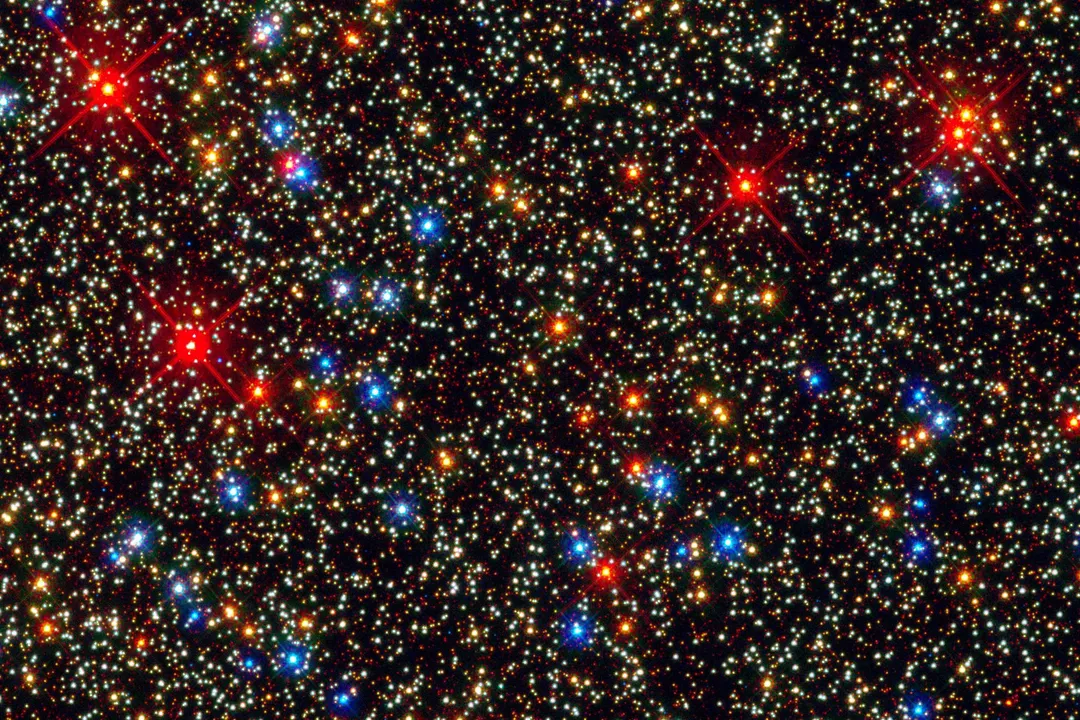
Cluster core separations can be much smaller, sometimes a fraction of the distance between the Sun and Neptune.
In the galactic plane, stars are separated by large distances (several light-years), but in a cluster core, stars can be packed so tightly that their separation approaches distances far smaller than that between the Sun and Neptune.
Related Questions
What are the two primary, interconnected factors challenging stable planetary systems in globular clusters?How does the average stellar separation in a dense globular cluster core generally compare to that in the quiet suburbs of the Milky Way?What is the primary mechanism described that removes planetary bodies from their host stars in dense clusters?What do simulations suggest about the frequency of disruptive gravitational encounters in the core of a cluster like M13 compared to our solar neighborhood?What secondary problem regarding longevity do globular clusters present for planetary survival?Why might the chemical composition of globular cluster stars hinder initial planet formation?Which observational instrument has been instrumental in searching for transiting planets in globular clusters?What was the primary surprising result from the Hubble observations targeting the cluster 47 Tucanae?How does the effective zone of stability for an Earth-like planet in a cluster core compare to the stability in our Solar System?If a planet were theoretically tossed from one star to another during an encounter in a cluster, what is the general consensus on its subsequent stability?