Which of the following statements apply in the final moments of the life of high-mass stars?
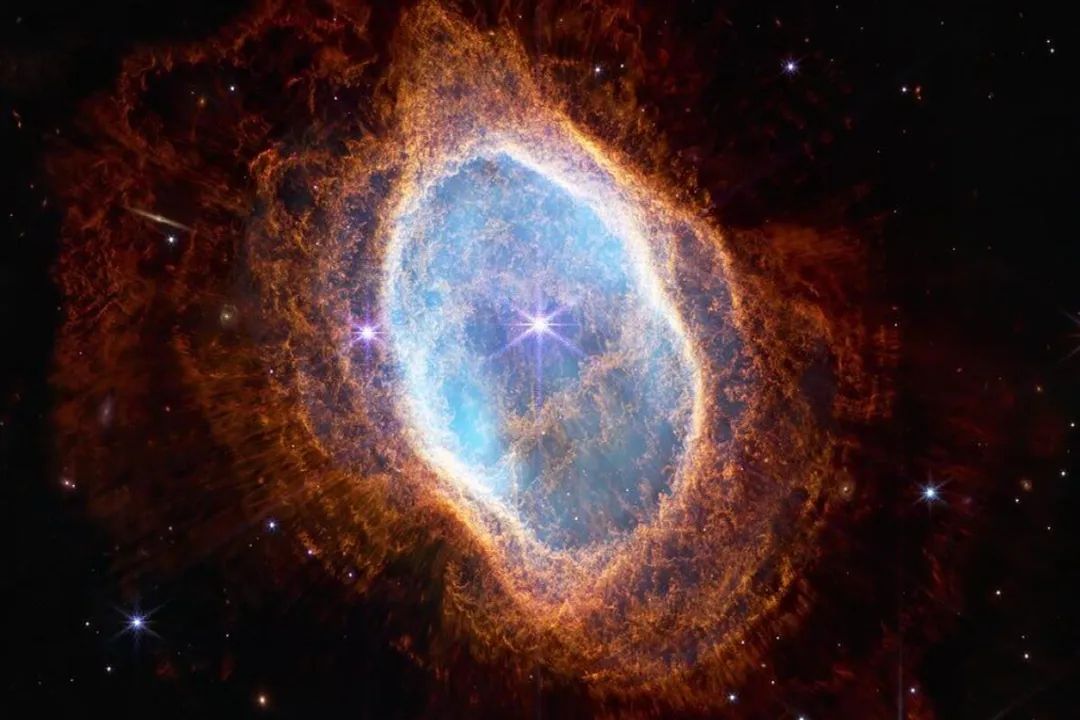
When a high-mass star approaches the end of its lifespan, it undergoes a series of rapid nuclear fusion changes that distinguish it significantly from lower-mass stars like our Sun. [7] While stars with less mass eventually shed their outer layers and leave behind a white dwarf, high-mass stars—those generally defined as having more than eight times the mass of the Sun—follow a more violent and dramatic path. [7] This progression leads to a catastrophic gravitational collapse that results in a supernova explosion, leaving behind dense, exotic remnants. [7]
# Stellar fusion
The internal architecture of a massive star changes as it ages. Initially, the star fuses hydrogen into helium in its core, which provides the outward pressure necessary to counteract the crushing force of gravity. [7] Once the hydrogen supply in the core is exhausted, the core contracts, heating up until helium fusion begins. This pattern continues, but with each successive stage, the star consumes its nuclear fuel at an exponentially faster rate. [7]
Following helium burning, the star creates a series of heavier elements through successive fusion cycles. These stages involve fusing carbon, neon, oxygen, and silicon. [7] Unlike lower-mass stars that stop at the carbon or helium stage, high-mass stars possess the gravitational pressure required to continue fusing these heavier elements. [7] As the core creates heavier elements, the star develops an internal structure resembling an onion, with layers of lighter elements surrounding the core where the heaviest fusion occurs. [7]
# Fusion progression
| Fusion Stage | Product | Relative Duration |
|---|---|---|
| Hydrogen | Helium | Billions of years |
| Helium | Carbon | Millions of years |
| Carbon | Neon | Thousands of years |
| Neon | Oxygen | Years |
| Oxygen | Silicon | Months |
| Silicon | Iron | Days |
This table illustrates the accelerating "burn" rate. Note how the final silicon-to-iron stage happens in a matter of days compared to the millions of years spent on earlier stages. [7] The reason for this drastic speed increase lies in the decreasing efficiency of energy production as nuclei become heavier, requiring higher temperatures and densities to achieve fusion. [7]
# Iron core
The creation of iron inside the star’s core marks the absolute beginning of the end. In the hierarchy of nuclear fusion, iron is a unique anomaly. Fusing elements lighter than iron releases energy, which helps the star maintain stability against gravity. [7] However, fusing iron is an endothermic process; it requires more energy to force iron nuclei together than the reaction releases. [7] Because of this, the core can no longer produce the outward pressure required to support the star's immense weight.
When the core becomes primarily iron, fusion halts completely. [7] This creates a dangerous void in the star's energy balance. Without the outward push of fusion energy, gravity immediately takes control, and the massive weight of the star's outer layers presses inward on the inert iron core. [7] The core, which has been supporting the entire star, suddenly finds itself unable to hold up the overlying material, leading to an almost instantaneous structural failure. [7]
# Core collapse
The collapse happens at a fraction of the speed of light. As the iron core reaches a critical density, it experiences a process known as electron degeneracy failure. [7] Electrons are forced into protons to form neutrons, releasing a massive burst of neutrinos in the process. [7] This transformation, called neutronization, occurs in a split second, causing the core to shrink to the size of a city—roughly 10 to 20 kilometers in diameter—in a fraction of a second. [7]
This sudden shrinkage creates a vacuum of sorts, allowing the outer layers of the star to fall inward at incredible speeds. The collapsing material slams into the ultra-dense neutron core and bounces off, creating a massive shockwave that propagates outward through the star. [7] This shockwave, combined with the extreme neutrino pressure, blows the rest of the star apart in a spectacular supernova explosion. [7]
# Scientific observation
It is useful to categorize the "dead-end" nature of iron. Think of iron as the nuclear "ash" of a star. In a fireplace, ash is the material that has already burned and can no longer provide fuel for the fire. Iron behaves similarly in a star. While other elements can be fused to generate heat and light, iron is the lowest energy state for a nucleus in that mass range, meaning it is the stable "ash" of the stellar furnace. [8] No amount of squeezing or heating can force iron to provide the energy needed to fight gravity, ensuring the star's collapse is inevitable once the iron core forms.
# Explosive death
The supernova explosion is one of the most energetic events in the universe. It is during this final moment that the majority of heavy elements in the universe are synthesized. [8] While normal stellar fusion creates elements up to iron, the intense heat and neutron flux generated by the explosion provide the energy necessary to create elements heavier than iron, such as gold, silver, and uranium. [8] These newly forged elements are then scattered across space by the shockwave, enriching the interstellar medium for future generations of stars and planets. [8]
This process demonstrates how high-mass stars act as chemical factories. Without the violent death of these massive objects, the universe would lack the complex heavy metals essential for rocky planets and biological life. Every heavy element found on Earth was once inside the core of a massive star before being dispersed by a supernova. [8]
# Final remnants
Once the dust settles from the supernova, what remains depends on the initial mass of the star. The core does not simply vanish; it is compressed into an incredibly dense object. [7]
- Neutron Stars: If the remaining core mass is between roughly 1.4 and 3 times the mass of the Sun, the core becomes a neutron star. [5][7] These objects are supported against further collapse by neutron degeneracy pressure, which is the resistance of neutrons to being packed closer together. [7] A neutron star is so dense that a teaspoon of its material would weigh billions of tons.
- Black Holes: If the core remnant is more than about 3 times the mass of the Sun, not even neutron degeneracy pressure can stop the collapse. [7] Gravity overwhelms all other forces, and the core collapses infinitely to a point known as a singularity, creating a black hole. [7]
The death of a high-mass star is essentially a race against gravity. While the star succeeds in generating energy for millions of years, the laws of physics eventually render its fuel sources useless. The transition from a shining, luminous giant to a dark, ultra-dense remnant—or a black hole—is a fundamental part of the cosmic cycle, ensuring that the materials from one generation of stars become the building blocks for the next. [7]
#Videos
Ch. 21: Life & Death of a High Mass Star (6 of 12) Model ... - YouTube
Life & Death of a High Mass Star (8 of 12) The Final Moments (Part 1 ...
Related Questions
#Citations
In the final moments of the life of high-mass stars, what can lead to ...
Astronomy CH 14 Flashcards - Quizlet
Ch. 21: Life & Death of a High Mass Star (6 of 12) Model ... - YouTube
Chapter 17 Homework 14 Star stuff Flashcards by michael pecoraro
Solved: Which of the following statements about the life of a star with ...
Evolution of Massive Stars: An Explosive Finish | Astronomy
Death of a Star: What Happens When Things Go Dark
Problem 36 Choose the best answer to each o... [FREE SOLUTION]