Which geological feature, nicknamed "blueberries," provides evidence of long-term interaction with liquid water on the Martian surface?
Answer
Hematite spheres
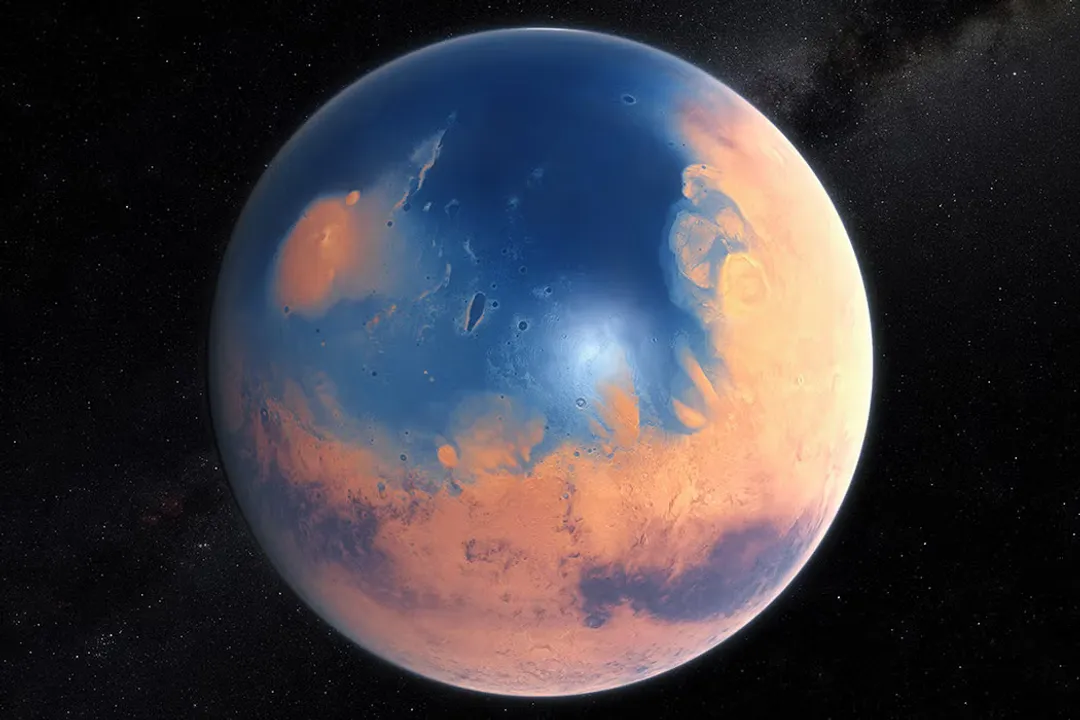
The presence of hematite spheres, commonly referred to as "blueberries," is cited as strong evidence that liquid water interacted with the Martian surface over extended periods. These minerals typically only form in the sustained presence of liquid water. Their discovery, along with dried-up riverbeds and deltas observed by orbital and surface missions, paints a picture of an early, wetter Mars during its initial billion years, capable of sustaining liquid environments across vast regions.
Related Questions
Which geological feature, nicknamed "blueberries," provides evidence of long-term interaction with liquid water on the Martian surface?What critical internal change caused the shutdown of Mars's planetary magnetic field billions of years ago?What is the primary mechanism by which the solar wind eroded the Martian atmosphere after the magnetic shield failed?How did the thinning of the Martian atmosphere directly affect the stability of liquid water on the surface?What two main routes did water molecules take to leave the Martian system following atmospheric breakdown?According to the University of Chicago study, what condition accelerated the initial loss of water vapor before the magnetic field fully disappeared?What chemical alteration did high-energy radiation cause on the Martian surface after the atmosphere thinned?What is the current state of Mars's atmosphere compared to Earth's sea-level pressure?What factor in planetary resilience is cited as the ultimate deciding factor between Earth remaining a water world and Mars becoming arid?What historical visual transformation accompanied the loss of water vapor and atmospheric thinning on Mars?Where is a significant fraction of Mars's remaining water currently locked away according to orbital observations and radar data?