What two main routes did water molecules take to leave the Martian system following atmospheric breakdown?
Answer
Physical blowing into space by the solar wind and dissociation by UV radiation
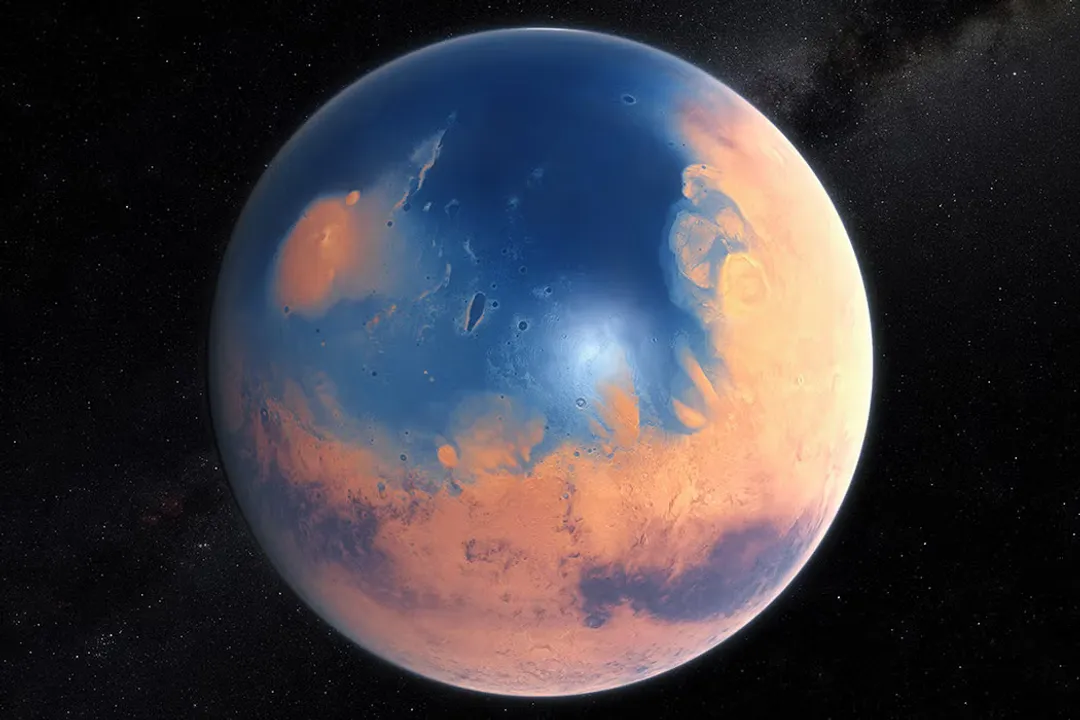
The water that escaped the planet took several distinct paths. A portion of the water vapor was physically stripped away and blown directly into space by the force of the solar wind. Another significant route involved ultraviolet radiation high in the atmosphere breaking down the water molecules into their constituent parts, hydrogen and oxygen. The much lighter hydrogen atoms were then easily able to escape into space, while the heavier oxygen either reacted with surface rocks or slowly followed into space.
Related Questions
Which geological feature, nicknamed "blueberries," provides evidence of long-term interaction with liquid water on the Martian surface?What critical internal change caused the shutdown of Mars's planetary magnetic field billions of years ago?What is the primary mechanism by which the solar wind eroded the Martian atmosphere after the magnetic shield failed?How did the thinning of the Martian atmosphere directly affect the stability of liquid water on the surface?What two main routes did water molecules take to leave the Martian system following atmospheric breakdown?According to the University of Chicago study, what condition accelerated the initial loss of water vapor before the magnetic field fully disappeared?What chemical alteration did high-energy radiation cause on the Martian surface after the atmosphere thinned?What is the current state of Mars's atmosphere compared to Earth's sea-level pressure?What factor in planetary resilience is cited as the ultimate deciding factor between Earth remaining a water world and Mars becoming arid?What historical visual transformation accompanied the loss of water vapor and atmospheric thinning on Mars?Where is a significant fraction of Mars's remaining water currently locked away according to orbital observations and radar data?