What historical visual transformation accompanied the loss of water vapor and atmospheric thinning on Mars?
Answer
The sky shifted from likely blue to the characteristic reddish-orange hue due to oxidized iron dust
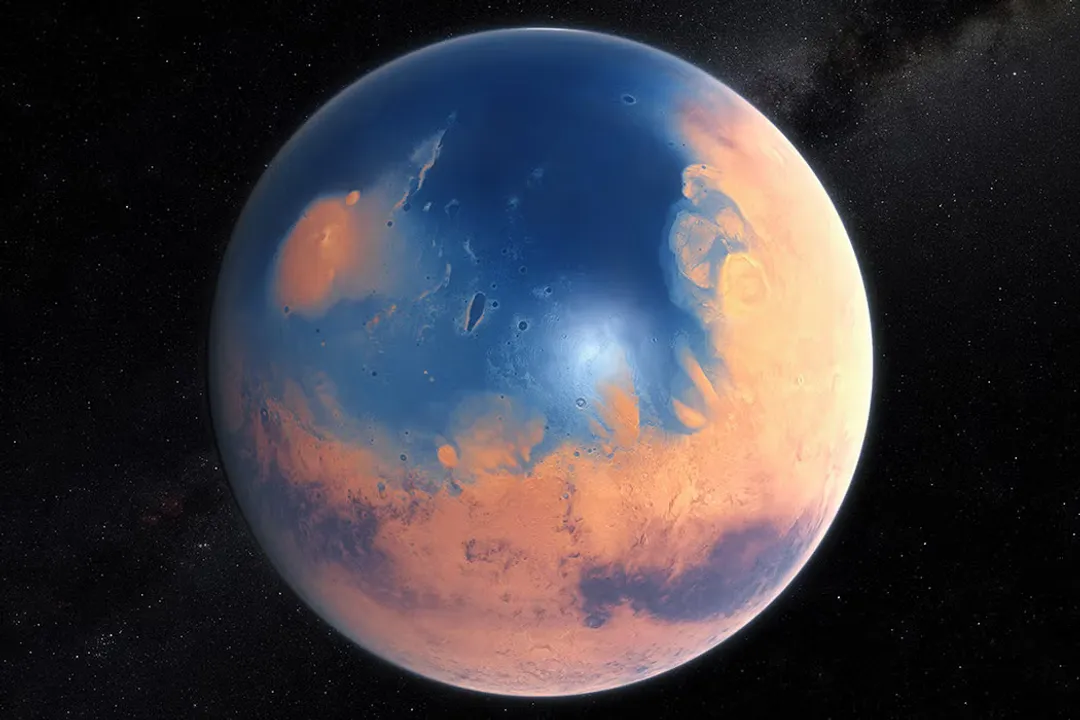
The change in atmospheric composition directly impacted how light scattered in the Martian sky. Early Mars likely possessed an atmosphere capable of scattering blue light, similar to Earth, resulting in a blue sky. As water vapor was lost and the atmosphere thinned, it became dominated by fine dust particles rich in oxidized iron—essentially rust. This particulate matter scattered light differently, causing the sky to take on the characteristic reddish-orange hue that defines the planet's appearance today.
Related Questions
Which geological feature, nicknamed "blueberries," provides evidence of long-term interaction with liquid water on the Martian surface?What critical internal change caused the shutdown of Mars's planetary magnetic field billions of years ago?What is the primary mechanism by which the solar wind eroded the Martian atmosphere after the magnetic shield failed?How did the thinning of the Martian atmosphere directly affect the stability of liquid water on the surface?What two main routes did water molecules take to leave the Martian system following atmospheric breakdown?According to the University of Chicago study, what condition accelerated the initial loss of water vapor before the magnetic field fully disappeared?What chemical alteration did high-energy radiation cause on the Martian surface after the atmosphere thinned?What is the current state of Mars's atmosphere compared to Earth's sea-level pressure?What factor in planetary resilience is cited as the ultimate deciding factor between Earth remaining a water world and Mars becoming arid?What historical visual transformation accompanied the loss of water vapor and atmospheric thinning on Mars?Where is a significant fraction of Mars's remaining water currently locked away according to orbital observations and radar data?