How did Lowell interpret the canals and vegetation he observed on Mars?
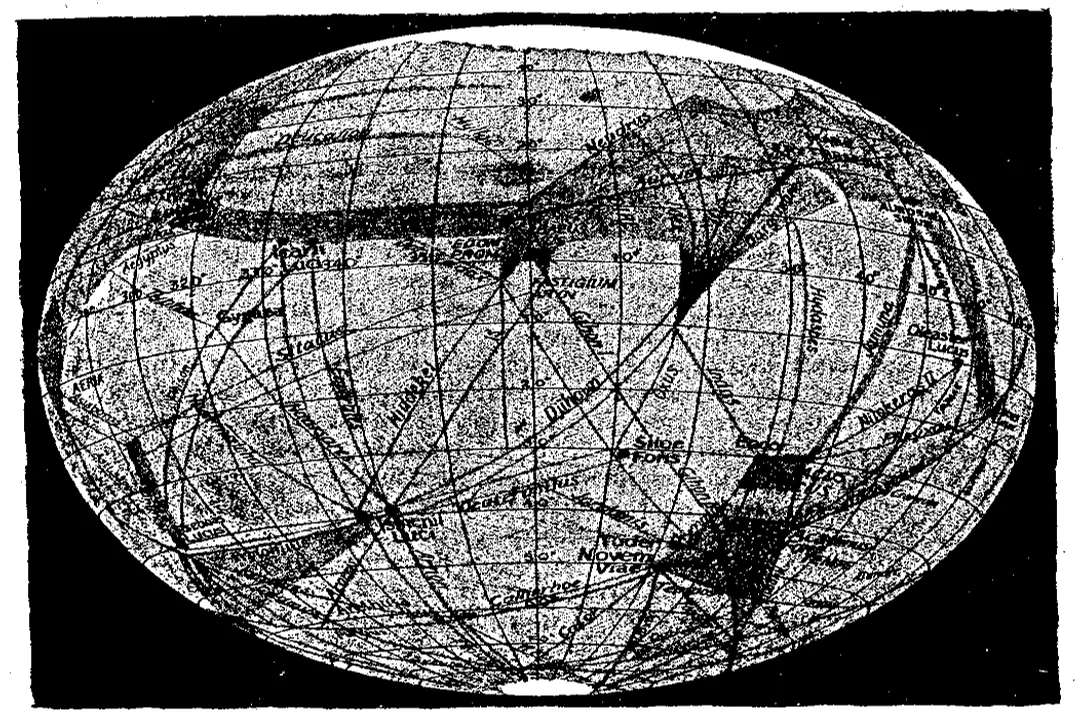
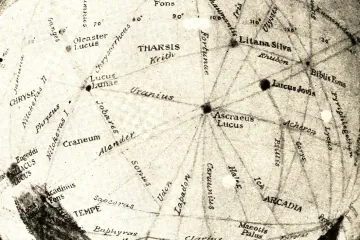
The appearance of lines on the surface of Mars, interpreted by Percival Lowell as evidence of intelligent life, captivated the public imagination and defined astronomical discourse for decades at the turn of the twentieth century. This obsession was not born in a vacuum; it grew from a crucial semantic shift regarding observations made by earlier European astronomers. Lowell’s interpretation went far beyond mere channels; he constructed an entire, coherent narrative of a dying world sustained by a massive, planet-spanning engineering feat, inextricably linking these structures to the very possibility of Martian vegetation.
# European Genesis
The foundation for Lowell’s work was laid by Italian astronomer Giovanni Schiaparelli in 1877. During a particularly favorable opposition of Mars, Schiaparelli mapped features he described as canali, which simply means "channels" in Italian. These lines appeared to connect the dark areas on the planet, which were then assumed to be seas. When this discovery crossed the Atlantic, the Italian word was rendered into English as "canals"—a word that inherently suggested artificial construction, a system built by intelligence rather than geological process.
While Schiaparelli remained agnostic about their origin, the seed was planted. French astronomer Camille Flammarion enthusiastically championed the idea, expanding the concept to include not just the waterways themselves, but also the wide bands of vegetation flourishing along their banks. This combination—intelligent engineers fighting planetary desiccation with irrigation—fixed a romantic, yet alarming, vision of Mars in the public mind: a planet being saved from encroaching deserts by massive engineering works.
It is worth noting the technical difficulties of these early observations. Viewing Mars from Earth meant battling atmospheric distortion, making fine details fleeting and subjective. The fact that Schiaparelli himself was colorblind may have subconsciously enhanced his perception of sharp, fine lines where others saw only subtle gradations.
# The American Champion
Percival Lowell, a scion of a wealthy and influential Boston family, inherited both means and ambition. After successful careers in business and travel writing, particularly in the Far East, he encountered Flammarion’s work around age 40 and became singularly focused on proving the existence of Martians. He was prepared to dedicate his wealth and life to this pursuit, establishing the Lowell Observatory on Mars Hill near Flagstaff, Arizona Territory, specifically to capitalize on the clear, dry air for observing the planet.
Lowell, who possessed keen eyesight and, arguably, an even livelier imagination, readily observed the canali when Mars approached opposition in 1894. Unlike Schiaparelli, Lowell made no attempt to remain detached; he saw the ordered pattern as undeniable proof of intelligent beings, proclaiming that "the full import of his great discovery lay hid even to him".
Lowell’s insistence on the artificial nature of these features, however, provides a fascinating case study in how entrenched belief can solidify interpretation. He was exceptionally consistent; his core arguments remained virtually unchanged across his major publications like Mars (1895) and Mars and Its Canals (1906). This theoretical rigidity contrasted sharply with the scientific method, which demands hypothesis testing and revision. When critics emerged, Lowell often reacted with ire, suggesting their skepticism stemmed from human vanity or an unwillingness to accept superior life forms.
# Vegetation: The Visible Evidence
Lowell's interpretation of the canals evolved into a sophisticated, albeit speculative, geological narrative about Mars's long-term fate. He posited that Mars was much older than Earth and, consequently, was far along in its own entropic decline, having lost most of its surface water to space. This remaining water was locked in the polar caps.
Lowell’s key observation regarding vegetation was the phenomenon he termed the “wave of darkening”. As the Martian spring approached, melting ice from the caps would release water. This water would flow through the engineered canal system, causing strips of vegetation planted along the banks to sprout and deepen in color, creating the dark lines visible from Earth. In the autumn and winter, this cultivation would die back, and the canals would fade from visibility. Thus, the visible lines were not the water channels themselves—which Lowell conceded would have to be impossibly wide to be seen directly—but rather the seasonal greening along the banks of those canals. The straightness and network structure advertised the builders; the seasonal change advertised the water supply and the agriculture necessary for survival.
This theory had a powerful hold because it spoke directly to contemporary terrestrial anxieties. Lowell suggested that Mars prophesied Earth’s future—a progressive drought where humanity, too, might eventually have to rely on vast, pole-to-pole irrigation networks to survive. This projection of human problems onto an alien world made the interpretation profoundly relevant to his audience.
# The Great Rift and Cultural Echoes
Lowell’s insistence created a profound division in the astronomical community between the "canalists" and the "anti-canalists". While his Flagstaff observatory produced fine work in other areas, the "Mars furor" often overshadowed it.
Many astronomers pointed out simpler natural explanations: long cracks in the surface, or even chance alignments of features like craters or sand dunes, organized into patterns by the eager human eye. The argument that straight lines could arise naturally was a persistent counterpoint, yet Lowell dismissed these alternatives as desperate attempts to deny a superior intelligence. The conflict was exacerbated by the primitive state of astrophotography; observations relied heavily on the subjective drawings of highly motivated observers, leading to a situation where confirmation bias was rampant.
The cultural ripple effect of Lowell’s work was immense, shaping early science fiction as much as astronomy. H.G. Wells, in The War of the Worlds (1898), presented a nightmare scenario of hardened, desperate Martians invading Earth for its water, spurred by early reports of Martian distress signals. Conversely, Edgar Rice Burroughs, deeply influenced by Lowell’s depiction of an ancient, technologically advanced civilization clinging to survival, created the more romantic world of Barsoom, where John Carter navigates the very irrigation canals Lowell described.
An interesting analysis emerges here regarding the context of discovery. In the late 19th and early 20th centuries, major terrestrial engineering projects like the Suez and Panama Canals were transforming continents. It was natural, perhaps inevitable, that when astronomers perceived straight lines on another world, the frame of reference for interpreting those features was one of massive human-scale construction, rather than, say, tectonic faults or aeolian deposits. The canal was the ultimate symbol of conquering a hostile environment, a concept that resonated deeply with the industrial age.
# Fading Lines and Modern Views
The downfall of the canal theory among scientists was gradual. It was not a single discovery, but a slow accumulation of better data.
One major blow came in 1909 from Eugène Michel Antoniadi, who had previously been a canalist himself. Observing Mars under near-perfect atmospheric stillness with Europe's largest telescope, Antoniadi saw the supposed straight lines resolve into natural, irregular surface features. His findings effectively ended the credibility of the canals within the scientific press within the following decade. Furthermore, other astronomers challenged Lowell’s core premise about water, suggesting the polar caps might be frozen carbon dioxide ("dry ice") rather than water ice, rendering his elaborate irrigation scheme pointless.
Even so, the public and some fringe astronomers held on. In 1924, Mars came closer to Earth than it had in a century, leading to a bizarre instance where the U.S. military agreed to enforce a period of national radio silence to listen for any signals the Martians might send in response to the favorable conditions.
The final refutation arrived with the space age. The Mariner 4 flyby in 1965, sending back the first close-up images, revealed a barren, heavily cratered landscape. There were no signs of civilization, no massive engineered networks, and nothing resembling the straight lines Lowell had meticulously mapped. Subsequent missions, like Mariner 9 and the Viking landers, confirmed this desolate view, showing evidence of ancient, dry riverbeds and massive volcanoes, but no evidence of current or past intelligent activity.
While Lowell’s canals were eventually proven to be illusions born of expectation, his legacy is complex. The Martian craze he fueled certainly had a negative side—promoting speculative science over rigorous testing—but it also provided a powerful cultural stimulus. The fascination he generated inspired later generations of scientists, including Robert H. Goddard, the father of American rocketry, and planetary scientist Carl Sagan, who credited Burroughs's Barsoom stories with sparking his interest in space exploration. The desire to see what Lowell saw, even if it meant traveling to the planet itself, ultimately drove the technological progress that proved him wrong. Lowell’s interpretation of Martian vegetation, tied directly to the canal system, failed, but the public interest he sustained ensured that Mars remained a primary target for every subsequent space mission aimed at answering humanity’s deepest question: Are we alone?.
Related Questions
#Citations
Tracing the Canals of Mars: An Astronomer's Obsession - Space
Lowell and Canals on Mars - Teach Astronomy
Mars Exploration History - CRISM
Matching Mars: Lost Canals of Percival Lowell by Den Valdron
life On Mars Is Almost Certain!
The Martian Craze: How Percival Lowell Invented Canals on Mars