Which instrument is used to observe the sky?
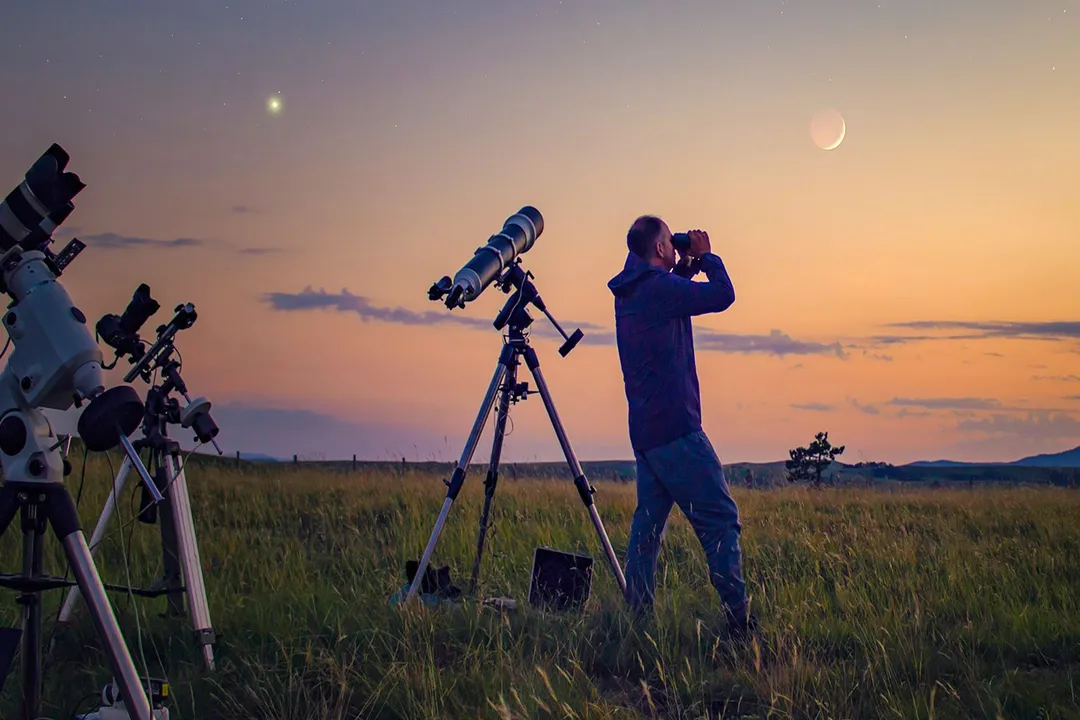
The simplest and most recognizable instrument used to observe the distant sky is the telescope. [1][7] However, looking up and making sense of the cosmos involves a diverse array of specialized tools, each designed to capture something different—whether it is visible light, radio waves, or even high-energy particles. [4][5] For centuries, these devices have served as our eyes into the universe, collecting information that the unaided human eye simply cannot perceive. [5]
The fundamental principle behind almost every observational instrument is the need to gather more information, primarily in the form of electromagnetic radiation. [5][7] Our own eyes, while incredibly sensitive, have a very limited aperture, restricting how much light we can collect from faint, far-off objects like nebulae or distant galaxies. [5] The primary advantage of any astronomical instrument isn't necessarily magnification, but its light-gathering power. [7][9]
# Light Power
Light-gathering ability is directly proportional to the area of the primary optical element—be it a lens or a mirror. [7] A larger area collects more photons over the same period, making dimmer objects appear brighter and allowing astronomers to study fainter targets. [7] If you consider light gathering like collecting rainwater, magnification is simply how wide the spout is that you use to pour the water into your viewing bucket. [5] A bigger bucket (aperture) is always more valuable than a stronger hose (magnification) when it comes to revealing detail in dim conditions. [7]
For instance, a common amateur telescope might have an aperture of 8 inches, while massive research telescopes can exceed 10 meters in diameter. [2][5] This difference in area translates directly into the capacity to see fainter objects or capture detailed images of brighter ones more quickly. [5] While magnification is important for separating close-together stars or viewing planetary details, it is a secondary concern compared to aperture size when starting out. [9]
# Basic Types
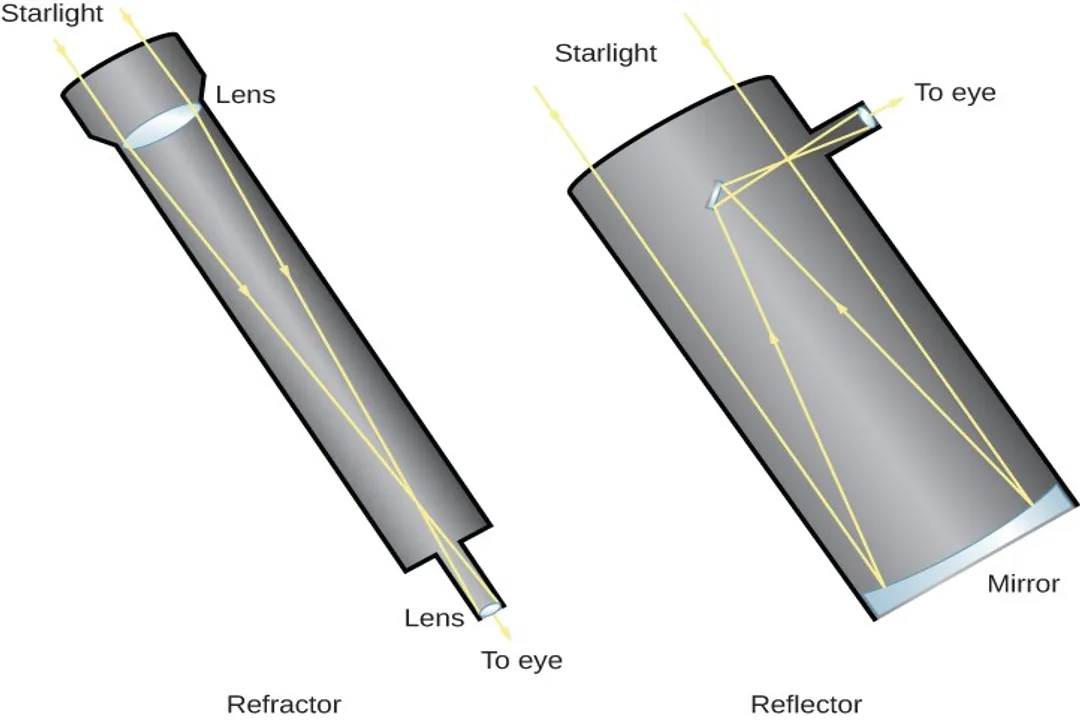
Astronomical instruments designed to collect visible light generally fall into two main categories based on how they focus that light: refractors and reflectors. [3][7] These basic designs form the backbone of hobbyist astronomy and have historically driven major scientific discoveries. [1]
# Refractor Lenses
A refracting telescope, often associated with Galileo’s early designs, functions by using lenses to bend, or refract, light toward a focal point. [1][3] The objective lens, located at the front end of the tube, collects the light and brings it to a focus where an eyepiece magnifies the resulting image. [3] Refractors are known for producing very sharp, high-contrast images because the light path is entirely enclosed, protecting the optics from dust and air currents. [3] They require very little maintenance once aligned. [3]
However, refractors suffer from a phenomenon called chromatic aberration. [7] This occurs because lenses bend different colors (wavelengths) of light by slightly different amounts, causing the colors to focus at slightly different points. [7] This results in a false, distracting purple or blue fringe around bright objects like the Moon or Jupiter. [7] While specialized glass (like apochromatic lenses) can minimize this effect, it often makes larger, high-quality refractors significantly more expensive than their reflector counterparts of the same aperture. [3]
# Reflector Mirrors
Reflecting telescopes, invented by Isaac Newton, rely on mirrors instead of lenses to gather and focus light. [1][3] The primary component is a large, curved mirror at the back of the tube, which reflects the incoming light back up to a smaller secondary mirror near the front. [3][7] This secondary mirror then directs the focused light out to the side where the observer or instrument can view it. [7]
The key advantage of the reflector is that mirrors can be supported across their entire backs, allowing them to be built much larger than lenses without worrying about the glass sagging under its own weight. [3] This makes large-aperture telescopes more practical and cost-effective to manufacture. [7] Reflectors do not suffer from chromatic aberration since light is reflected, not refracted. [3] The main trade-off is that reflectors require periodic maintenance, often needing the primary mirror to be recoated (re-aluminized) every few years, and the optics must be periodically aligned, or "collimated". [3]
# Specialized Focus
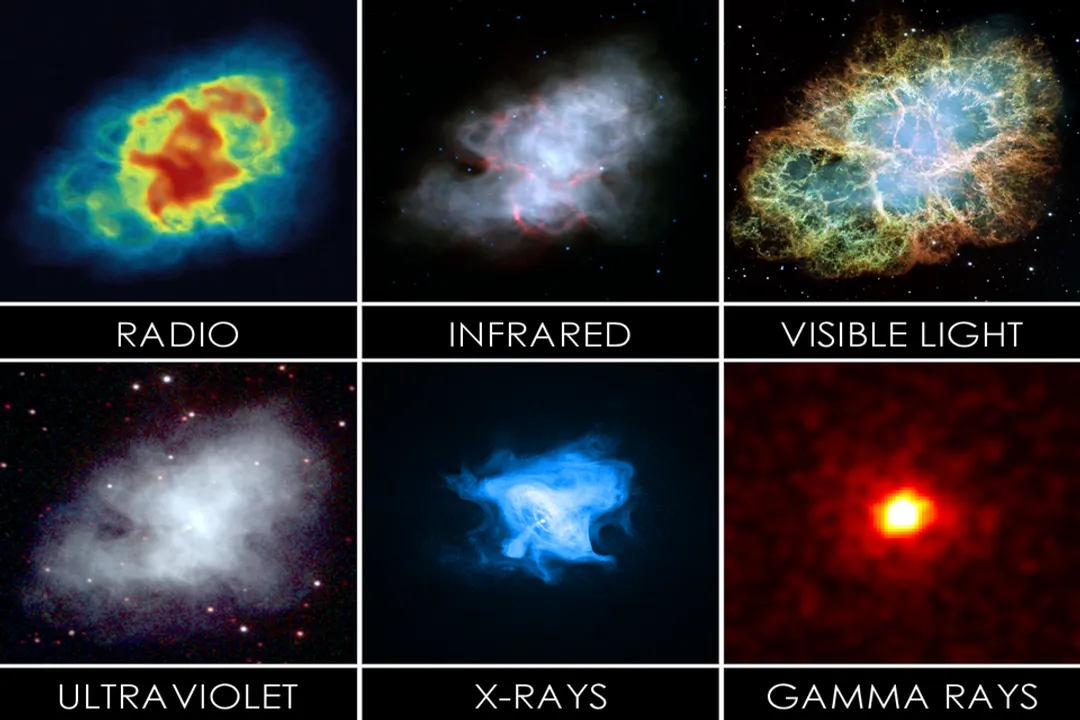
While refractors and reflectors handle visible light, the sky emits radiation across the entire electromagnetic spectrum. [5] True, high-quality sky observation in modern science demands instruments capable of viewing wavelengths beyond what our eyes can detect. [2][4]
# Beyond Sight
The electromagnetic spectrum dictates the need for many instrument types:
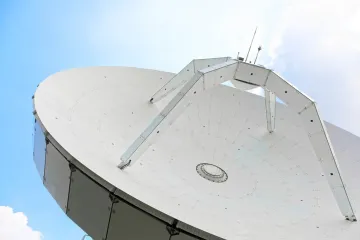
- Radio Telescopes: These instruments do not use glass lenses or mirrors in the traditional sense. [4] Instead, they employ large dish antennas to capture long-wavelength radio waves emitted by celestial objects. [5] Radio astronomy allows scientists to study extremely cold gas clouds, distant galaxies, and phenomena that are opaque to visible light, such as dust-obscured star formation regions. [5]
- Infrared Telescopes: These collect heat radiation. [4] They are essential for peering through dense clouds of cosmic dust that block visible light, allowing observation of stellar nurseries or the centers of galaxies. [2]
- Ultraviolet, X-ray, and Gamma-Ray Telescopes: These high-energy instruments observe extremely hot or energetic processes, such as black holes feeding or supernova explosions. [4] Crucially, the Earth's atmosphere blocks most of these high-energy rays, meaning these instruments must be placed in space, such as aboard orbiting observatories. [2][5]
The development of these diverse tools means that the answer to "which instrument observes the sky" depends entirely on what the observer wants to learn. [4] Studying the 21-cm line of neutral hydrogen requires a radio dish, while viewing the structure of a supernova remnant requires an X-ray satellite. [5]
# Remote Eyes
The challenge of the Earth’s atmosphere is a significant factor in instrument choice and placement. [8] Even on the clearest night, turbulence in the air—which causes stars to appear to twinkle—blurs the image, limiting the effective resolution of even the largest ground-based optical telescopes. [8]
# Space-Based Assets
To circumvent atmospheric distortion and capture UV, X-ray, and gamma-ray light, instruments are placed above the atmosphere. [5] The Hubble Space Telescope (HST) is perhaps the most famous example of an optical instrument placed in orbit. [1] Orbiting above the blurring layer provides unparalleled image clarity for visible and UV observations. [2] More recently, the James Webb Space Telescope (JWST) operates in the infrared spectrum, allowing it to see further back in time to the first galaxies, as its cooler operating environment minimizes interference from its own heat signature. [2]
# Professional Sites
On the ground, astronomers manage the atmospheric limitation through location and technology. Observatories are strategically placed on high, dry mountains far from city lights, reducing both light pollution and atmospheric path length. [8] Furthermore, advanced adaptive optics systems are employed. [8] These systems use rapidly changing, deformable mirrors that receive instantaneous feedback from a laser guide star (or a natural bright star) to counteract atmospheric blurring thousands of times per second, bringing ground-based views closer to the clarity achieved in space. [8]
An interesting point for dedicated amateurs is understanding the trade-off between aperture and seeing. If you live in an area with poor atmospheric seeing—say, due to heat rising off nearby rooftops or high humidity—a large, expensive telescope may not perform much better than a smaller one, as the air itself becomes the limiting factor, not the glass. [8] For example, an 8-inch reflector on a mediocre night might yield less satisfying results than using a smaller, high-quality 4-inch refractor on a night with exceptionally stable "glassy" air. [9] This practical limitation often goes unmentioned in basic guides that focus only on light gathering. [7]
# Comparing Modern Observatories
The instruments used today are complex systems, often involving multiple detectors and specialized components attached to the main light-gathering structure. [2] Modern professional setups rarely involve just one simple eyepiece; they are sophisticated data-gathering machines. [2]
| Instrument Type | Primary Function | Typical Location | Key Advantage |
|---|---|---|---|
| Optical Telescope | Visible Light Imaging/Spectroscopy | High Mountains | High spatial resolution (with adaptive optics) [8] |
| Radio Telescope | Low-energy long waves (e.g., neutral hydrogen) | Remote, dry plains | Sees through cosmic dust [5] |
| Space Observatory (e.g., JWST) | Infrared, UV, X-ray, Gamma-ray | Earth Orbit | No atmospheric interference [2][5] |
| Spectrograph | Separating light into component wavelengths | Attached to optical/radio telescopes | Determines chemical composition and velocity [5] |
The spectrograph, which separates light into its constituent colors (like a prism), is arguably one of the most vital instruments, even though it's an attachment rather than the primary collector. [5] By analyzing the spectrum, astronomers determine an object's temperature, composition, and speed, turning simple light into a wealth of physical data. [5][7]
# Entry Level Considerations
For those starting out, the choice of instrument is often a balance between budget, portability, and the desired target. [9] While professional observatories seek maximum aperture, an amateur must consider experience. [9]
When selecting a first telescope, prioritize aperture and stability over high magnification claims. [9] Many entry-level packages come with low-power eyepieces that promise extreme magnification but result in dim, blurry views because the magnification exceeds the usable light collected by the small objective lens. [9]
A good starting tip is to invest in a solid, steady mount. [9] An equatorial mount, which tracks the sky's movement by rotating on one axis, is often preferred by visual observers because it keeps the object centered without constant nudging, which is far less frustrating than a wobbly alt-azimuth mount when viewing at high power. [3] Even the best optics will deliver poor results if the mount shakes every time you touch the focus knob. [9]
Another consideration involves tracking celestial objects. While the Earth rotates, stationary instruments must compensate. Many modern mounts use electronic "GoTo" systems programmed with star catalogs. [6] These systems use motors to automatically point and track objects once the telescope is calibrated to the sky. [6] This reduces time spent fiddling with star charts and increases time spent observing the actual targets. [6]
Ultimately, the instrument used to observe the sky has evolved from simple glass tubes to vast arrays of radio dishes and orbiting laboratories. [1][4] Whether it is the segmented primary mirror of the Keck Telescopes on Mauna Kea [2] or a small, high-quality refractor in a suburban backyard, the shared goal remains the same: to gather the faint whispers of light from the cosmos and translate them into knowledge. [5]
#Videos
Telescopes for Beginners | Wonders of the Night Sky - YouTube
Related Questions
#Citations
Telescope - Wikipedia
Telescopes & Instruments | Center for Astrophysics
Types of Telescopes Explained - Learn What Fits Your Needs at OPT
6: Astronomical Instruments - Physics LibreTexts
Telescopes for Beginners | Wonders of the Night Sky - YouTube
Telescopes | Astronomy - Lumen Learning
Tools for observing the night sky | Dark Sky Møn Guide
Best telescopes this holiday season: View stars, galaxies and nebulas