What term describes the low abundance of elements heavier than hydrogen and helium in globular cluster stars?
Answer
Low metallicity
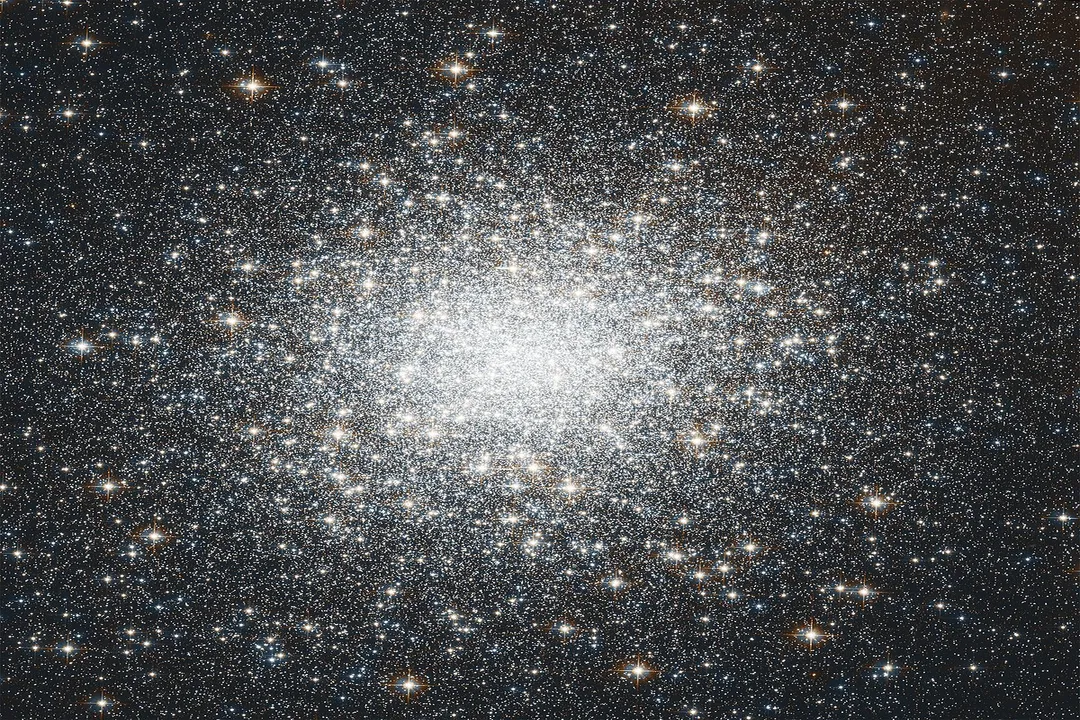
The shared chemical makeup of stars in globular clusters is characterized by low metallicity. In astronomical terms, 'metals' refer specifically to any element found in the universe heavier than the two lightest elements, hydrogen and helium. Since globular cluster stars formed very early in the universe's history, before multiple cycles of stellar birth, death, and subsequent enrichment had seeded the cosmos with these heavier atoms, they possess a chemical makeup that is considered primitive compared to younger stars. This low abundance of elements like silicon and iron has profound implications, particularly limiting the material available to form rocky, terrestrial planets around these ancient stars.
Related Questions
What is the approximate age estimate for stars found in globular clusters?What stellar classification identifies the elderly citizens in globular clusters?What characteristic feature on an H-R diagram reveals a globular cluster's age?What term describes the low abundance of elements heavier than hydrogen and helium in globular cluster stars?In a dynamically relaxed globular cluster core, what describes the star's velocity distribution?What stellar commonality forms by stealing fuel or merging, appearing younger on the H-R diagram?How does the core density of a globular cluster (100 to 1000 stars/pc³) compare to the Sun's neighborhood (0.1 stars/pc³)?What dynamic process causes heavier stars to sink toward the core of a globular cluster?What does the retrograde orbit of Omega Centauri suggest about its formation history?What process causes stars in the outer regions of a cluster to be pulled away by the galaxy's gravity?