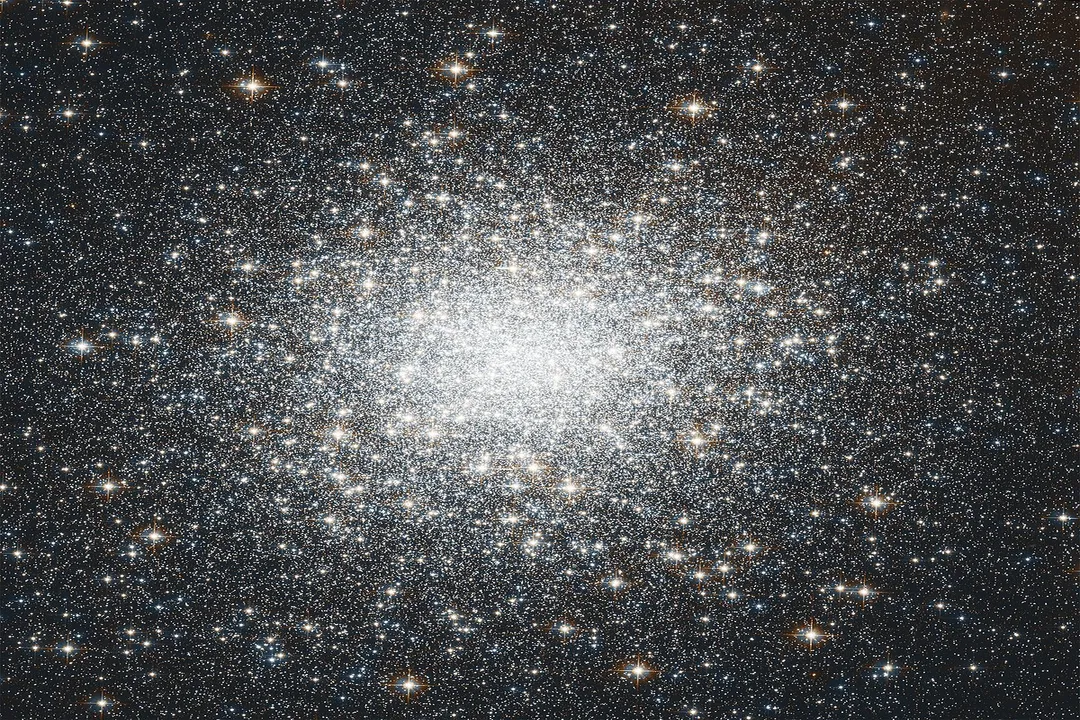
What does the retrograde orbit of Omega Centauri suggest about its formation history?
It is a remnant of a captured dwarf galaxy
The existence of globular clusters, such as Omega Centauri in the Milky Way, exhibiting retrograde orbits—meaning they circle the galactic center in the opposite direction to the main rotation of the galactic disk—provides strong evidence regarding their origin. This orbital characteristic suggests that the cluster did not form in situ within the Milky Way's disk or halo structure. Instead, it implies that the cluster is a surviving remnant of a much smaller dwarf galaxy. This ancient system was likely gravitationally stripped and subsequently captured by the larger Milky Way galaxy long ago. Therefore, the stars within Omega Centauri share a common ancestry that predates their current orbital home within our galaxy.