What stellar commonality forms by stealing fuel or merging, appearing younger on the H-R diagram?
Answer
Blue stragglers
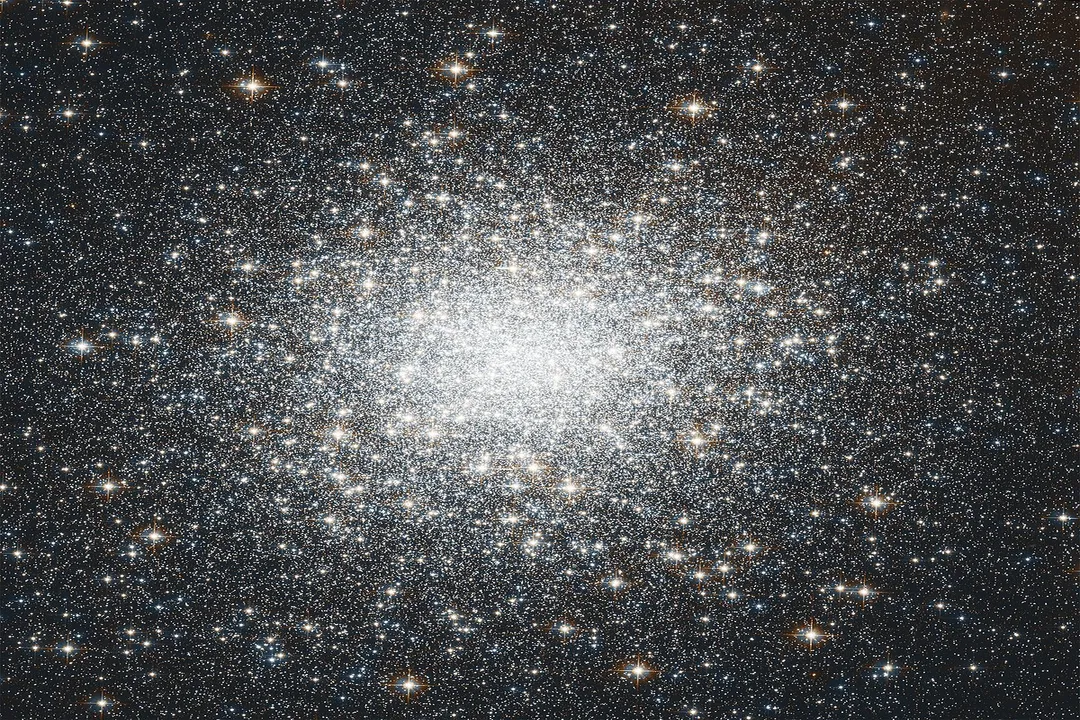
The incredibly dense, dynamic environment of a globular cluster core fosters conditions that lead to the prevalence of exotic stellar components, a prime example of which is the blue straggler. These stars appear anomalous because they have reverted to a hotter, brighter state, seemingly younger than the rest of their age cohort observed on the H-R diagram. This phenomenon is achieved through violent gravitational interactions, such as stealing fuel from a close binary neighbor, undergoing complete stellar mergers, or through complex exchanges within binary systems. Their presence serves as a direct indicator that the cluster has experienced significant dynamical activity over its long lifetime.
Related Questions
What is the approximate age estimate for stars found in globular clusters?What stellar classification identifies the elderly citizens in globular clusters?What characteristic feature on an H-R diagram reveals a globular cluster's age?What term describes the low abundance of elements heavier than hydrogen and helium in globular cluster stars?In a dynamically relaxed globular cluster core, what describes the star's velocity distribution?What stellar commonality forms by stealing fuel or merging, appearing younger on the H-R diagram?How does the core density of a globular cluster (100 to 1000 stars/pc³) compare to the Sun's neighborhood (0.1 stars/pc³)?What dynamic process causes heavier stars to sink toward the core of a globular cluster?What does the retrograde orbit of Omega Centauri suggest about its formation history?What process causes stars in the outer regions of a cluster to be pulled away by the galaxy's gravity?