In a dynamically relaxed globular cluster core, what describes the star's velocity distribution?
Answer
Isotropic
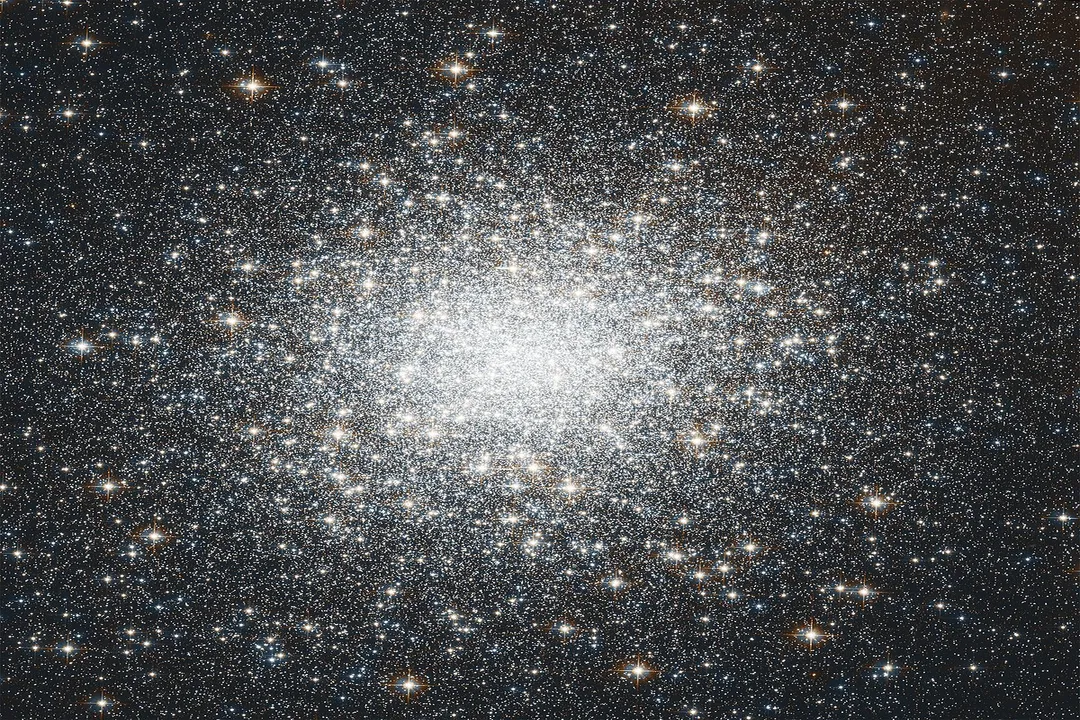
Globular clusters, due to their extreme density and long history of frequent stellar interactions, evolve toward a state known as relaxation. When a system reaches this relaxed state, the individual orbital histories of the stars become largely erased through numerous gravitational encounters. The result is that the distribution of stellar velocities becomes isotropic, meaning there is no preferred direction of motion; stars move randomly in all directions relative to the cluster's center of mass. This randomization occurs because the cluster's relaxation time is shorter than the cluster's overall age, allowing enough close encounters to effectively thermalize the system's dynamics.
Related Questions
What is the approximate age estimate for stars found in globular clusters?What stellar classification identifies the elderly citizens in globular clusters?What characteristic feature on an H-R diagram reveals a globular cluster's age?What term describes the low abundance of elements heavier than hydrogen and helium in globular cluster stars?In a dynamically relaxed globular cluster core, what describes the star's velocity distribution?What stellar commonality forms by stealing fuel or merging, appearing younger on the H-R diagram?How does the core density of a globular cluster (100 to 1000 stars/pc³) compare to the Sun's neighborhood (0.1 stars/pc³)?What dynamic process causes heavier stars to sink toward the core of a globular cluster?What does the retrograde orbit of Omega Centauri suggest about its formation history?What process causes stars in the outer regions of a cluster to be pulled away by the galaxy's gravity?