What specific color channel is assigned to light emitted by ionized oxygen (O III) in the Hubble Palette?
Answer
Blue channel
The Hubble Palette employs a systematic assignment where different chemical elements, identified by their unique spectral emission lines, are deliberately mapped to the primary color channels (RGB) to facilitate visualization of physical conditions. Specifically, the light emitted by ionized oxygen (O III) is conventionally mapped to the blue channel. This assignment is strategic because O III emission often indicates regions of higher energy ionization within a nebula, meaning that by observing where the blue color is strongest in the final image, researchers can immediately locate areas where the gas is being excited by the hottest stars present.
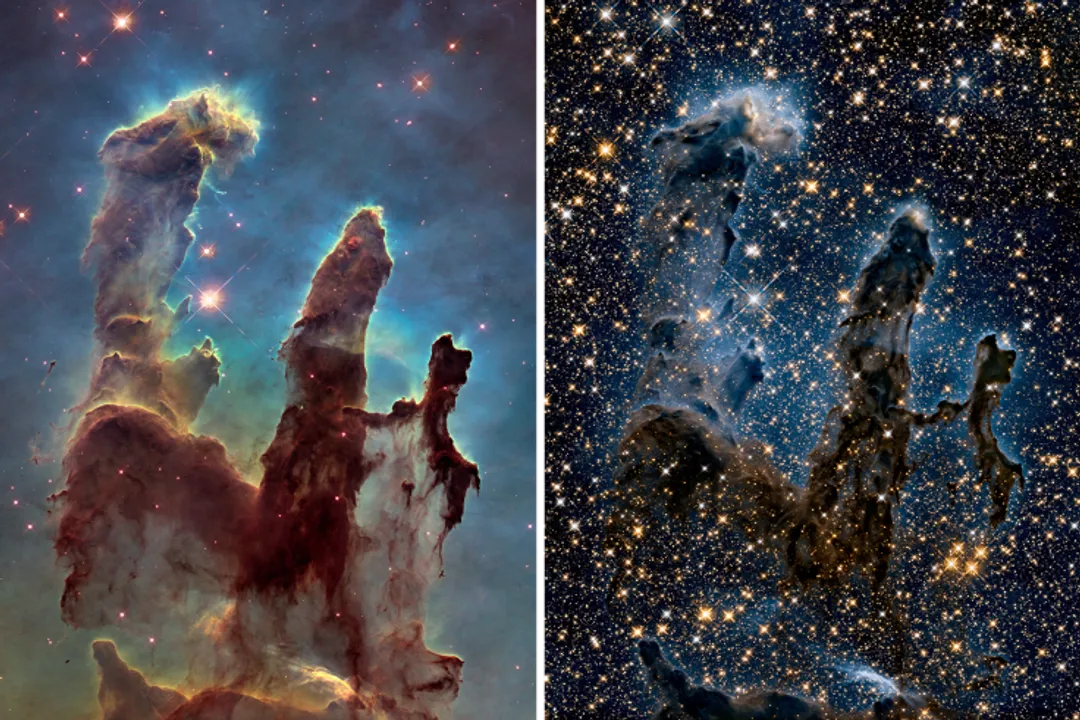
#Videos
How are Hubble Space Telescope images 'colorized' and processed?
Related Questions
If a human eye were next to a distant nebula captured by Hubble, what would the light appear as?Human vision is limited to visible light wavelengths between what range, unlike Hubble's capabilities?In the common configuration of the Hubble Palette, which chemical element is mapped to the red channel?Which condition must be met for a Hubble image resulting from filter data to often be labeled "true color"?What is the primary scientific purpose behind presenting Hubble images as false-color representations?What specific color channel is assigned to light emitted by ionized oxygen (O III) in the Hubble Palette?What is the immediate step following the acquisition of three grayscale data sets from different filters?What effect does the required brightness range stretching process have on the visual representation of deep space objects?What primary part of the spectrum does the James Webb Space Telescope (JWST) mainly observe, often resulting in different color schemes than Hubble?In the analogy comparing image processing to musical translation, what specific aspect is represented by the color palette selection?