Human vision is limited to visible light wavelengths between what range, unlike Hubble's capabilities?
Answer
400 and 700 nanometers
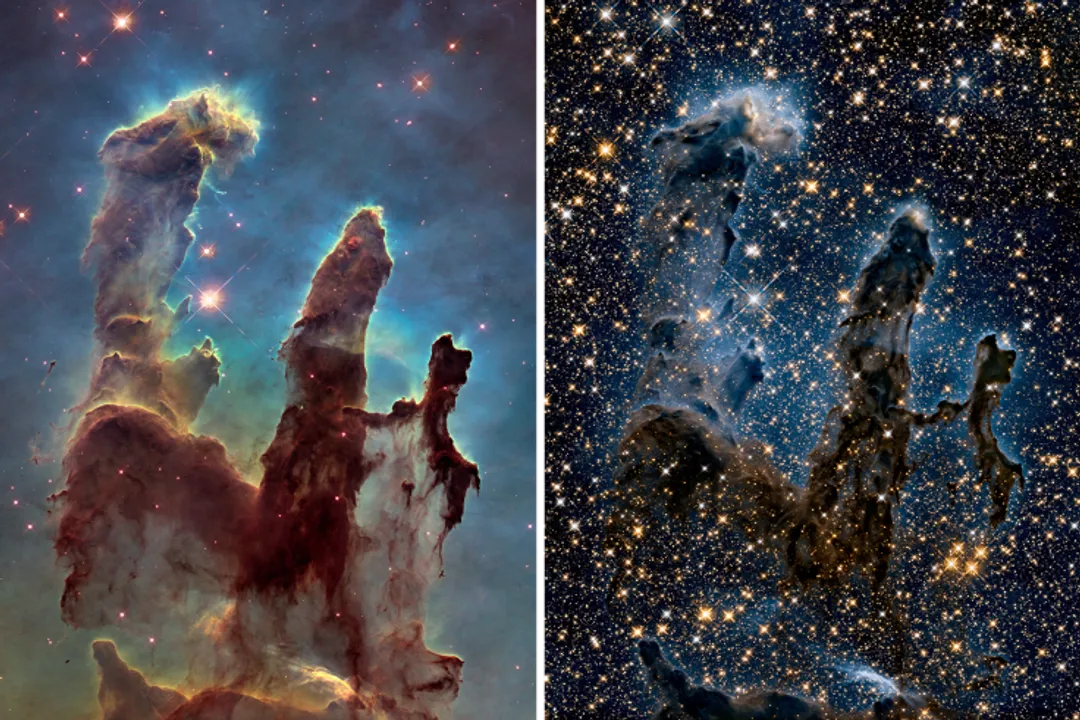
Human visual perception is restricted to a very narrow band within the electromagnetic spectrum, specifically wavelengths roughly between 400 nanometers (which corresponds to violet/blue light) and 700 nanometers (which corresponds to red light). Astronomical phenomena often emit or reflect crucial radiation outside of this visible band, particularly in the ultraviolet (UV) and infrared (IR) regions. Hubble's cameras are specifically designed to capture these non-visible ranges, allowing scientists to observe energetic processes and structures, such as hot star formation or cool dust, that remain completely hidden to the unaided human eye.
#Videos
How are Hubble Space Telescope images 'colorized' and processed?
Related Questions
If a human eye were next to a distant nebula captured by Hubble, what would the light appear as?Human vision is limited to visible light wavelengths between what range, unlike Hubble's capabilities?In the common configuration of the Hubble Palette, which chemical element is mapped to the red channel?Which condition must be met for a Hubble image resulting from filter data to often be labeled "true color"?What is the primary scientific purpose behind presenting Hubble images as false-color representations?What specific color channel is assigned to light emitted by ionized oxygen (O III) in the Hubble Palette?What is the immediate step following the acquisition of three grayscale data sets from different filters?What effect does the required brightness range stretching process have on the visual representation of deep space objects?What primary part of the spectrum does the James Webb Space Telescope (JWST) mainly observe, often resulting in different color schemes than Hubble?In the analogy comparing image processing to musical translation, what specific aspect is represented by the color palette selection?