Why were Hubble's first images blurry?

The moment the first images trickled back from the Hubble Space Telescope in 1990, the scientific community didn't see the universe in a new light; they saw a disappointing blur. It was a jarring and public failure for what was arguably the most expensive and prestigious scientific instrument ever built. The anticipation that had built over decades, coupled with the immense cost—upwards of $1.5 billion by the time of launch, requiring years of political wrangling just to get the final funding to deploy it [1]—made the blurry output feel like a betrayal of monumental proportions. This wasn't just a slight focus issue; the images lacked the sharpness that ground-based telescopes were already achieving, raising immediate and difficult questions about the flagship observatory that was supposed to revolutionize astronomy from above Earth’s atmosphere. [3]
# The Optical Flaw
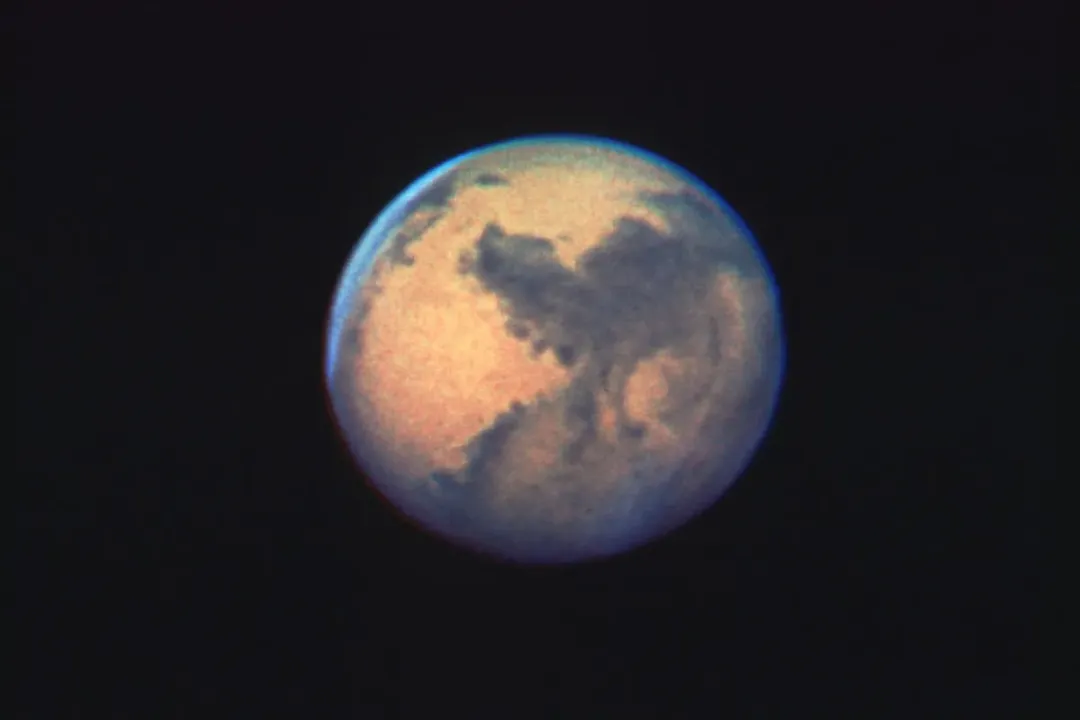
The issue wasn't software, nor was it primarily cosmic rays or internal vibrations. The root cause was elegantly simple and catastrophically precise: the telescope's massive primary mirror had been ground to the wrong shape. [9] Hubble relies on a precisely shaped primary mirror, $2.4$ meters across, to gather light and direct it to smaller secondary mirrors, which then focus it onto the scientific instruments. [2] For the light to focus into a perfect point, the primary mirror needed to be an extremely precise parabola. [9]
The problem was a minute, yet crucial, deviation from this perfect curve. The mirror was manufactured to be too flat at its edges by about $2.2$ micrometers, which is roughly th the thickness of a human hair. [2][9] This tiny error was enough to derail the entire system.
# Aberration Explained
It is a common misconception that the images were merely unfocused, like looking through a poorly adjusted pair of reading glasses. [5] While the result was certainly blurry, the underlying optical defect was more complex: spherical aberration. [5] This specific type of defect occurs when light rays hitting the outer edges of a mirror focus at a different point than the rays hitting closer to the center. [2] Instead of a single, sharp focal point, the light spreads out into a complex, fuzzy pattern. [5]
If the mirror had simply been too long or too short in its focus distance—a simple focal error—the image would have been uniformly soft across the entire field of view. [5] Spherical aberration, however, introduces a pattern of sharpness and fuzziness that varies depending on where you are looking in the image plane, making it impossible to get the entire image sharp simultaneously. [5] This meant that while a small section might look momentarily crisp, the surrounding areas would degrade rapidly. It was a systematic defect woven into the very fabric of the telescope’s light-gathering component. [2]
# Measuring the Error
The precision required for Hubble's optics was staggering. The mirror's surface had to conform to the prescribed parabolic shape with an accuracy of about th the wavelength of visible light. [2] Given that the wavelength of visible light is around $0.5$ micrometers, the required tolerance was less than $0.03$ micrometers—a truly microscopic standard. [2]
The actual error—the $2.2$ micrometer flattening at the edge—was about $60$ times greater than the specification allowed. [2] To put this in perspective, consider the scale. If the entire $2.4$-meter primary mirror were scaled down to the size of a standard dinner plate, the error in the edge polishing would be equivalent to shaving off the thickness of a thin coat of paint from the edge of that plate. [9] This is the kind of imperfection that is virtually undetectable by casual inspection or even standard manufacturing checks if the tools are flawed themselves.
This brings up an interesting facet of the failure. The mirror was tested extensively on the ground using a complex system of null correctors and sensors to ensure its shape was right before launch. [8] The fact that the error persisted indicates that the testing equipment, the null corrector, was itself flawed. [8] The mirror was ground perfectly to match the flawed test standard, creating an instrument that was perfectly tuned to an incorrect reference point. [2][9] It was a failure of metrology—the science of measurement—at the very foundation of the project.
Insight: The Hubble failure serves as a powerful, if painful, real-world example of how quality control in complex systems is often as critical as the initial design itself. In modern engineering, we often rely on digital simulations to verify component geometry before machining, but in the 1980s, physical test rigs were king. The Hubble experience underscored the non-negotiable need for "truth in measurement"—ensuring that the tools used to verify precision are themselves verified against an external, absolute standard, independent of the component being tested.
# Scientific Fallout and Battle
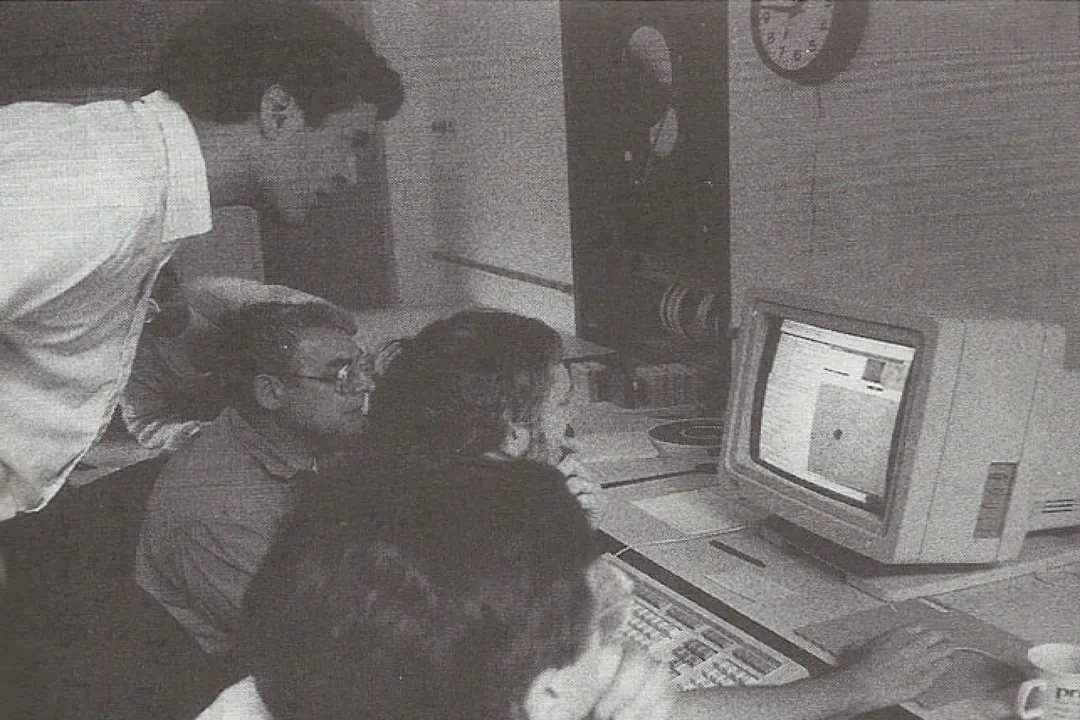
The blurry images resulted in immediate and severe consequences for the scientific endeavors planned for the observatory. [3] Instead of viewing distant galaxies with clarity, early instruments were severely handicapped. The initial instruments, like the Wide Field Planetary Camera (WFPC), were severely impacted. [2] The planned scientific breakthroughs were put on hold, and the program faced immense public and political scrutiny. [1]
For a time, the fate of the telescope hung in the balance. There were serious discussions about whether the mission should be aborted or if the cost of fixing it was justifiable. [1] The telescope was stuck in orbit, unable to perform its function, while the ground teams had to figure out not just what was wrong, but how to fix something a quarter of a million miles away. [6] This political drama was almost as intense as the technical puzzle, with Congress and the public demanding accountability for the massive expenditure. [1]
# Pinpointing the Problem

The diagnosis was not immediate. It took months of careful analysis back on Earth by teams of experts, including optical scientists and engineers. [8] The first step was determining the exact nature of the defect, confirming it was indeed spherical aberration and not something else. [5]
The breakthrough came from comparing data from different instruments and running sophisticated simulations of light paths through the flawed optics. [2] Crucially, NASA and the associated teams realized that the fix did not require bringing the entire telescope down or replacing the massive primary mirror—an impossible task. [6] Instead, they realized they could design corrective optics that would act like a pair of custom-made eyeglasses for Hubble. [2]
The primary instrument suffering the most was the Wide Field and Planetary Camera (WFPC). The team conceived of a replacement, the Wide Field and Planetary Camera 2 (WFPC2), which would incorporate the required corrective elements directly into its design. [2]
Insight: The sheer genius of the corrective optics solution lies in the geometric principle. Because the error was spherical aberration, the required correction was also a known, predictable form of aberration—specifically, a compensating shape known as a hyperboloid. Designing COSTAR and WFPC2 was effectively designing a precise, small "contact lens" to be placed in Hubble’s light path, perfectly undoing the error induced by the large, flawed primary mirror. This approach is conceptually cleaner than trying to warp the light differently at every point in the beam path.
# The Service Mission Strategy
The decision was made to send astronauts up to repair the telescope, a daring move known as Servicing Mission 1 (SM1), scheduled for December 1993. [6] This was not a simple repair job; it required installing entirely new corrective hardware in zero gravity, a task that demanded meticulous planning and multiple spacewalks. [6]
The solution involved two main components designed to compensate for the primary mirror’s flaw:
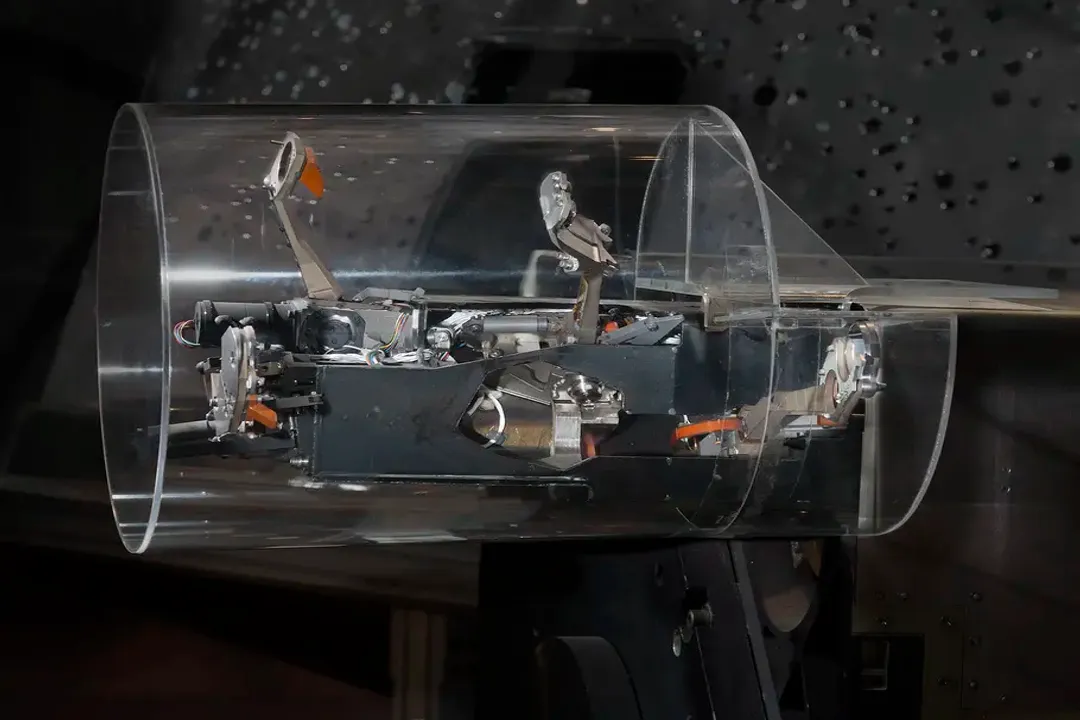
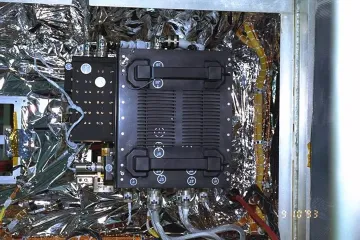
COSTAR (Corrective Optics Space Telescope Axial Replacement): This was a dedicated instrument inserted into one of Hubble's bays. [2][6] COSTAR held several small, exquisitely polished corrective mirrors, each tailored to intercept the light path going toward a specific instrument that could not be replaced, such as the Fine Guidance Sensors or the Goddard High Resolution Spectrograph. [2] These small mirrors were shaped as hyperboloids to precisely counteract the spherical aberration introduced by the main mirror. [9]
WFPC2: The original WFPC was physically removed and replaced with the new Wide Field and Planetary Camera 2. [2][6] This new camera had its own corrective optics built right into its light path, essentially acting as a self-contained, perfectly corrected instrument. [2]
The astronauts had to execute a series of intricate maneuvers, involving removing large bay doors, disconnecting electronic boxes, and installing the new hardware with extremely tight tolerances. [6] This servicing mission effectively acted as the do-over for the mirror grinding error that occurred years earlier on Earth. [3]
# The Return to Clarity
When the data started flowing back after SM1, the transformation was immediate and dramatic. [3] The blurry patches resolved into the stunning, sharp celestial views that the world had originally expected. The universe snapped into focus, validating the faith, the political battles, and the near-impossible engineering feat of the repair mission. [3]
The instruments corrected by COSTAR and the replacement WFPC2 began delivering images with unprecedented clarity, far surpassing the capabilities of any previous space or ground-based telescope at that time. [2] For example, the newly corrected instruments allowed astronomers to measure the expansion rate of the universe with much greater accuracy and to image star formation regions with fine detail never before possible. [3] The telescope’s stunning images, from the Pillars of Creation to the deep fields, became household icons, cementing its status as an astronomical legend. [3]
The success of SM1 fundamentally changed how major space projects are managed and maintained. It proved that complex instruments in orbit could be serviced and upgraded, turning a potential black hole of sunk cost into a sustainable, evolving scientific asset. [6] This concept of in-orbit servicing, pioneered by Hubble’s desperate repair, has since influenced the design philosophy for subsequent missions. [8]
The initial failure was a massive setback, costing time, money, and public trust. [1] However, the ability of the engineers and scientists to diagnose the micron-level flaw, devise a macro-level space-based fix involving replacement instruments and custom "eyeglass" optics, and then successfully execute the repair mission, transformed the narrative from one of error to one of unparalleled resilience and ingenuity in the history of space exploration. [3]
#Videos
Why Was The Hubble Space Telescope Initially Blurry? - YouTube
Related Questions
#Citations
TIL that after almost 20 years of battling for a Hubble budget ... - Reddit
History: The Spherical Aberration Problem - ESA/Hubble
Hubble's Comeback Story - NASA Science
Why Was The Hubble Space Telescope Initially Blurry? - YouTube
Why are the disappointing first pictures obtained from the original ...
Repairing Hubble | National Air and Space Museum
Hubble images of M100 galaxy before and after repairs - Facebook
Hubble's blurry years - Physics Today
What was wrong with Hubble's mirror, and how was it fixed?