If a human eye were next to a distant nebula captured by Hubble, what would the light appear as?
Answer
A dull gray or black smear
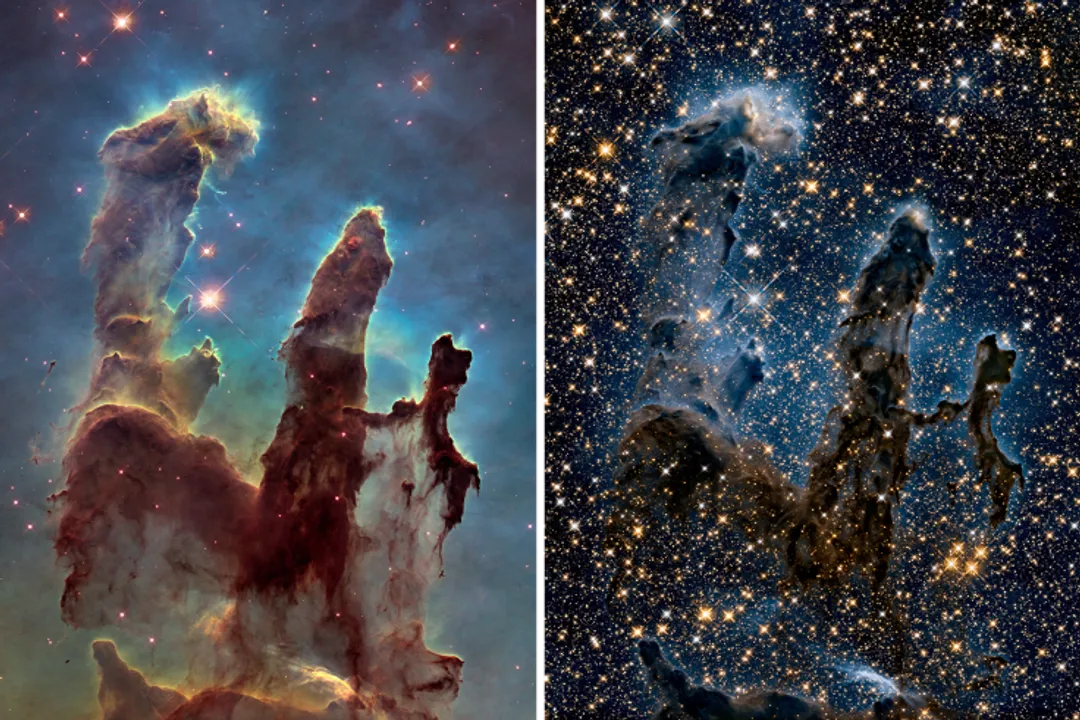
The light reaching human eyes from deep-space objects, even those successfully captured by instruments like the Hubble Space Telescope, would appear extremely faint due to the immense distance involved and the comparatively limited light-gathering capacity of human eyes. Unlike the sophisticated mirrors and sensors of astronomical equipment, our eyes cannot collect sufficient photons in a short period to resolve detail or perceive color from these faint sources. Consequently, the visual experience would be dominated by darkness, rendering the object as little more than a subtle gray or black smudge against the background.
#Videos
How are Hubble Space Telescope images 'colorized' and processed?
Related Questions
If a human eye were next to a distant nebula captured by Hubble, what would the light appear as?Human vision is limited to visible light wavelengths between what range, unlike Hubble's capabilities?In the common configuration of the Hubble Palette, which chemical element is mapped to the red channel?Which condition must be met for a Hubble image resulting from filter data to often be labeled "true color"?What is the primary scientific purpose behind presenting Hubble images as false-color representations?What specific color channel is assigned to light emitted by ionized oxygen (O III) in the Hubble Palette?What is the immediate step following the acquisition of three grayscale data sets from different filters?What effect does the required brightness range stretching process have on the visual representation of deep space objects?What primary part of the spectrum does the James Webb Space Telescope (JWST) mainly observe, often resulting in different color schemes than Hubble?In the analogy comparing image processing to musical translation, what specific aspect is represented by the color palette selection?