Why did the ejected orbital debris coalesce into a single satellite (the Moon) rather than forming a second, independent planet?
Answer
The material was gravitationally bound to Earth, and orbital dynamics favored aggregation into a stable satellite orbit
Due to being gravitationally bound to the Earth-Theia system and influenced by tidal forces and orbital mechanics, the material preferred to aggregate into one large, stable satellite mass rather than achieving the mass needed to clear its own path as a planet.
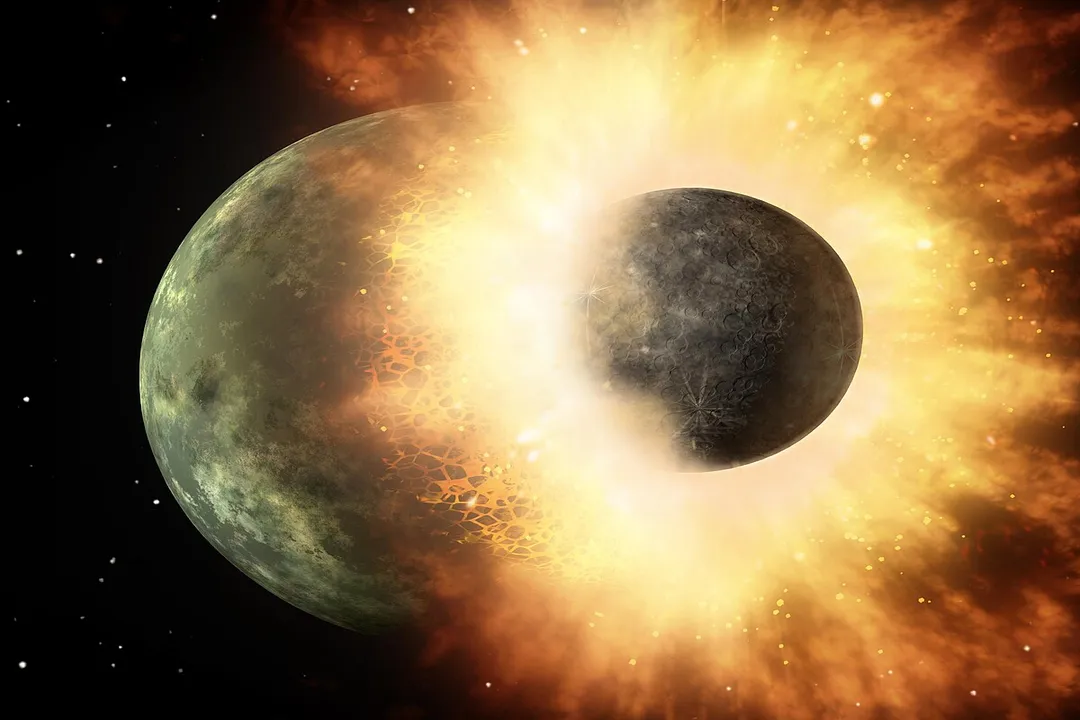
#Videos
How Theia, the Planet that Created the Moon, Could Also Be Hiding ...
Related Questions
What catastrophic event led to the formation of the Moon?Approximately how long ago did the colossal collision that formed the Moon occur?What celestial body size is the impactor Theia generally modeled after?What covered the early Earth in the immediate aftermath of the high-energy impact?What key chemical observation shifted scientific perspective regarding Theia and Earth's material contribution?Where are the suspected remnants of the impactor Theia believed to reside deep within our planet today?How are the Large Low Shear Velocity Provinces (LLSSVs) characterized seismically?Why did the ejected orbital debris coalesce into a single satellite (the Moon) rather than forming a second, independent planet?According to early theoretical models that suggested a grazing blow, what would the Moon primarily be made of?What does the current mass of the Moon constrain regarding the energy dynamics of the collision?