How did Theia turn into the moon?
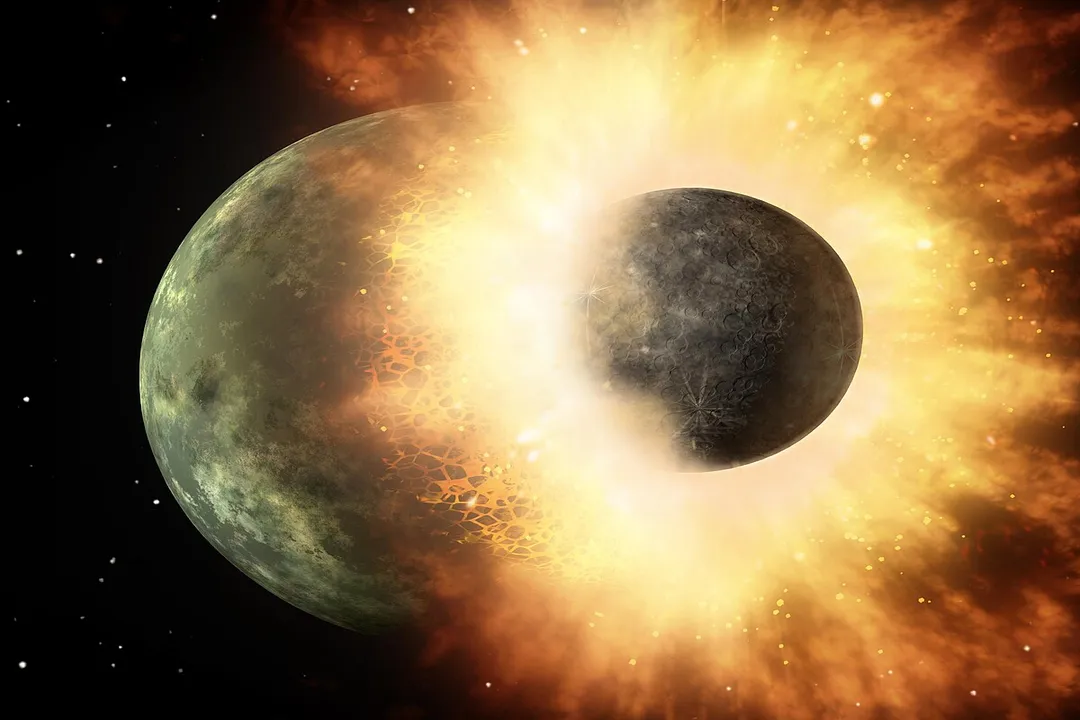
The spectacular formation of our Moon remains one of the most compelling stories in planetary science, originating from a catastrophic, world-altering event about 4.5 billion years ago. This event centered on a violent collision between the early Earth, known then as the proto-Earth, and a distinct, Mars-sized protoplanet designated Theia. The sheer scale of this impact was so immense that it vaporized vast amounts of material, ejecting a massive cloud of superheated rock and gas into orbit around the scarred Earth. Over a relatively short period, this orbital debris cooled and clumped together through accretion, gradually assembling into the single, massive satellite we see today: the Moon.
# Collision Timing
The accepted timeline places this colossal impact near the beginning of the solar system's formation. While the exact chronology is still refined, scientists estimate the collision occurred approximately 4.51 billion years ago. The process was not a gentle nudge; it was a high-energy scenario that melted much of the proto-Earth, leading to the creation of a giant magma ocean engulfing the planet in the immediate aftermath. This event fundamentally altered the early Earth's rotational speed and axial tilt, setting the stage for the planet's long-term geological and climatic evolution.
# Theia's Nature
Understanding the Moon requires understanding its progenitor, Theia. It is generally modeled as a body about the size of modern Mars. Early theoretical models often depicted this impact as a grazing blow—a high-velocity, oblique collision. Such a scenario suggested that the resulting debris disk surrounding Earth would be composed primarily of the mantle material originating from Theia itself.
However, subsequent modeling has complicated this picture considerably. Newer simulations suggest the impact might have been a much more direct, lower-energy, head-on collision, or perhaps even a sequence of smaller impacts. A critical finding that has shifted scientific perspective relates to the chemical fingerprint left behind. If Theia had been entirely separate from the material that formed Earth, the Moon should exhibit a distinct isotopic signature compared to Earth's own rocks. Yet, the Moon appears strikingly similar in composition to Earth’s own mantle. This similarity has led researchers to propose radical ideas: perhaps Theia was not an isolated, unique body, but rather a planetary embryo that had already differentiated and developed an internal structure similar to Earth's, or perhaps the impact was so energetic that the two bodies mixed far more thoroughly than previously assumed. This apparent isotopic mirroring hints that the material responsible for the Moon was nearly 50/50 Earth and Theia, or that Theia’s composition was surprisingly similar to Earth’s to begin with.
# Debris Disk Dynamics
The material launched into orbit following the impact was not a static ring; it was a scorching, rapidly rotating disk of molten rock and vaporized material. The Moon formed as this material rapidly accreted. The key question that drove much of the research was where this material came from. If the impact was glancing, the Moon should be Theia-rich. If the impact was fully energetic and mixing occurred, the Moon should be Earth-rich. The fact that it seems to be a blend, or almost entirely Earth-like, suggests a complex sharing of material.
It is fascinating to consider the energy dynamics required for this specific outcome. For the debris to coalesce into a stable Moon orbiting Earth, the released energy had to be perfectly channeled into establishing an orbital velocity for the ejecta, rather than simply flinging the material entirely out of the Earth's gravitational influence or having it all fall back onto the proto-Earth. The formation appears to represent a very narrow energetic sweet spot. To put this into perspective, calculating the minimum escape velocity for the material ejected is extremely complex, but any significant over-energy would have resulted in a loss of mass to space, meaning the current Moon’s mass is a direct testament to the precise kinetic energy released during the collision.
# Deep Earth Remnants
The story of Theia does not end with the Moon’s ascent; evidence of the impactor is believed to still reside deep within our home planet. Seismic studies have identified two massive, chemically distinct anomalies within the lower mantle, known as Large Low Shear Velocity Provinces (LLSSVs). These zones are unusually hot and dense compared to the surrounding mantle material. One prominent hypothesis suggests that these blobs are the remnants of Theia itself, which, instead of completely mixing with Earth’s molten mantle during the impact, survived and sank to rest near the core-mantle boundary.
This persistence of Theia’s material explains why the Moon is so similar to Earth’s mantle despite the violent mixing—because a significant, unmixed portion of Theia remained inside Earth. If the mixing had been total, these distinct chemical signatures would have been smeared throughout the entire planetary interior over billions of years, but their localized presence provides a powerful constraint on the energy and mixing efficiency of the Giant Impact Hypothesis.
# Planetary Stability
A natural follow-up question arises when contemplating such a massive collision: why didn't the debris coalescing in orbit form a second, independent planet instead of a satellite?. The answer lies in the mechanics of accretion within a confined space dominated by a much larger body. The impact injected a vast amount of material into orbit around Earth. Because this material was already gravitationally bound to the Earth-Theia system—and due to tidal forces and orbital dynamics—it preferred to aggregate into a single, large mass (the Moon) in a stable orbit, rather than gathering enough mass separately to clear its own orbital path and achieve planetary status. The gravitational influence of the proto-Earth dictated the final outcome, ensuring that the debris formed a satellite system rather than a double-planet system.
The formation process, therefore, can be summarized by tracking the fate of the colliding material: a portion was flung into orbit to become the Moon, a substantial portion mixed into the proto-Earth to form the current mantle, and potentially, an unmixed remnant settled deep within the Earth, all stemming from that initial, world-shattering encounter.
# Formation Models Compared
Modern understanding requires reconciling several distinct observations: the Moon's high angular momentum, its similar isotopic makeup to Earth, and the potential deep structure within Earth. The differences between the older, high-energy oblique impact model and the newer, lower-energy synestia or head-on models highlight how scientific understanding evolves as computational power increases and new data, like the seismic mantle blobs, emerge.
| Model Characteristic | Early High-Velocity Oblique Impact | Recent Low-Energy/Head-On Impact |
|---|---|---|
| Primary Debris Source | Mostly Theia's mantle | Significant contribution from Earth's mantle |
| Resulting Earth Structure | High degree of mixing predicted | Possible LLSSV remnant accumulation |
| Energy Required | Very High | Moderately High to allow significant ejection |
The ongoing refinement of the Giant Impact Hypothesis demonstrates the scientific process at work—moving from a plausible initial concept to a far more nuanced explanation that accounts for both the Moon’s existence and the strange, hidden architecture of our own planet.
#Videos
How Theia, the Planet that Created the Moon, Could Also Be Hiding ...
Related Questions
#Citations
The Moon-forming impactor Theia originated from the inner Solar ...
Moon Formation - NASA Science
Did Theia actually smash into the Earth or is Earth a combination of ...
Giant-impact hypothesis - Wikipedia
Theia slammed into Earth, left marks and then formed the Moon ...
How did the Moon form from a collision with Theia? Why wasn't ...
How Theia, the Planet that Created the Moon, Could Also Be Hiding ...
The Remains of an Ancient Planet Lie Deep Within Earth - Caltech
Moon may have formed through Earth's collision with close neighbor ...