Which wavelengths effectively pierce the obscuring interstellar dust clouds?
Answer
Infrared and radio waves
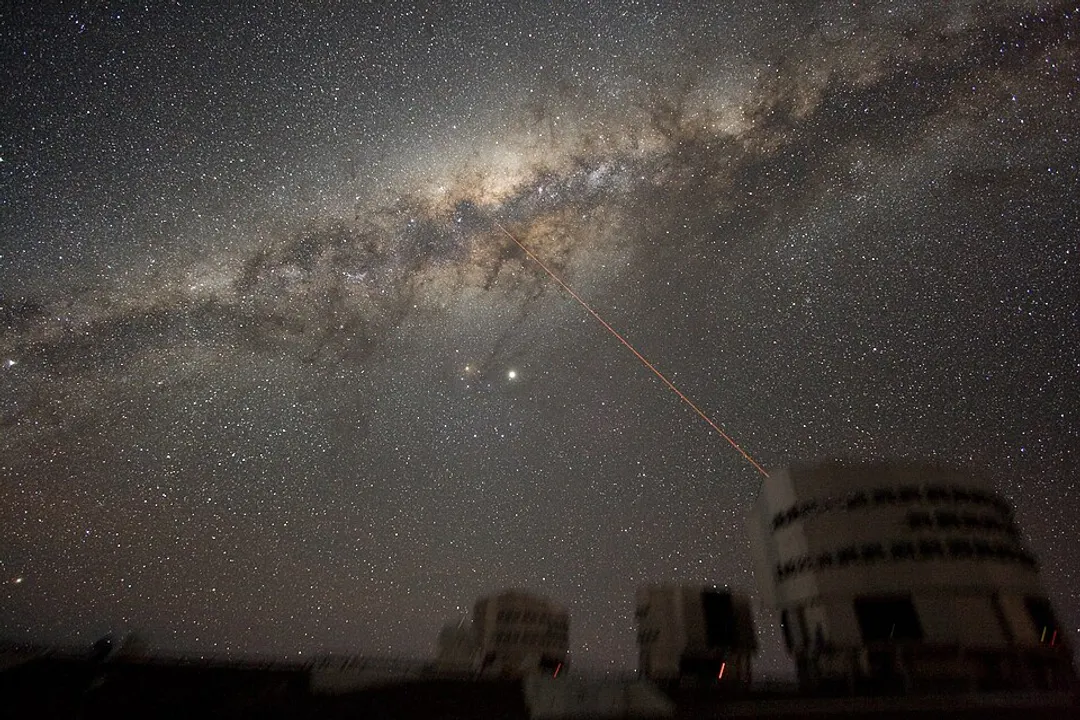
To bypass the severe blockage caused by dense interstellar dust and gas clouds—a problem known as extinction—astronomers rely on longer wavelengths of the electromagnetic spectrum. Specifically, infrared radiation and radio waves possess the ability to pass through these obscuring materials much more easily than visible light. Infrared observations help reveal the heat signatures of obscured stars, while radio waves are used to detect emissions from abundant hydrogen gas clouds, providing crucial data points for constructing a three-dimensional structural map.
Related Questions
Why can't we take a single photograph of the Milky Way's entire structure?What is the estimated span across the Milky Way galaxy?How far is the Solar System located from the Milky Way's central bulge?What term do astronomers use for the obscuring effect of dust toward the Galactic Center?Which wavelengths effectively pierce the obscuring interstellar dust clouds?What specific signal do radio telescopes detect to map the Milky Way's structure?What classification is given to the Milky Way galaxy's structure?Why does the Andromeda Galaxy (M31) appear as a complete spiral shape in images?What characterizes an Artist's Conception image of the Milky Way?Which arms are included in the consensus of the Milky Way's four major arms?