What mineral, typically forming in water on Earth, was indicated by spectral data at Opportunity's landing site?
Answer
Hematite.
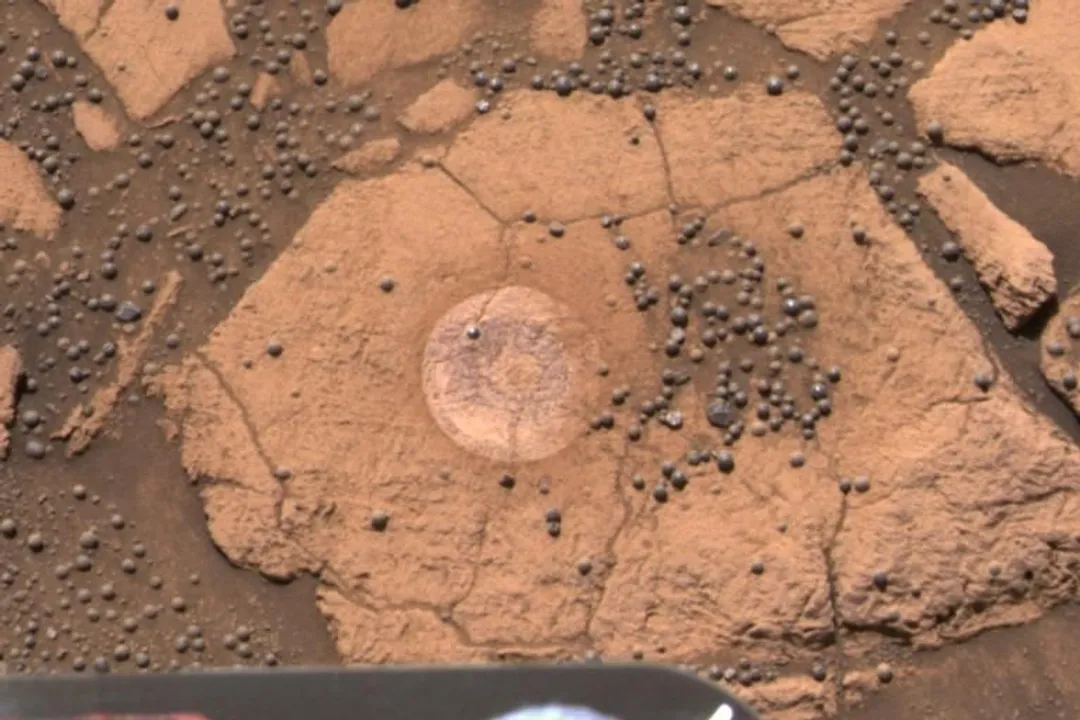
The selection of Meridiani Planum as Opportunity's landing site was directly driven by specific scientific data gathered from orbit. Spectral data analyzed prior to landing indicated an unusually high concentration of hematite across that region of Mars. On Earth, hematite often forms when iron-bearing minerals react with water, frequently through processes involving subsurface water circulation or localized surface pooling. The presence of this specific mineral provided a strong pre-mission indicator that the site would yield evidence of past aqueous activity, making the investigation of these hematite deposits Opportunity's foremost initial imperative.
Related Questions
What was the definitive proof sought by Spirit and Opportunity upon arrival in January 2004?Which Martian feature was Spirit tasked to examine by driving toward the rim of Bonneville Crater?What specific surface feature at Meridiani Planum prompted Opportunity's initial high-value inspection?For what duration was the official primary mission set for both Spirit and Opportunity in Martian sols?Which fundamental task relied on the Alpha Particle X-ray Spectrometer (APXS) instrument?What specific water-related minerals was the Miniature Thermal Emission Spectrometer (Mini-TES) instructed to look for?What was the core physical routine sequence defined for Spirit when analyzing a rock sample?What implied *type* of water environment was Spirit seeking, contrasted with Opportunity's focus?What role did the thorough initial success of the rovers upgrade them to, moving beyond proof-of-concept explorers?What mineral, typically forming in water on Earth, was indicated by spectral data at Opportunity's landing site?