How does Mars Rover transmit data?
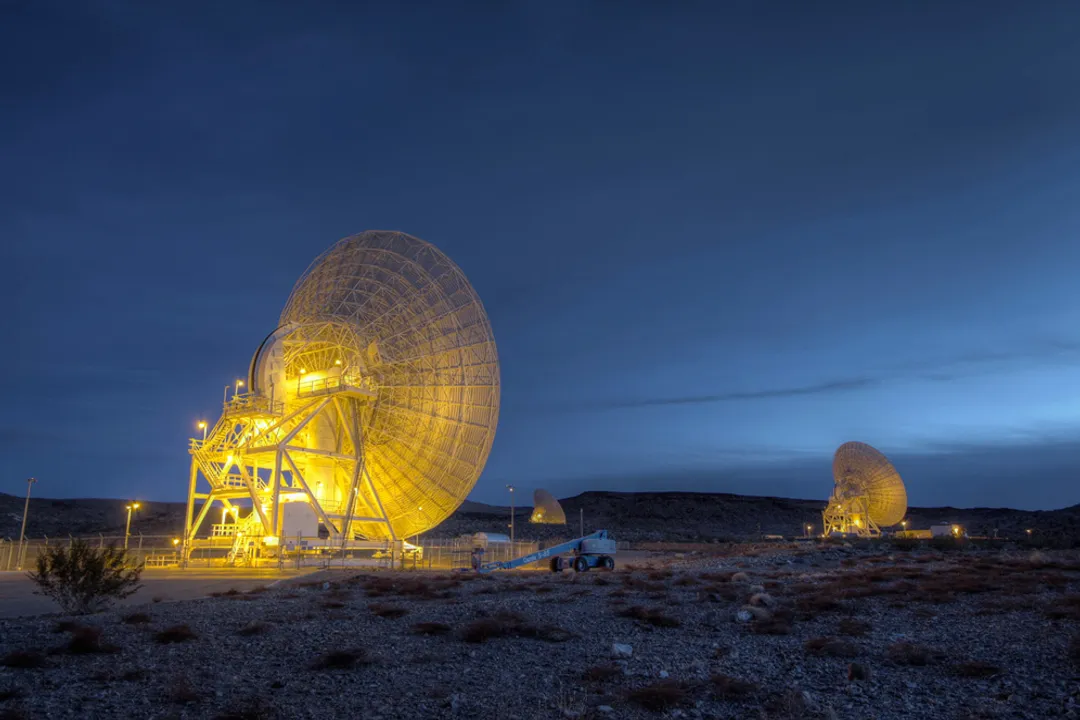
The process of retrieving data from a robotic explorer millions of miles away on the surface of Mars is far more complex than simply pointing a powerful radio telescope at the planet and hitting "send." It requires a carefully orchestrated chain of command involving multiple pieces of hardware operating across vast distances, each handling a specialized part of the communication link. [5][7] The signals sent by rovers like Curiosity or Perseverance are incredibly faint by the time they reach Earth, necessitating enormous receiving dishes and sensitive electronics to capture them. [9]
# Distance Challenges

The sheer scale of interplanetary communication presents immediate hurdles, the most obvious being the physical distance separating the rover and Earth. [5] This separation creates a significant one-way time delay, often referred to as the light time delay. When a command is sent from Earth, it can take anywhere from about 3 to 22 minutes to reach Mars, depending on the orbital positions of the two planets. [5] This delay means that operating a rover in real-time, as one might remotely pilot a car, is impossible. [5] Operations must be planned meticulously in advance, often uploaded as a sequence of instructions for the rover to execute autonomously over the next Martian day. [1] The communication system must account for this latency, prioritizing reliability over instantaneous response. [7]
# Rover Transmission Methods
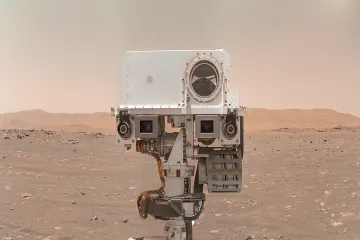
Once the rover collects scientific data or images, it needs a way to send that information off the planet. Martian rovers typically have two primary methods for communicating with Earth, differentiated by the antenna used and the path taken. [4]
The first method involves a direct link to Earth, usually employing a high-gain antenna (HGA). [4] This antenna is typically directional, meaning it must be precisely aimed toward Earth or the region of space where Earth is located. [7] While a direct link saves time by skipping the relay step, it is severely constrained by two factors: power and data rate. [4] Because the rover has finite power reserves—especially when operating far from a solar array, as is common on modern rovers—it cannot transmit high-power signals continuously. [7] Furthermore, even with a directional HGA, the distance results in a relatively low data rate compared to Earth-based systems. [4] This direct communication is often reserved for sending essential status updates or small emergency files when orbital assets are unavailable. [1]
The second, and more common, method relies on the assistance of orbiters currently circling Mars. [2][4] This system utilizes the rover's UHF (Ultra High Frequency) antenna. [1] Unlike the HGA, the UHF antenna is often omnidirectional or has a much wider beamwidth, meaning the rover doesn't need to know the exact location of the receiving spacecraft, only that it is in view. [4] This simplicity is crucial for daily operations. [1] The power required for this short-range communication with an orbiter is significantly less than what is needed to beam a signal all the way to Earth. [7]
An interesting consideration in the rover's communication design is the power/data trade-off. A rover commander must decide: use precious power for a slow, highly reliable emergency check-in via the HGA aimed at Earth, or use less power for a high-volume data dump that relies on an orbiter being overhead at the right time. The UHF relay system essentially trades instantaneous contact for vastly superior throughput and power efficiency, making it the backbone of science data return. [1][4]
# The Orbital Bridge
The Martian orbiters—such as NASA's Mars Reconnaissance Orbiter (MRO) or the Mars Odyssey craft—serve as indispensable communication relay satellites. [2] They are positioned in orbits that allow them to pass over the rover's location multiple times a day. [1] This setup creates what is often called the uplink/downlink window. [2]
When the orbiter passes overhead, the rover transmits its stored data via its UHF antenna to the orbiter. [1] The orbiter receives this data, stores it momentarily, and then relays it back to Earth using its own much more powerful transmitter and larger antenna, typically operating in the X-band frequency range. [4][9] This relay process converts a weak, slow, two-hop link into a much faster, stronger, one-hop link from the orbiter to Earth. [4] For example, the Mars Reconnaissance Orbiter’s High Gain Antenna can often relay data from a rover at rates significantly faster than the rover could achieve directly to Earth. [1] The scheduling is precise; ground controllers must know the exact location and timing of these orbital passes to ensure the rover is commanded to transmit when the orbiter is listening. [2]
# The Deep Space Network
Regardless of whether the signal comes directly from the rover or via an orbiter relay, the final destination on Earth is almost always managed by NASA’s Deep Space Network (DSN). [9] The DSN is a global array of massive radio antennas strategically located in the United States (California), Spain, and Australia. [8] This global placement is critical; it ensures that at least one station has a clear line of sight to Mars at any given time, overcoming Earth's rotation. [8]
These antennas are enormous, often measuring 70 meters (230 feet) in diameter. [9] They are engineered not just to transmit powerful signals over deep space distances, but to act as extremely sensitive receivers capable of detecting the incredibly faint electromagnetic energy that arrives from Mars. [9] The DSN handles the data downlink from the orbiters, processes the raw signal, and then forwards the structured data to mission control centers, such as NASA's Jet Propulsion Laboratory (JPL). [9] The DSN acts as the primary communications gateway for nearly all deep-space robotic missions. [8]
# Data Handling and Integrity
The data transmission process involves several layers of error checking to ensure that the complex instructions sent to the rover, and the scientific findings sent back, arrive without corruption. [7] Data is packaged into specific formats, often using protocols designed for noisy, long-distance transmission paths. Error correction codes are embedded within the digital stream. [7] If an orbiter or the DSN detects errors during reception, it can request a retransmission of the corrupted segment. [1] This process of verification and, when necessary, re-sending small blocks of data is standard procedure for maintaining data integrity over billions of miles. [7]
The overall efficiency of the system is best understood by looking at the components sequentially. A rover like Curiosity transmits data using its UHF radio to an orbiter, which acts like a high-speed messenger pigeon, storing the data briefly before beaming it down to the DSN using a much higher-power X-band link. [1][4] This layered approach is necessary because the power constraints on the rover are far stricter than the constraints on the much larger, Earth-powered orbiters. [7]
Analyzing the typical setup, we can see a clear hierarchy of capability. The rover's initial UHF link is optimized for low power and wide coverage to quickly contact a passing satellite. The orbiter's relay link is optimized for maximum throughput, as it is transmitting from a much more powerful platform with large, highly sensitive receiving dishes (on Earth) waiting for it. This difference in optimization dictates that the most valuable data is intentionally channeled through the slower but higher-bandwidth orbital path whenever possible. [1][4] This structured reliance on relays is not a backup plan; it is the primary operational mode designed for mission success. [2]
#Videos
How Mars rover Curiosity communicates with Earth - YouTube
Related Questions
#Citations
Communicating with Curiosity - NASA Science
How does Curiosity stay in contact with Earth when Mars is ... - Reddit
Radio Science Subsystem (RSS)
What connection do Mars rovers use to send data to Earth?
How can we communicate with a mars rover million of miles away ...
How Mars rover Curiosity communicates with Earth - YouTube
[PDF] Telecommunications for Mars Rovers and Robotic Missions
A Complete Guide On Mars Rover and the Earth - Starscapes
Communicating with Mars: The Deep Space Network and ... - Peraton