What is the consequence of the one-way time delay for operating a robotic explorer on Mars?
Answer
Operating the rover in real-time is impossible
The inherent light time delay—the several minutes it takes for a command to travel to Mars—makes immediate, responsive control unfeasible. Unlike controlling a ground vehicle where immediate feedback allows for continuous, real-time adjustments, operations on Mars must be proactive rather than reactive. Commands cannot be issued based on what the rover is currently doing, as by the time the command arrives, the rover will have already executed the previous instruction. Therefore, mission controllers must upload comprehensive sequences of instructions, often planned for an entire Martian day, which the rover then executes autonomously.
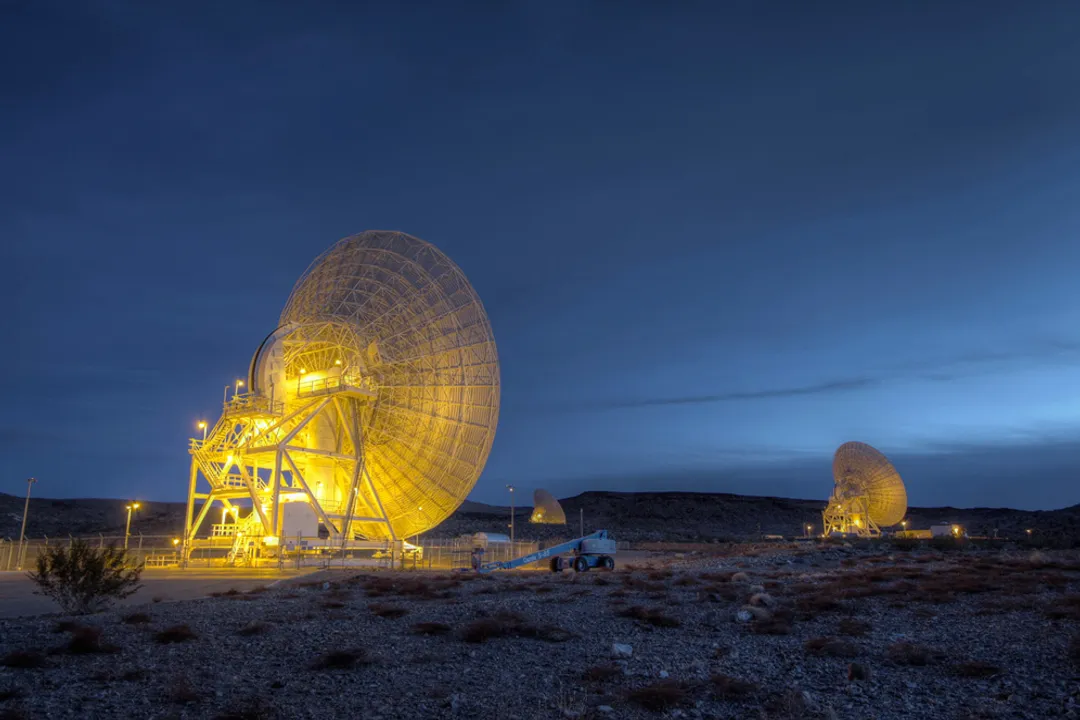
#Videos
How Mars rover Curiosity communicates with Earth - YouTube
Related Questions
What is the range of the one-way light time delay for commands traveling from Earth to Mars?What two critical factors severely constrain the direct communication link a rover uses via its High-Gain Antenna (HGA)?Which antenna type is typically employed by Martian rovers for the more common, power-efficient link with an orbiting spacecraft?What frequency range do Martian orbiters typically utilize when transmitting relayed scientific data down to Earth stations?What phrase describes the period when controllers must schedule transmission because an orbiter is passing overhead of the rover?What is the designated primary communication gateway on Earth responsible for receiving signals from Mars missions?What key characteristic of the Deep Space Network (DSN) overcomes the challenge posed by Earth's rotation?What must a rover commander balance when deciding between using the HGA for an emergency check-in versus the UHF relay system?What specific procedure is standard for maintaining data integrity when the DSN or an orbiter detects corrupted signal segments?What is the consequence of the one-way time delay for operating a robotic explorer on Mars?