What mechanism defines energy transport within the stellar radiative zone?
Answer
Transfer via electromagnetic waves (photons)
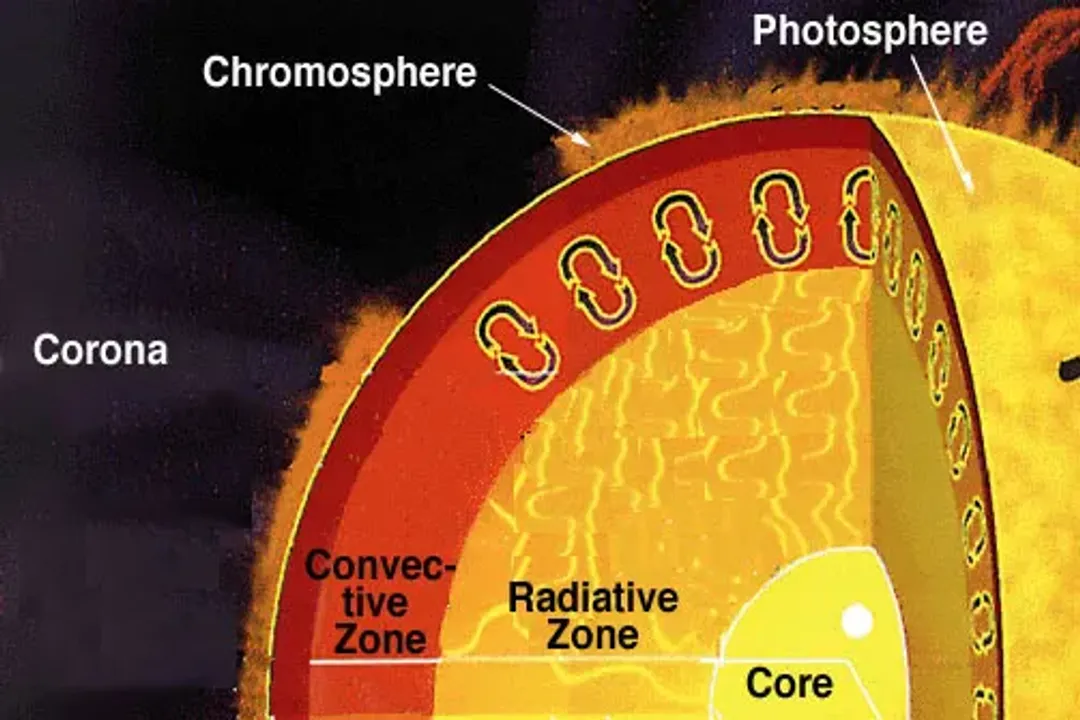
The defining characteristic of the radiative zone is the method by which energy moves outward from the core. This transfer relies entirely on radiation, which involves the emission and subsequent absorption and re-emission of photons, or light quanta. Unlike convection, where matter physically churns, this process involves electromagnetic waves navigating the incredibly dense plasma. A photon travels only a short distance, often just a millimeter, before being absorbed by an atom or ion, which then excites and re-emits a new photon, frequently in a random direction, thereby characterizing the slow outward journey.
#Videos
How Do Convection And Radiation Zones Work In Stars? - YouTube
Related Questions
What mechanism defines energy transport within the stellar radiative zone?What is the process famously dubbed for energy propagation in this dense stellar layer?For our Sun, what is the inner radial boundary of the radiative zone in solar radii?How does the mechanism of energy transfer in the radiative zone contrast with the convection zone?What extreme internal property forces energy transport to rely on the slow, iterative dance of photons?What is the approximate time lag for energy created in the core to exit the Sun's radiative zone?Near the core, what is the approximate temperature reached within the radiative zone?What structural instability causes the transition from radiation to convection near the edge of the zone?What is the crucial function the radiative zone provides for long-term stellar stability?How do the radiative zones of larger, hotter stars generally compare to that of the Sun?