What does the radiation zone of a star do?
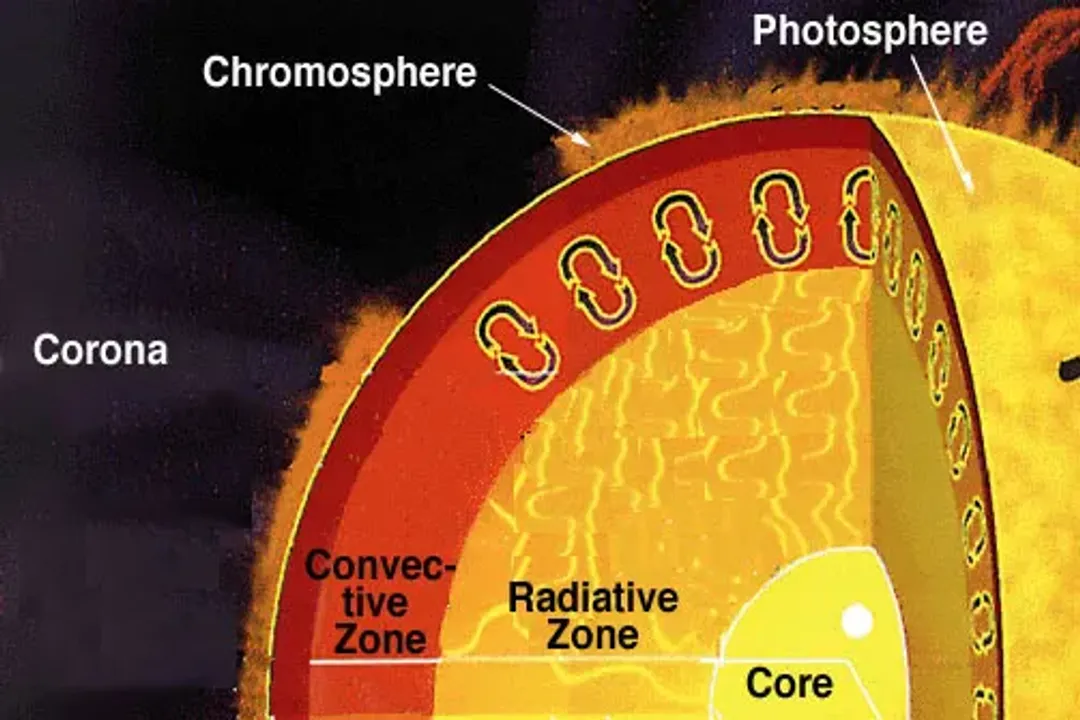
The engine room of any star generates energy in its innermost section, the core, through nuclear fusion. Yet, that immense power doesn't just instantly flood the vacuum of space; it has to navigate a vast, dense interior first. This intermediate layer, crucial for stellar stability and evolution, is known as the radiative zone. [5][7][8] It is the realm where energy is transported not by bulk movement, like boiling water, but through the slow, painstaking process of radiation—the transfer of energy via electromagnetic waves, or photons. [1][7]
This zone represents a fundamental shift in how a star manages its outward flow of power. Imagine the core producing blindingly hot light; the radiation zone is the immense hallway that light must traverse before it can reach the surface, and traversing it is far from a straight shot. [2][4]
# Energy Transfer
The defining characteristic of the radiative zone is its mechanism of energy transfer: radiation. [6] In this region, the plasma is so hot, yet dense enough, that charged particles effectively block the path of photons almost immediately. [4] A photon generated in the core travels perhaps a millimeter before being absorbed by an atom or ion. [2] After absorption, the particle excites momentarily, then re-emits a new photon, often in a completely random direction. [4] This cycle of absorption and re-emission happens constantly as the energy packet bounces its way outward. [2][9]
This process is famously dubbed the "random walk". [2] It is a stark contrast to the outer layers of many stars, like our Sun, where temperatures drop sufficiently that the plasma becomes more transparent to photons but opaque to heat transfer via convection. [2][6] Where the convection zone churns matter like a pot of boiling soup, the radiative zone relies entirely on the movement of light quanta, trapped within the stellar material. [1][6]
# Stellar Placement
The physical location of this zone dictates the conditions present. In a star like the Sun, the radiative zone begins where the fusion reactions cease to dominate energy generation, effectively surrounding the core. [6][9] For our Sun, this region extends from roughly $0.25$ solar radii () out to about . [2] This means the radiation zone makes up a substantial portion—nearly half—of the Sun's total radius, sitting immediately beneath the outermost layer we see, the convection zone. [9]
Consider the scale difference: if the Sun were represented by a large basketball, the core would be a marble at the center, and the radiative zone would be a thick shell extending almost to the ball's outer surface, with the thin skin of the convection zone being the very last layer. [2] This immense volume is what forces the energy to take so long to escape.
# Extreme Conditions
The conditions inside the radiative zone are defined by their extremity, which is precisely what makes photon transfer the dominant mechanism. Temperatures here are extremely high, often reaching several million degrees Kelvin. [2] At the inner boundary, near the core, the temperature can be around $7$ million Kelvin (). [2] This intense heat keeps the plasma highly ionized, but the density is still far too high for the gas to mix freely or convect efficiently. [2][6]
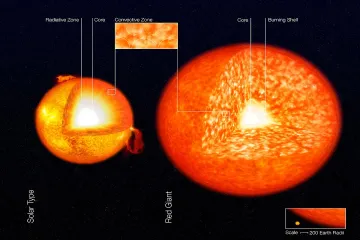
It is the very high opacity—the measure of how much material blocks light—that enforces the radiative transfer mechanism. [9] The density gradient means that as you move outward toward the convection zone, the temperature gradient becomes steeper enough that the transfer of heat through moving plasma (convection) becomes a more energetically favorable and faster method than relying on the slow, iterative dance of the photons. [2][6] Understanding this transition point is key to modeling a star's entire life cycle. For instance, the Sun shifts from radiation to convection around $70%$ of its radius; larger, hotter stars tend to have a much smaller or even non-existent radiative zone because their cores are so hot that convection can start much closer to the center. [2][9]
# Time Lag
Perhaps the most astonishing aspect of the radiative zone is the time it takes for energy to cross it. While the photons themselves are moving at the speed of light, the random walk means the net movement of energy is incredibly slow. [4] The path taken is not a straight line from the core boundary to the outer boundary; rather, it is a sprawling, zigzagging maze that can take hundreds of thousands, or even millions, of years. [4]
A fascinating way to frame this is by comparing the speed of the messenger versus the speed of the message delivery. The individual photon is the fastest thing in the universe, zipping along momentarily before being snagged by an electron or nucleus. [2] However, the package—the energy itself—is delivered on geological timescales. If you could track the exact parcel of energy released from a fusion event in the Sun's core, it might take close to a million years to finally exit the radiative zone and enter the churning convection layer. [4] This vast time lag provides a buffer between the instantaneous creation of energy in the core and the surface phenomena we observe, like solar flares or sunspots.
# Boundary Dynamics
The boundary between the radiative zone and the convection zone marks a profound physical change within the star's structure. The inner zone, the radiative layer, is characterized by thermal equilibrium, where energy moves steadily outward as radiation. [8]
When the star's interior composition changes over billions of years—perhaps due to the core burning hydrogen into helium—the temperature gradient shifts. If the temperature gradient becomes too steep (meaning the temperature drops too quickly over a small distance), the plasma near the boundary becomes unstable to convection. [6][9] At this point, the material itself begins to physically mix, effectively taking over the job of energy transport from the slow photons. [2] This switch is critical; it changes the star’s internal dynamics, which ultimately influences its surface appearance and lifespan. [6] This boundary isn't a fixed wall; it migrates slowly inward as the core ages and converts its hydrogen fuel, meaning the size of the radiative zone actually shrinks over eons.
In essence, the radiative zone acts as the great density filter and time delay mechanism of a star. It efficiently channels the high-energy photons produced by fusion, ensuring that the star’s light reaches the outer layers over a timeframe that allows for the stable, long-lived existence we observe. Without this stable transport layer, the surface would likely flare wildly, leading to a much shorter stellar lifespan characterized by unpredictable bursts of energy. It is the quiet, dense middle ground that maintains the star’s placid exterior.
#Videos
How Do Convection And Radiation Zones Work In Stars? - YouTube
Related Questions
#Citations
Glossary term: Radiative Zone - IAU Office of Astronomy for Education
Radiation Zone - Solar Physics at MSU
How Do Convection And Radiation Zones Work In Stars? - YouTube
Why do photons get absorbed and quickly expelled in the radiation ...
Radiative Zone | Definition & Layers of the Sun - Lesson - Study.com
Radiative Zone Definition - Astrophysics II Key Term - Fiveable
What is the meaning of radiative zone? | CK-12 Foundation
RADIATIVE ZONE Definition & Meaning | Dictionary.com
NASA: The Solar Interior