Near the core, what is the approximate temperature reached within the radiative zone?
Answer
Around $7$ million Kelvin ($7 imes 10^6 ext{ K}$)
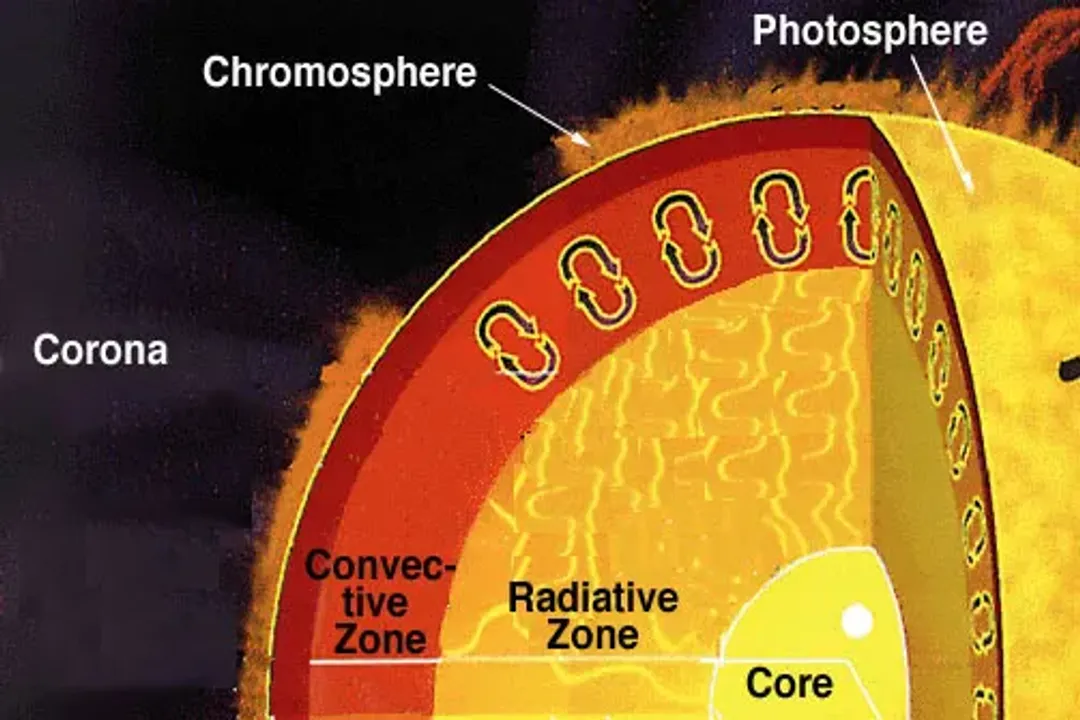
The conditions in the radiative zone are characterized by extreme heat, necessary to maintain the plasma state and drive the energy transport process. While the entire zone reaches temperatures in the millions of Kelvin, the hottest point is located at the inner boundary, immediately adjacent to the fusion-producing core. At this interface, the temperature is stated to reach roughly 7 million Kelvin, or $7 imes 10^6 ext{ K}$. This intense heat ensures the material remains highly ionized, but the density is high enough to suppress bulk convection, reinforcing the need for radiative transfer.
#Videos
How Do Convection And Radiation Zones Work In Stars? - YouTube
Related Questions
What mechanism defines energy transport within the stellar radiative zone?What is the process famously dubbed for energy propagation in this dense stellar layer?For our Sun, what is the inner radial boundary of the radiative zone in solar radii?How does the mechanism of energy transfer in the radiative zone contrast with the convection zone?What extreme internal property forces energy transport to rely on the slow, iterative dance of photons?What is the approximate time lag for energy created in the core to exit the Sun's radiative zone?Near the core, what is the approximate temperature reached within the radiative zone?What structural instability causes the transition from radiation to convection near the edge of the zone?What is the crucial function the radiative zone provides for long-term stellar stability?How do the radiative zones of larger, hotter stars generally compare to that of the Sun?