What is the crucial function the radiative zone provides for long-term stellar stability?
Answer
It acts as a density filter and a significant time delay mechanism.
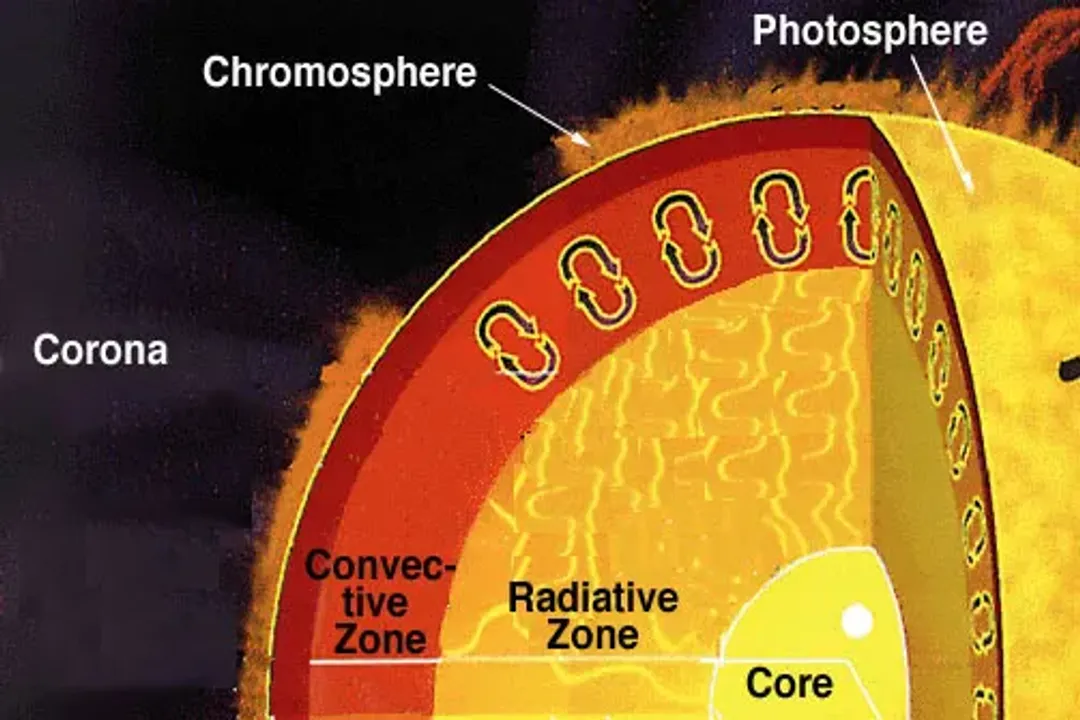
The radiative zone plays a vital stabilizing role in a star's life by acting as a massive buffer between the instantaneous energy production occurring in the core and the observable surface phenomena. Because the energy transport is so slow, taking potentially millions of years, it ensures that energy release at the surface is steady and predictable over vast timescales. This massive time lag prevents the star from exhibiting wild fluctuations or unpredictable bursts of energy that would otherwise result if the surface reacted immediately to the intense, rapid energy output generated by nuclear fusion.
#Videos
How Do Convection And Radiation Zones Work In Stars? - YouTube
Related Questions
What mechanism defines energy transport within the stellar radiative zone?What is the process famously dubbed for energy propagation in this dense stellar layer?For our Sun, what is the inner radial boundary of the radiative zone in solar radii?How does the mechanism of energy transfer in the radiative zone contrast with the convection zone?What extreme internal property forces energy transport to rely on the slow, iterative dance of photons?What is the approximate time lag for energy created in the core to exit the Sun's radiative zone?Near the core, what is the approximate temperature reached within the radiative zone?What structural instability causes the transition from radiation to convection near the edge of the zone?What is the crucial function the radiative zone provides for long-term stellar stability?How do the radiative zones of larger, hotter stars generally compare to that of the Sun?