What mass threshold must a white dwarf stay below to remain stable via electron degeneracy pressure?
Chandrasekhar limit (approximately 1.4 solar masses)
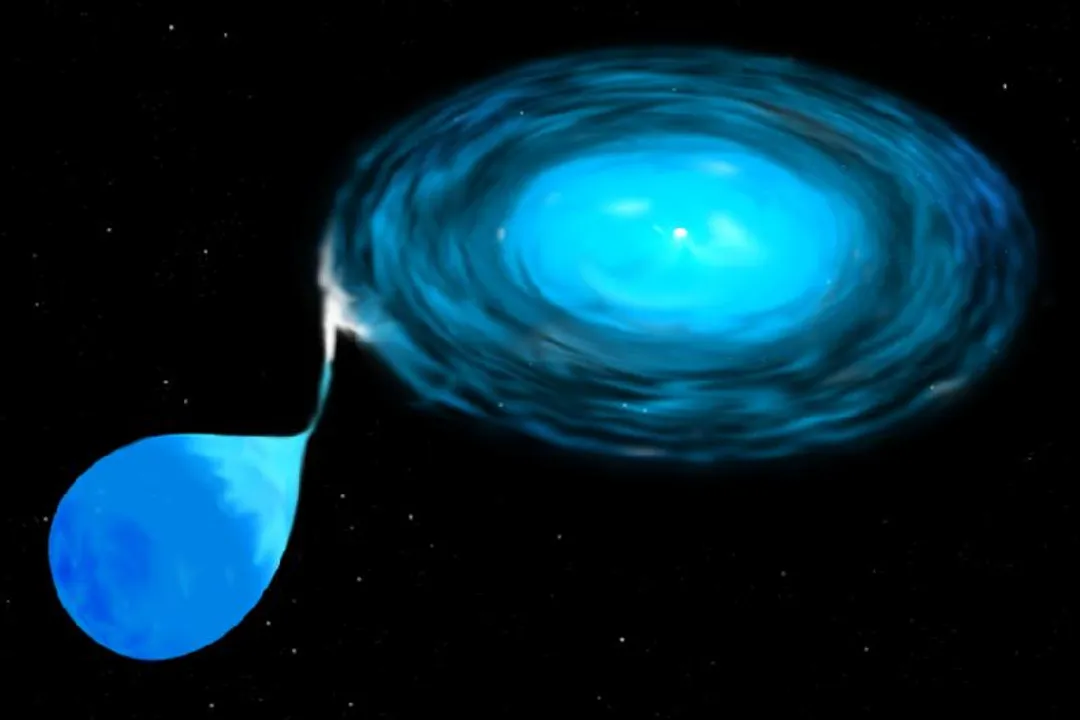
A white dwarf, which is the remnant of a less massive star, maintains its physical size and prevents further gravitational collapse not through ongoing nuclear fusion, but through a quantum mechanical effect known as electron degeneracy pressure. This pressure arises because electrons resist being squeezed into the same quantum state. However, this support mechanism has a finite limit based on the total mass enclosed. This critical tipping point is precisely defined as the Chandrasekhar limit, which equates to roughly 1.4 solar masses. If the white dwarf accretes matter from a companion star or merges with another white dwarf and exceeds this limit, electron degeneracy pressure fails, leading directly to the core temperature and density surge that triggers a thermonuclear runaway explosion, resulting in a Type Ia supernova.