What large-scale structures result from smaller galaxy groups being drawn together over billions of years through gravitational dominance?
Answer
Galaxy clusters
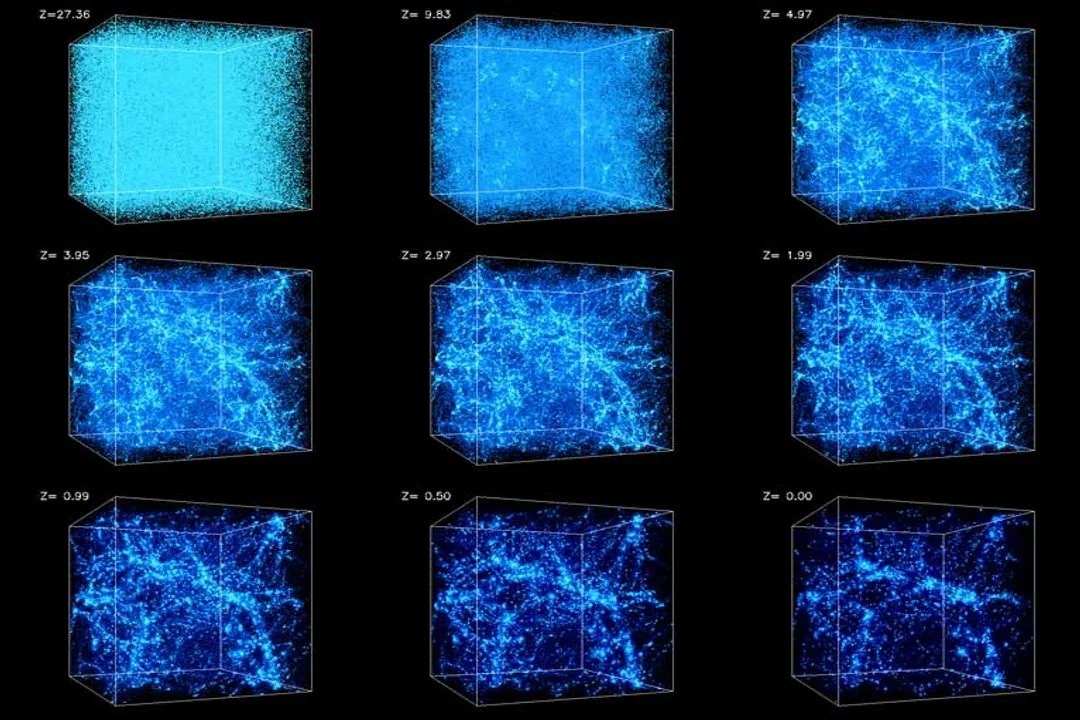
The process of galaxy aggregation is a long-term evolutionary path dictated by gravity. Smaller collections of galaxies, or groups, are continually drawn toward one another by their collective gravitational pull. Over spans of billions of years, this relentless accretion and merging process builds up the largest known gravitationally bound structures observed in the cosmos, which are classified as galaxy clusters. These clusters represent the successful completion of early gravitational collapses before the accelerating expansion separated the intervening space too much.
#Videos
What Force Binds A Galaxy Together? - Physics Frontier - YouTube
Related Questions
What fundamental force is at the heart of galaxy aggregation, pulling galaxies into groups and clusters?What shape typically results after the gravitational scrambling of two large spiral galaxies through collision?Which small collection of galaxies, including the Milky Way and Andromeda, is gravitationally bound to collide?What observational phenomenon involving light bending reveals the gravitational mass of clusters exceeds visible matter?What invisible substance forms the necessary gravitational scaffold upon which visible galaxies are arrayed?What force is theorized to be a property of space itself, causing the accelerating expansion of the universe?What specific event during a galaxy merger violently triggers intense bursts of star formation?On which scale does the accelerating separation driven by dark energy become the dominant factor over gravity?What large-scale structures result from smaller galaxy groups being drawn together over billions of years through gravitational dominance?What happens to the average density of the cosmos as the volume of space increases due to expansion?