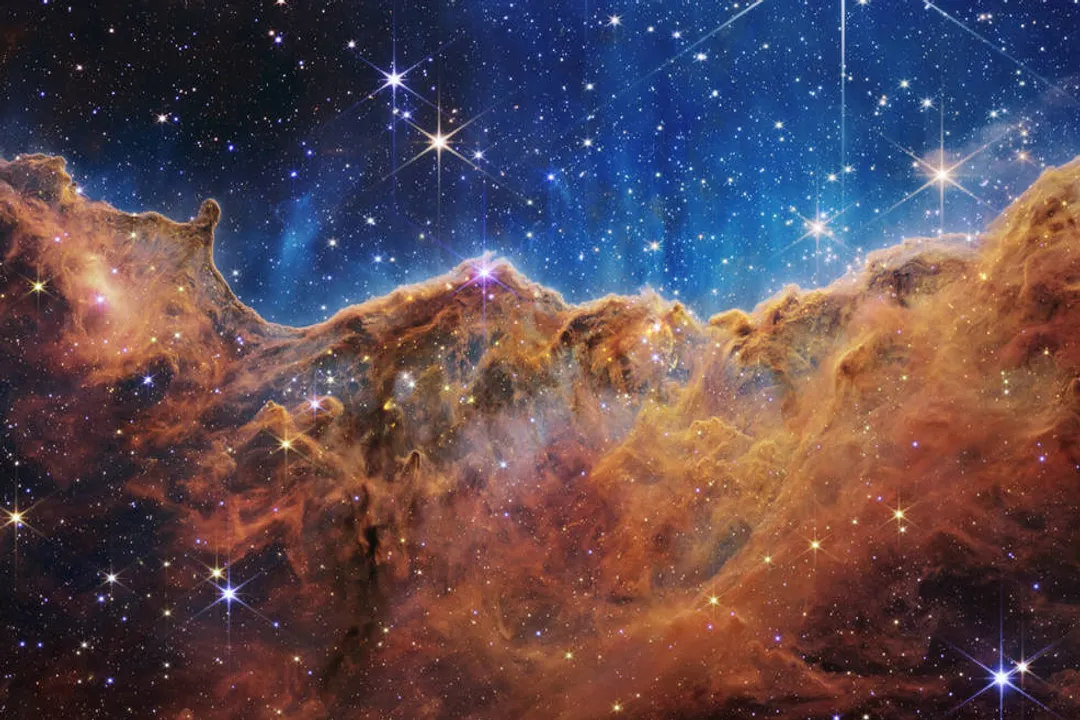
What causes Emission Nebulae, like the Orion Nebula (M42), to typically glow with a characteristic red hue?
Ionizing the gas, often ionized hydrogen atoms.
Emission nebulae are classified by their ability to generate their own visible light, a process achieved when nearby or embedded stars emit intense ultraviolet radiation. This high-energy radiation strips electrons from the surrounding gas atoms, a process called ionization. When these ionized atoms subsequently capture electrons again, they release energy in the form of photons at specific wavelengths. For nebulae predominantly composed of hydrogen, the characteristic spectral line that dominates this process is the Balmer series emission, which results in the prevalent, easily recognizable red glow observed in many emission nebulae, including the brightest one visible, the Orion Nebula (M42).