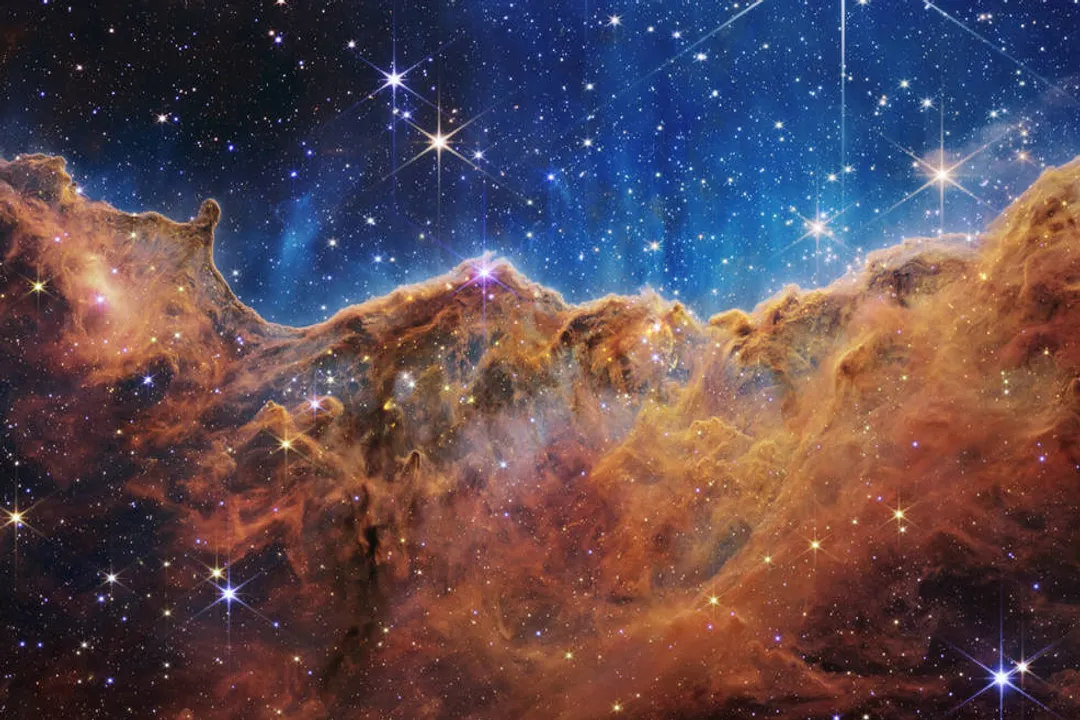
How does the Horsehead Nebula, an example of a Dark Nebula, become visible?
It appears as a dark silhouette against a bright background.
Dark nebulae are identified by their complete lack of inherent luminosity; they neither emit nor reflect light effectively because they are extremely dense concentrations of dust and gas. Consequently, these objects cannot be seen by looking for light coming from them directly. Instead, they are rendered visible because they completely absorb or block the light originating from luminous objects situated behind them, such as a bright star field or an illuminated emission nebula lying farther in the background. The striking Horsehead Nebula serves as a classic example of this phenomenon, appearing starkly black or silhouetted against the brighter glow situated behind its opaque structure.