How does the redshift of a galaxy observed from the early universe (looked at very far back in time) compare to nearby galaxies?
Answer
It is more pronounced because the light had more distance to travel while space expanded around it
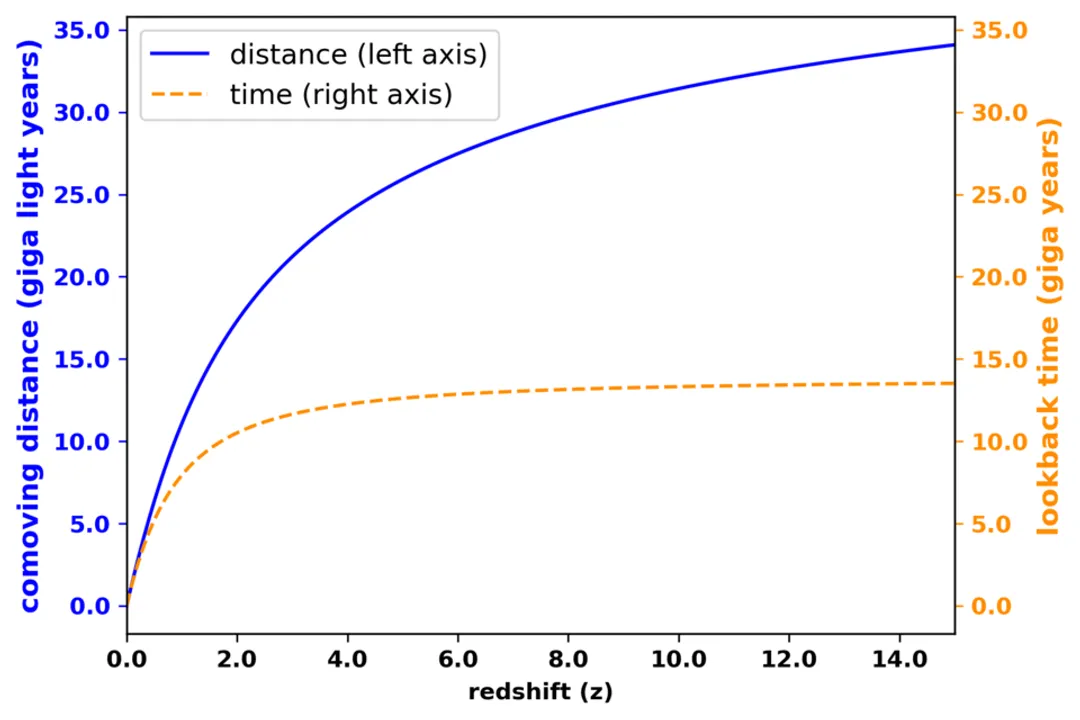
The further back in time we look, the more pronounced the redshift becomes because the universe was smaller and denser then, meaning the light had more distance to travel while space expanded around it.
Related Questions
What phenomenon occurs when a light source moving away from an observer causes the light waves to stretch?What primarily causes the redshift observed in very distant galaxies across vast intergalactic distances?If a cosmic object exhibits a blueshift, what does that indicate about its motion relative to us?Which large neighboring galaxy is known to exhibit a measurable blueshift toward the Milky Way due to gravitational attraction?What is the fundamental observation supporting the idea that the universe is expanding when observing deep space?What cosmic signatures act as 'cosmic rulers' for comparing detected light wavelengths against stationary expectations?On what scale does local gravity typically become the primary driver dictating motion, sometimes causing blueshifts despite cosmic expansion?According to Hubble’s Law, what is generally evidenced by a greater redshift value observed in a distant galaxy?Do the existence of nearby blueshifted galaxies invalidate the model of an expanding universe?How does the redshift of a galaxy observed from the early universe (looked at very far back in time) compare to nearby galaxies?