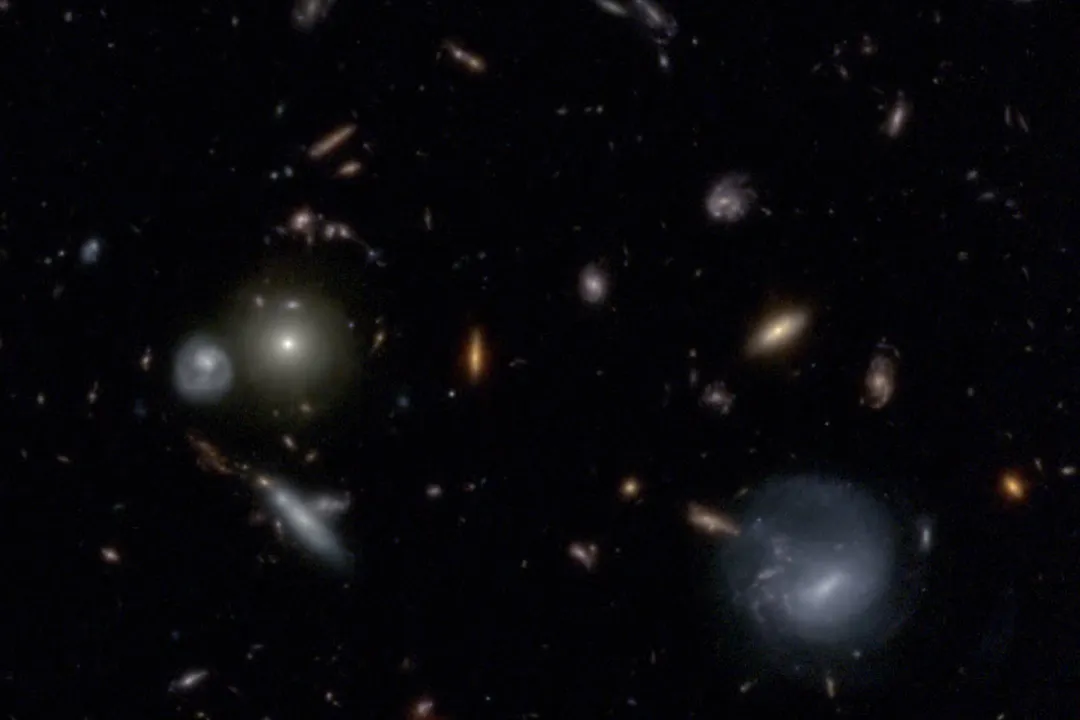
How does the Intergalactic Medium (IGM) allow researchers to study conditions when the universe was much younger?
It absorbs specific wavelengths from a distant background source, leaving absorption lines
The IGM, consisting of the gas between galaxies, can be probed indirectly using background light sources. As light from a very distant galaxy or quasar travels across billions of years, it passes through intervening clouds of gas within the IGM at various cosmic ages. If these gas clouds contain specific elements or are in a certain state of ionization, they will absorb precise wavelengths of light from the background source. This absorption creates characteristic gaps, or absorption lines, in the observed spectrum. By analyzing the location and depth of these lines, scientists can determine the temperature, density, and chemical composition of the IGM at the time the light passed through it, effectively using the distant source as a flashlight shining through the structure of interest.