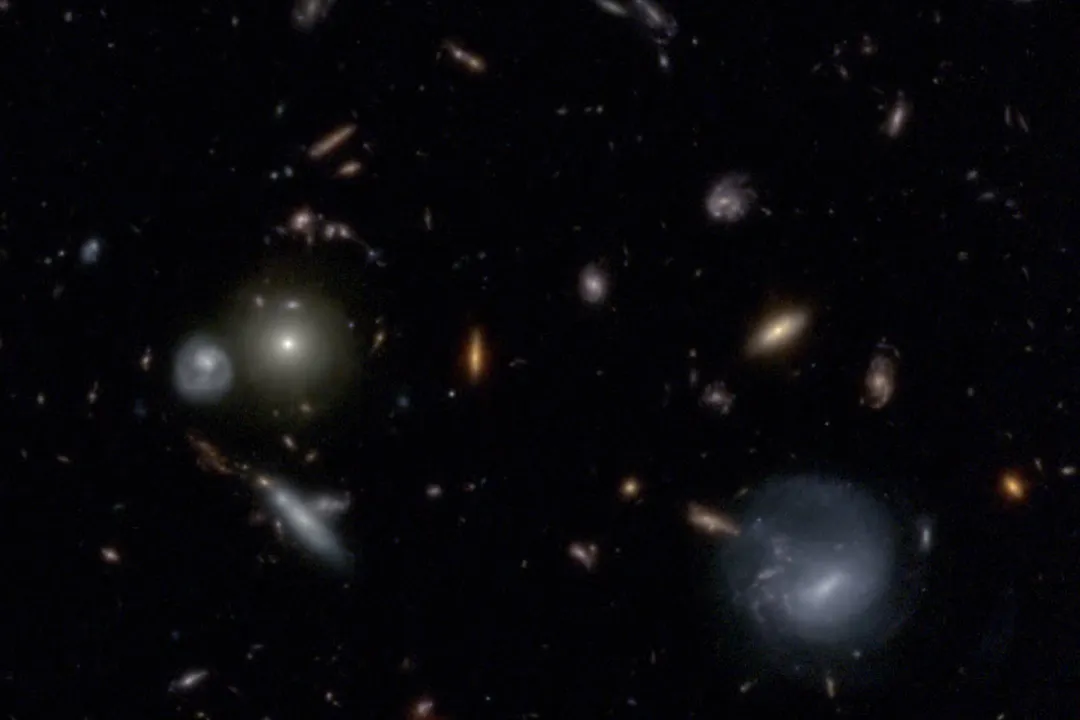
How do the morphologies of early galaxies, seen at high redshifts, typically differ from nearby grand spirals?
They often appear small, irregular, and clumpy
The appearance of galaxies changes drastically when viewed across cosmic epochs, providing insight into the physical processes dominating their youth. Galaxies observed at high redshifts, representing the early universe, do not possess the grand, neat structures seen nearby, such as smooth ellipticals or grand spirals. Instead, these nascent systems are frequently characterized as being small, highly irregular, and clumpy. This structural difference implies that the hierarchical and chaotic processes of organization, such as mergers, were actively taking place, and the mechanisms needed to arrange matter into stable, well-defined features like galactic discs had not yet fully matured over billions of years.