Approximately how long was the cumulative exposure time required to accumulate the light for the HUDF?
Answer
nearly 11 days
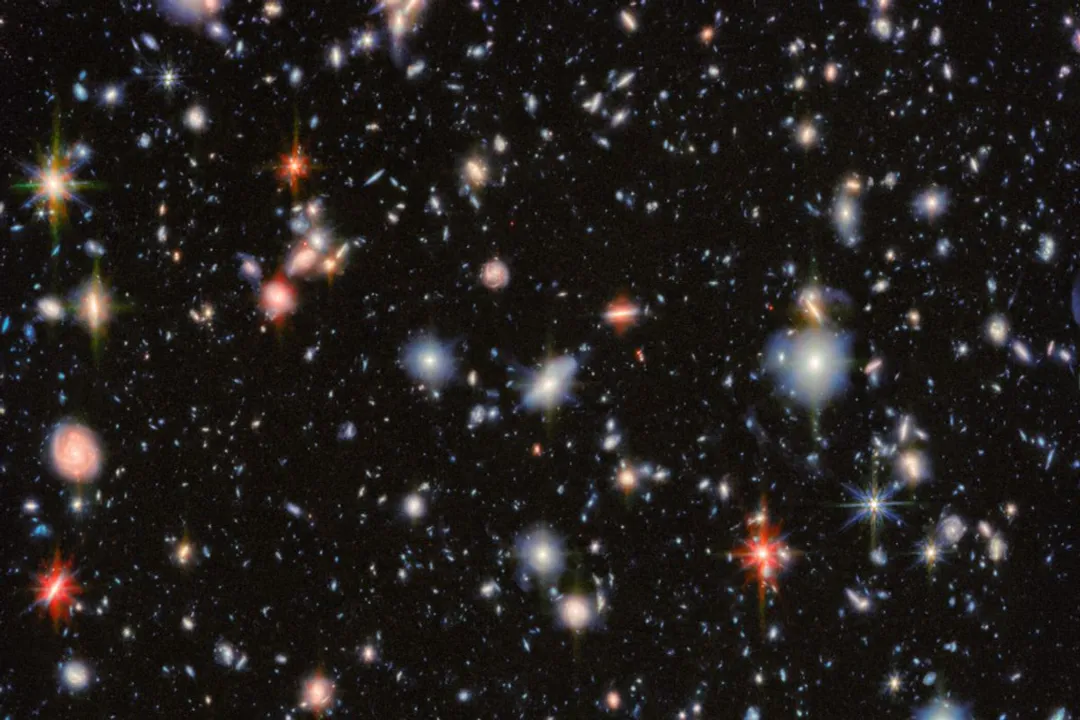
The successful accumulation of light necessary to create the Hubble Ultra Deep Field (HUDF) required a massive cumulative integration time, amounting to nearly 11 days of exposure time. This extensive duration corresponded to approximately 400 separate orbits around Earth made by the Hubble Space Telescope. This vast cumulative integration time was the critical factor that permitted the detection of objects so faint that they would have remained entirely invisible if the telescope had been pointed at that region for the shorter duration used for the original Hubble Deep Field (HDF).
Related Questions
What was the commonly cited number of galaxies shown by the Hubble Ultra Deep Field (HUDF)?Which instruments were used to construct the Hubble Ultra Deep Field (HUDF) image?How small was the region of the sky targeted by the Hubble Ultra Deep Field (HUDF) relative to the total sky area?What was the initial galaxy count reported when the Hubble Ultra Deep Field (HUDF) results were first published?Approximately how long was the cumulative exposure time required to accumulate the light for the HUDF?What was the approximate number of galaxies cataloged in the initial Hubble Deep Field (HDF) observation?Why were instruments like NICMOS necessary for constructing the HUDF image using Hubble?What next-generation observatory is prioritizing revisiting the HUDF area to build upon Hubble's foundation?How did the HDF compare to the HUDF in terms of initial exposure duration?What variety of galactic structures did the Hubble Deep Field (HDF) observation reveal in its cross-section of cosmic time?