How did the HDF compare to the HUDF in terms of initial exposure duration?
Answer
The HDF utilized approximately 10 days of exposure, less than the HUDF's 11 days.
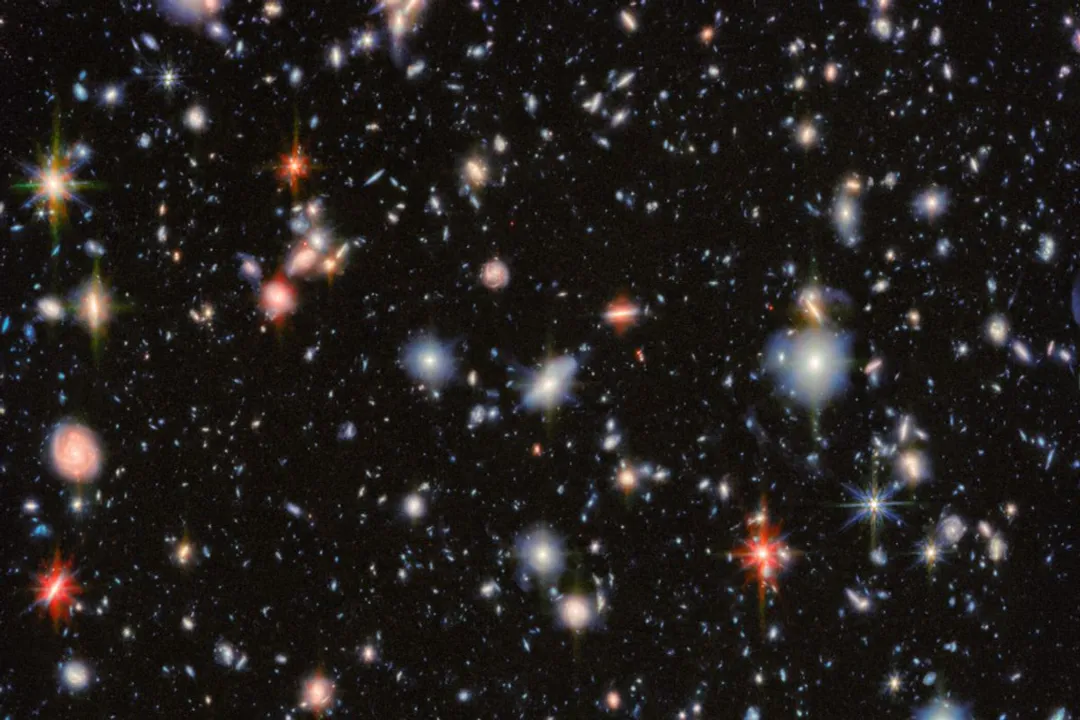
The initial Hubble Deep Field (HDF) effort was created after approximately 10 days of dedicated exposure time. In contrast, the successor image, the Hubble Ultra Deep Field (HUDF), required a longer, deliberate, and much deeper dive into the same region, accumulating light over nearly 11 days. This difference in exposure time was key to the HUDF's success in pulling in significantly fainter and more distant light that had been traveling for a greater proportion of the universe's age, leading to the detection of roughly three times the number of galaxies.
Related Questions
What was the commonly cited number of galaxies shown by the Hubble Ultra Deep Field (HUDF)?Which instruments were used to construct the Hubble Ultra Deep Field (HUDF) image?How small was the region of the sky targeted by the Hubble Ultra Deep Field (HUDF) relative to the total sky area?What was the initial galaxy count reported when the Hubble Ultra Deep Field (HUDF) results were first published?Approximately how long was the cumulative exposure time required to accumulate the light for the HUDF?What was the approximate number of galaxies cataloged in the initial Hubble Deep Field (HDF) observation?Why were instruments like NICMOS necessary for constructing the HUDF image using Hubble?What next-generation observatory is prioritizing revisiting the HUDF area to build upon Hubble's foundation?How did the HDF compare to the HUDF in terms of initial exposure duration?What variety of galactic structures did the Hubble Deep Field (HDF) observation reveal in its cross-section of cosmic time?