How many major classes or types of galaxies are there?
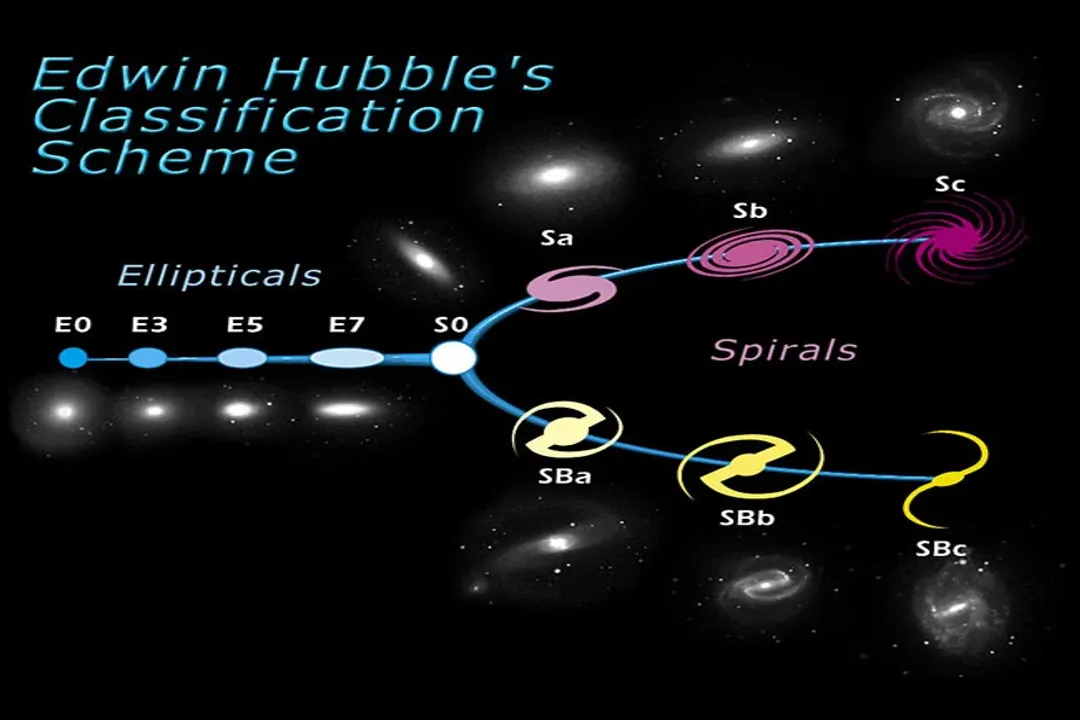
When astronomers look into the deep reaches of the universe, they do not see a random scatter of stars. Instead, they find structured systems known as galaxies, ranging from tiny collections of stars to massive, sprawling pinwheels containing billions of solar masses. [1][2] While the sheer variety in images from space telescopes might seem overwhelming, astronomers use a specific system to categorize these structures. The foundation for this system was laid by Edwin Hubble in the 1920s, providing a way to organize galaxies based on their visual appearance, or morphology. [1][7]
# Hubble Sequence
The most widely recognized classification system is the Hubble Sequence, often illustrated as a "tuning fork" diagram. [1][5] This model organizes galaxies into categories based on their shape rather than their age or mass. While modern astrophysics has refined these definitions with complex data regarding star formation rates and gas content, the Hubble system remains the standard for describing a galaxy's basic structure. [3][9] It suggests a continuum of forms rather than rigid, distinct boxes, meaning many galaxies exist as hybrids that do not fit perfectly into a single category. [5]
# Elliptical Galaxies
Elliptical galaxies appear as smooth, featureless, and round or oval-shaped blobs of light. [2][4] They lack the structured arms or complex disks found in other types, appearing almost like a uniform glow of stars. [7] Because they contain very little gas and dust, they have low rates of star formation. [3] Most of the stars found in these systems are older, reddish, and cooler, which explains the characteristic soft, yellow-red hue often seen in photographs. [2][9] These galaxies range from tiny "dwarf ellipticals" that are common throughout the universe to massive "giant ellipticals" that typically occupy the centers of large galaxy clusters. [1][9]
# Spiral Galaxies
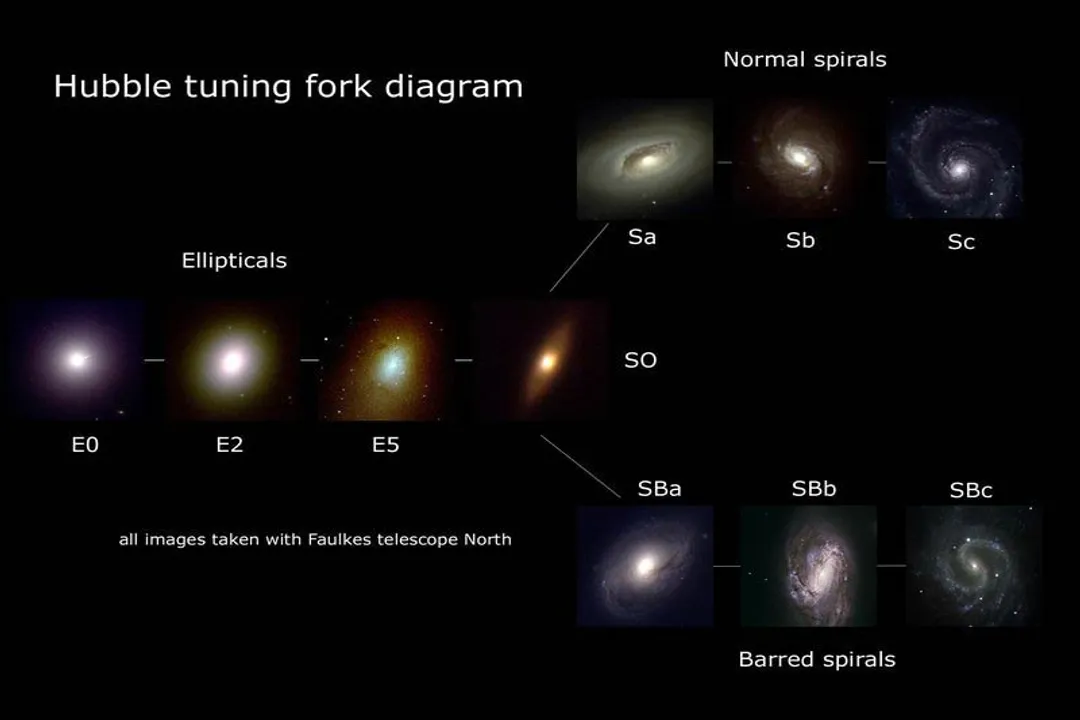
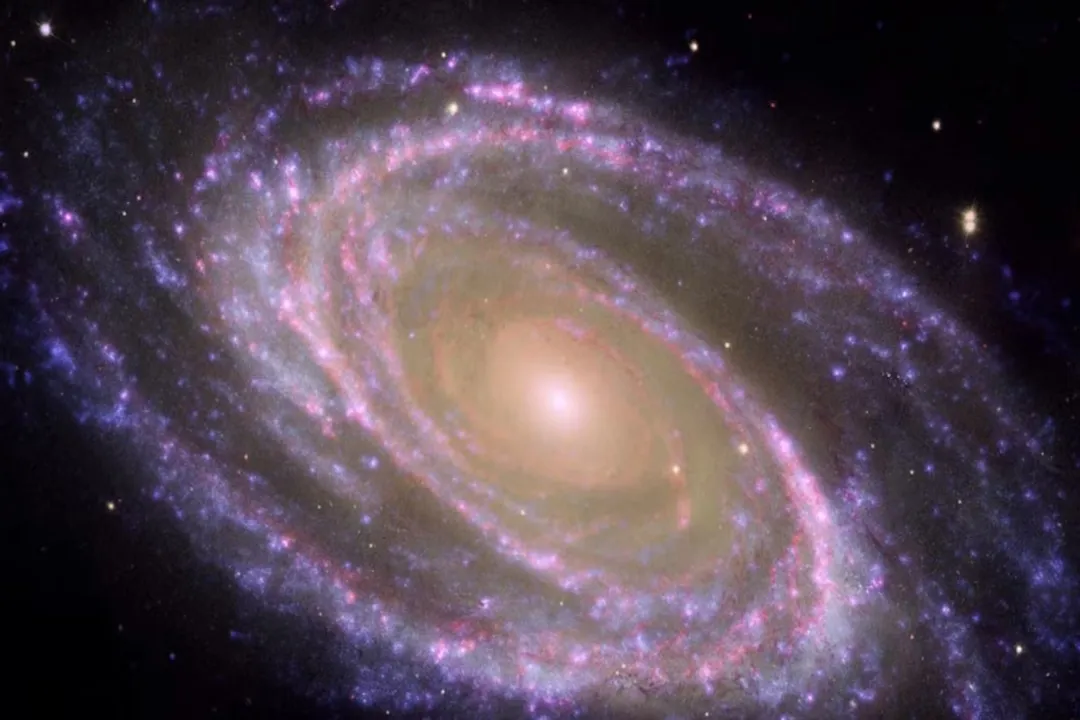
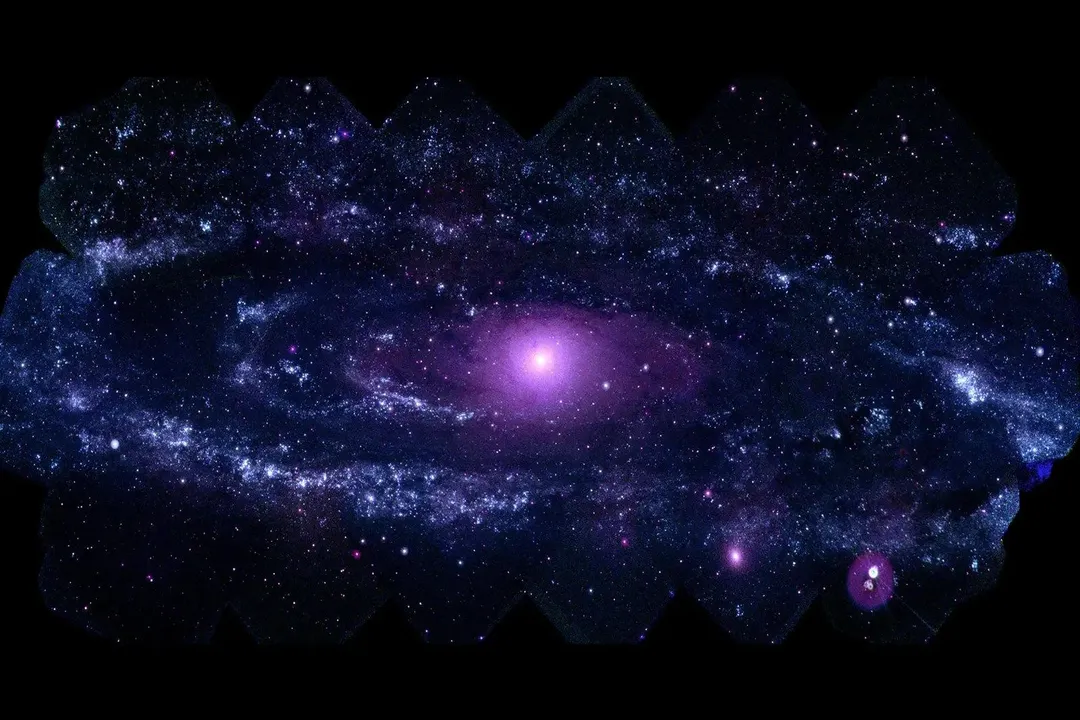
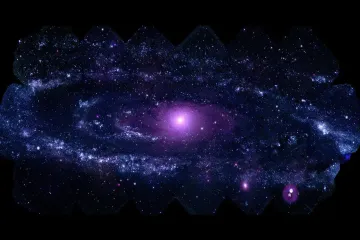
Spiral galaxies are the most iconic structures in the night sky. They are defined by their flattened, rotating disks and distinct spiral arms that contain stars, gas, and dust. [3][7] These arms are often the sites of active star formation, appearing bright blue due to the presence of young, massive, hot stars. [1][2] At the center of these galaxies, there is usually a "bulge"—a dense, spherical concentration of older stars. [4][9] Our own galaxy, the Milky Way, falls into this category. [7] The rotation of these disks is what gives the arms their characteristic curved, pinwheel appearance. [2]
# Barred Spirals
A sub-category of spiral galaxies, barred spirals possess a central "bar" structure running through the middle of the bulge. [1][3] The spiral arms extend from the ends of this bar rather than directly from the nucleus. [2][9] Approximately two-thirds of all spiral galaxies, including the Milky Way, are believed to be barred spirals. [1][7] Astronomers think this bar structure plays a role in channeling gas into the center of the galaxy, which can trigger bursts of star formation or fuel the supermassive black hole at the core. [3][5]
# Lenticular Galaxies
Lenticular galaxies represent a transition state between elliptical and spiral galaxies, often referred to as "S0" galaxies in the Hubble sequence. [1][3] They possess a central bulge and a disk, much like a spiral galaxy, but they lack the distinct, well-defined spiral arms. [2][7] Additionally, like elliptical galaxies, lenticulars contain very little interstellar gas and dust, meaning they do not exhibit the same level of active star formation seen in spirals. [3][4] They often look like a lens—thicker at the center and thinning out toward the edges—which is how they earned their name. [2]
# Irregular Galaxies
Not every galaxy fits into the orderly shapes defined by the Hubble Sequence. Irregular galaxies lack any distinct, symmetric form, appearing chaotic or amorphous. [1][7] These systems often result from gravitational interactions, such as collisions or near-misses with other galaxies, which distort their structure. [3][4] Because these interactions often compress clouds of gas, irregular galaxies can have very high rates of star formation, causing them to shine with a bright, erratic glow. [2][9] Many of these are dwarf galaxies, though some larger irregular systems exist, and they provide astronomers with a look at how galaxies evolve through violent cosmic encounters. [5]
# Comparison Data
To better understand the differences between these primary classes, it helps to look at their distinguishing characteristics side-by-side. While these are broad categorizations, individual galaxies often display traits that bridge these gaps.
| Galaxy Class | Structure | Gas/Dust Content | Star Formation |
|---|---|---|---|
| Elliptical | Round/Oval | Very Low | Minimal |
| Spiral | Disk with Arms | High | Active |
| Barred Spiral | Disk/Bar/Arms | High | Active |
| Lenticular | Disk/No Arms | Low | Minimal |
| Irregular | No Symmetry | Variable | High |
# Observational Tips
If you are looking to identify these objects through a telescope, the key is observing the "glow" rather than the detail. Spiral galaxies will often reveal a bright nucleus and, under good conditions, a slightly mottled or "textured" appearance in the outer regions. Elliptical galaxies, by contrast, look remarkably consistent regardless of the magnification; they appear as a steady, fading gradient of light, with no clear definition or edge. If you spot a galaxy that looks like a smudge with no distinct orientation, you are likely looking at an irregular or a distant, edge-on spiral.
Another important aspect is the color. While amateur telescopes often show light in grayscale, long-exposure astrophotography reveals the colors that define these classes. Blue indicates the hot, young stars typical of active spirals, whereas a yellowish or reddish tint is a strong indicator of the aged stellar populations in an elliptical galaxy. [3][9] Understanding these visual cues can turn a simple observation into a meaningful study of galactic evolution.
# Galactic Evolution
It is tempting to view these classifications as fixed, but in the context of the universe, they are snapshots of long-term processes. Astronomers often consider how a galaxy might transition from one type to another. For example, when two spiral galaxies collide, the resulting merger often consumes the gas and scrambles the disk structure, potentially creating an elliptical galaxy. [2][5] Furthermore, as spirals exhaust their gas supply over billions of years, their star formation slows, and they may gradually fade into lenticular-like systems. [1][3] By identifying a galaxy's class, you are essentially determining its stage in a cosmic life cycle that spans billions of years.
#Videos
Types of Galaxies in Space - Spiral, Elliptical, Irregular plus more
Related Questions
#Citations
Galaxy Types - NASA Science
Galaxy Classification - Las Cumbres Observatory
Galaxy Classification | The Schools' Observatory
The Three Types of Galaxies - Slooh
galaxy types: stage, family, and variety
Types of Galaxies in Space - Spiral, Elliptical, Irregular plus more
Galaxies—facts and information | National Geographic
How many types of galaxies are there in the universe?
Types of Galaxies | Pictures, Facts, and Information - AstroBackyard