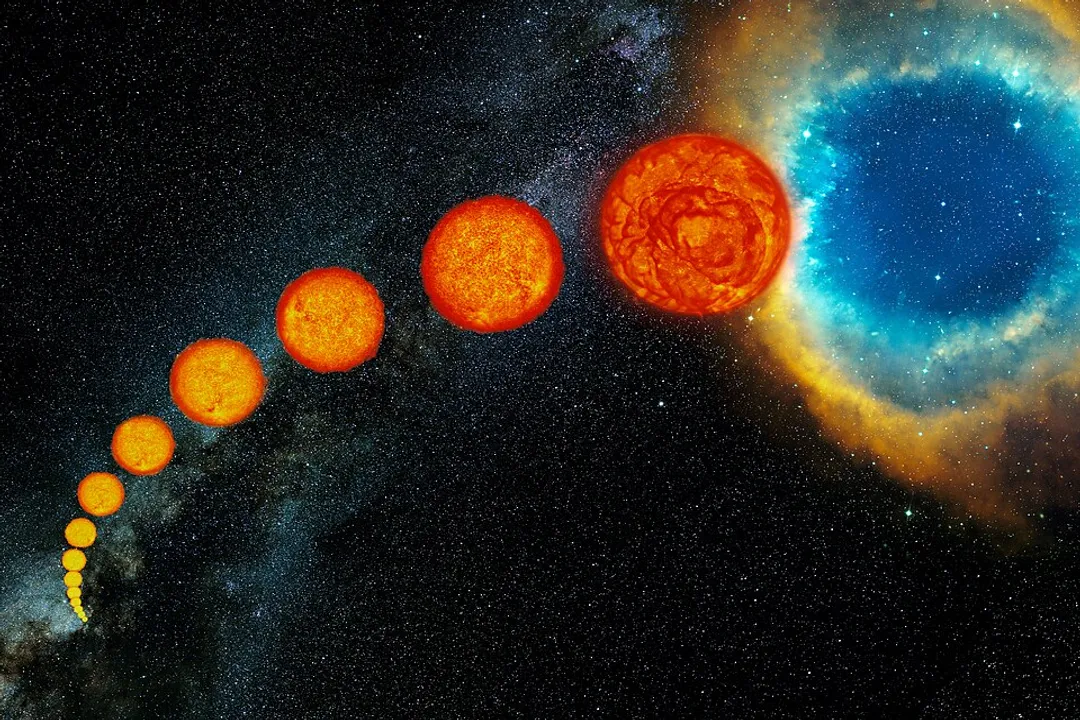
Why does a massive 15 $M_{\odot}$ star have a significantly shorter Main Sequence lifetime than the Sun?
Stronger gravity requires a much higher core temperature and fusion rate to maintain equilibrium.
The inverse relationship between a star's initial mass and its total lifespan is a fundamental concept governed by the rate at which fuel is consumed. More massive stars possess significantly greater gravitational forces pulling inward due to their larger mass. To counteract this immensely stronger gravity and maintain the necessary hydrostatic equilibrium, the core must reach far higher temperatures and pressures than a less massive star like the Sun. This elevated condition forces the nuclear fusion reactions—converting hydrogen to helium—to occur at a vastly accelerated rate. Consequently, these massive stars burn through their substantial hydrogen fuel reserves incredibly quickly, resulting in lifetimes measured in millions of years rather than the billions characteristic of solar-mass stars.