What do chemically enriched planetary nebulae primarily display regarding their elemental makeup?
Answer
Elements processed within the stars themselves
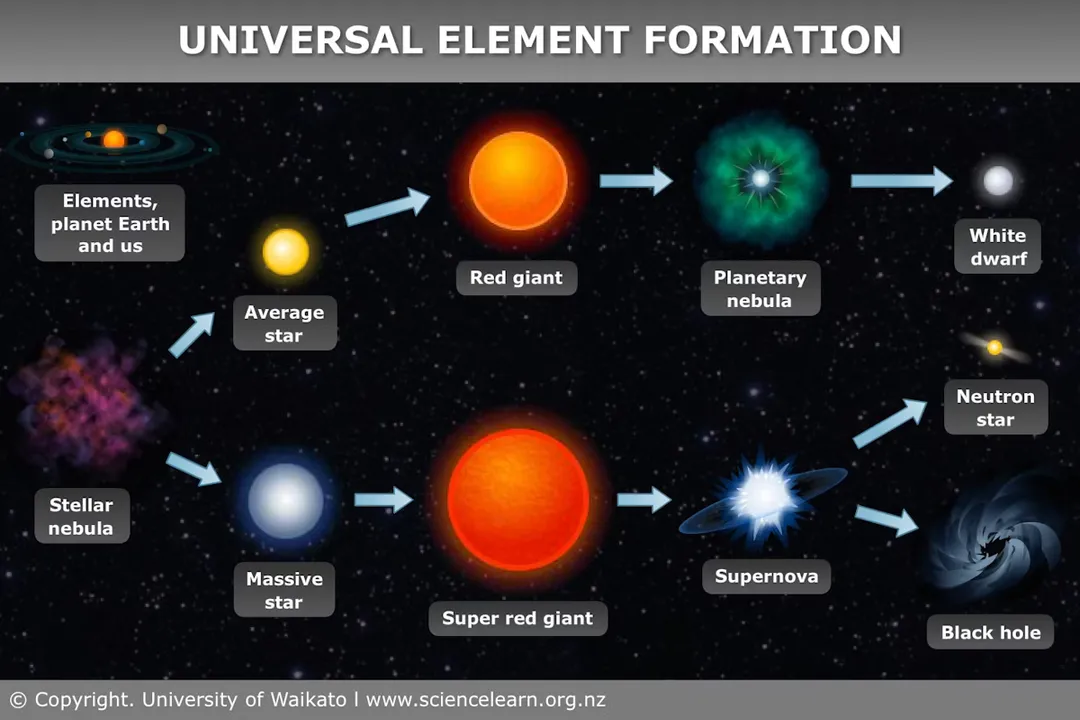
While the raw material for new stars originates from primordial hydrogen and helium created during the Big Bang, planetary nebulae represent the later stages of stellar evolution. The material ejected to form a planetary nebula is the star's outer envelope, which has been gently expelled following the red giant phase. This material carries the chemical signature of the star's interior, where sufficient temperatures and pressures existed to drive fusion reactions beyond the initial hydrogen burning. Therefore, these nebulae offer a concentrated view of elements that were forged and processed inside the progenitor star over millions or billions of years.
Related Questions
What two elements dominate the bulk mass of any stellar nebula, forming material or dispersing remnants?What do chemically enriched planetary nebulae primarily display regarding their elemental makeup?What specific process is responsible for creating elements heavier than helium inside a star's interior?What is the resulting product when intermediate-mass stars fuse helium nuclei during the triple-alpha process?If a star's interior composition was significantly altered by the CNO cycle, what enrichment will the resulting nebula show?What is the specific term astronomers use for the abundance of elements heavier than hydrogen and helium?Which elements dominate the material ejected by progenitor stars classified as Low-to-Intermediate Mass?What exposed stellar core causes the surrounding gas in a planetary nebula to glow brightly?What is the chemical consequence when ejected gas and dust from an aging star mix back into the general interstellar medium?What significant implication arises from detecting elements like neon or oxygen in a newly forming stellar nebula?