What two elements dominate the bulk mass of any stellar nebula, forming material or dispersing remnants?
Answer
Hydrogen and Helium
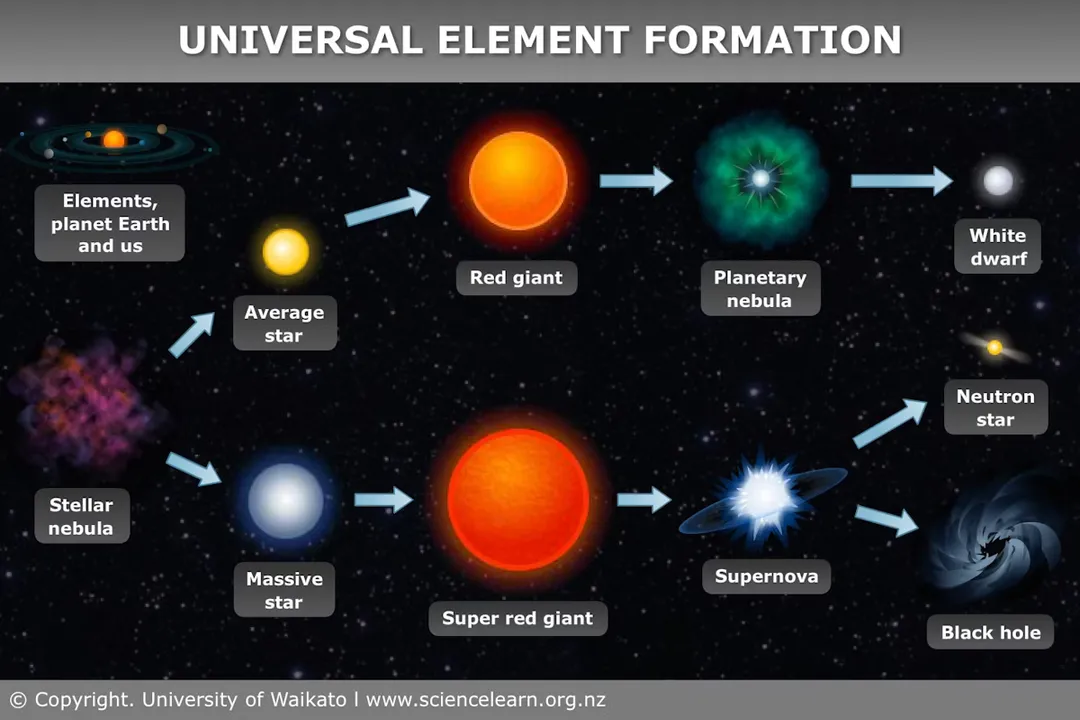
The fundamental composition of any stellar nebula, regardless of whether it is actively forming stars or dispersing after a stellar death, is overwhelmingly defined by the two lightest elements, hydrogen (H) and helium (He). These components constitute the vast majority of the mass present in the initial interstellar medium and also in the expanding shells expelled by dying stars, such as planetary nebulae. The concentration is extremely high, with hydrogen often accounting for roughly ninety percent of the mass, and helium making up most of the remaining portion. This specific ratio reflects the universe's initial composition established shortly after the Big Bang.
Related Questions
What two elements dominate the bulk mass of any stellar nebula, forming material or dispersing remnants?What do chemically enriched planetary nebulae primarily display regarding their elemental makeup?What specific process is responsible for creating elements heavier than helium inside a star's interior?What is the resulting product when intermediate-mass stars fuse helium nuclei during the triple-alpha process?If a star's interior composition was significantly altered by the CNO cycle, what enrichment will the resulting nebula show?What is the specific term astronomers use for the abundance of elements heavier than hydrogen and helium?Which elements dominate the material ejected by progenitor stars classified as Low-to-Intermediate Mass?What exposed stellar core causes the surrounding gas in a planetary nebula to glow brightly?What is the chemical consequence when ejected gas and dust from an aging star mix back into the general interstellar medium?What significant implication arises from detecting elements like neon or oxygen in a newly forming stellar nebula?