What process involving hydrogen results in the characteristic ruddy glow of emission nebulae?
Answer
Recombination of ionized hydrogen releasing H-alpha emission
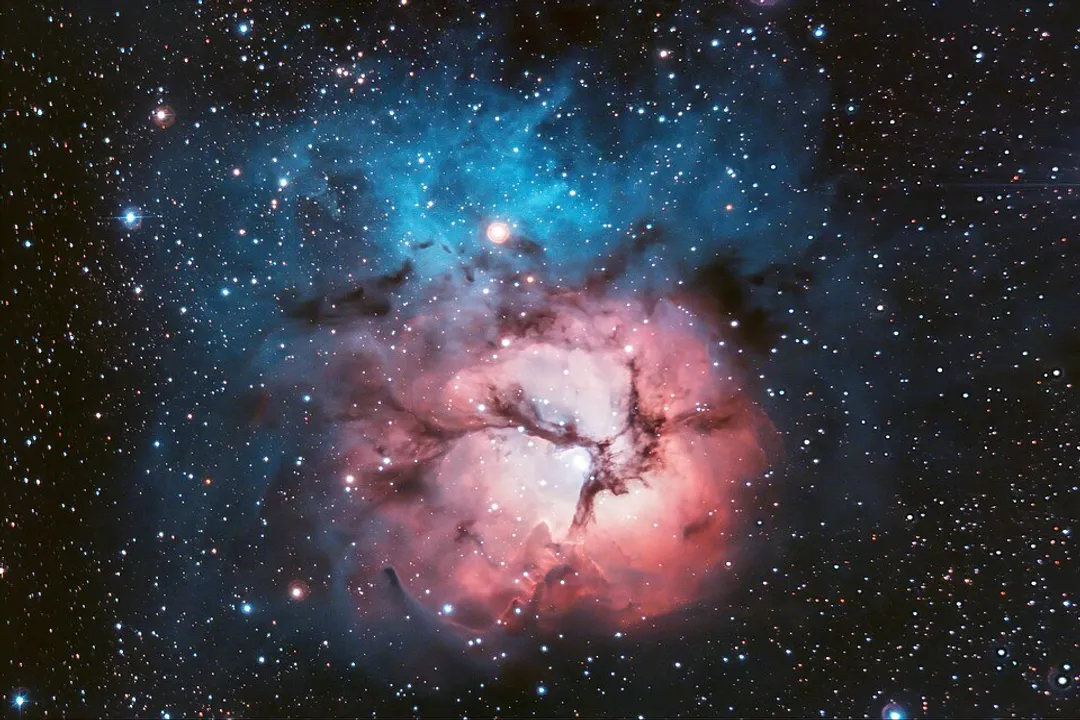
In emission nebulae, the hydrogen gas is energized, or ionized, by nearby hot, young stars. When the electrons in these hydrogen atoms subsequently recombine with the protons, energy is released. This release primarily occurs in the red part of the light spectrum, a specific signature known as H-alpha emission. This H-alpha emission is what is responsible for giving many nebulae their distinct, characteristic ruddy or reddish glow.
Related Questions
What elements compose the overwhelming majority of any given nebula?What process involving hydrogen results in the characteristic ruddy glow of emission nebulae?What collective term do astronomers use for the heavier elements found in nebulae?What is the primary structural role of heavier dust grains and molecules in a nebula?Why do reflection nebulae primarily appear blue when scattering light from nearby stars?What are the primary components of dark nebulae that cause them to appear as silhouettes?What does the presence of heavier elements in a collapsing cloud reveal about its galactic neighborhood?Approximately what percentage of the elemental mass does hydrogen account for in a young, star-forming nebula?Which analytical process allows astronomers to measure the specific elements and their proportions in a nebula?How do elements typically manifest in the colder, denser regions of a nebula?