Why do reflection nebulae primarily appear blue when scattering light from nearby stars?
Answer
The scattering process favors shorter wavelengths
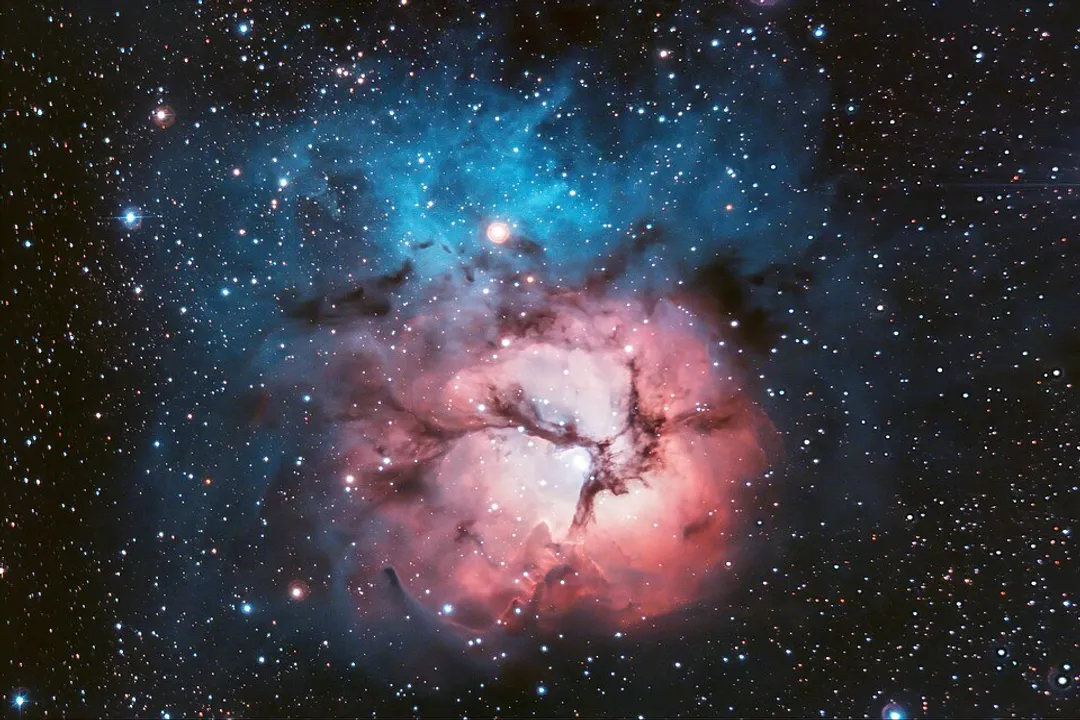
Reflection nebulae are characterized by the fact that they do not emit their own light but instead scatter the light originating from nearby stars. This scattering phenomenon, primarily involving the dust component composed of heavier elements, exhibits wavelength dependence. The process favors the scattering of shorter wavelengths of visible light, which corresponds to the blue end of the spectrum, similar to the physical reason why Earth's atmosphere appears blue.
Related Questions
What elements compose the overwhelming majority of any given nebula?What process involving hydrogen results in the characteristic ruddy glow of emission nebulae?What collective term do astronomers use for the heavier elements found in nebulae?What is the primary structural role of heavier dust grains and molecules in a nebula?Why do reflection nebulae primarily appear blue when scattering light from nearby stars?What are the primary components of dark nebulae that cause them to appear as silhouettes?What does the presence of heavier elements in a collapsing cloud reveal about its galactic neighborhood?Approximately what percentage of the elemental mass does hydrogen account for in a young, star-forming nebula?Which analytical process allows astronomers to measure the specific elements and their proportions in a nebula?How do elements typically manifest in the colder, denser regions of a nebula?