Approximately what percentage of the elemental mass does hydrogen account for in a young, star-forming nebula?
Answer
$ ext{ extasciicircum } 75\%$
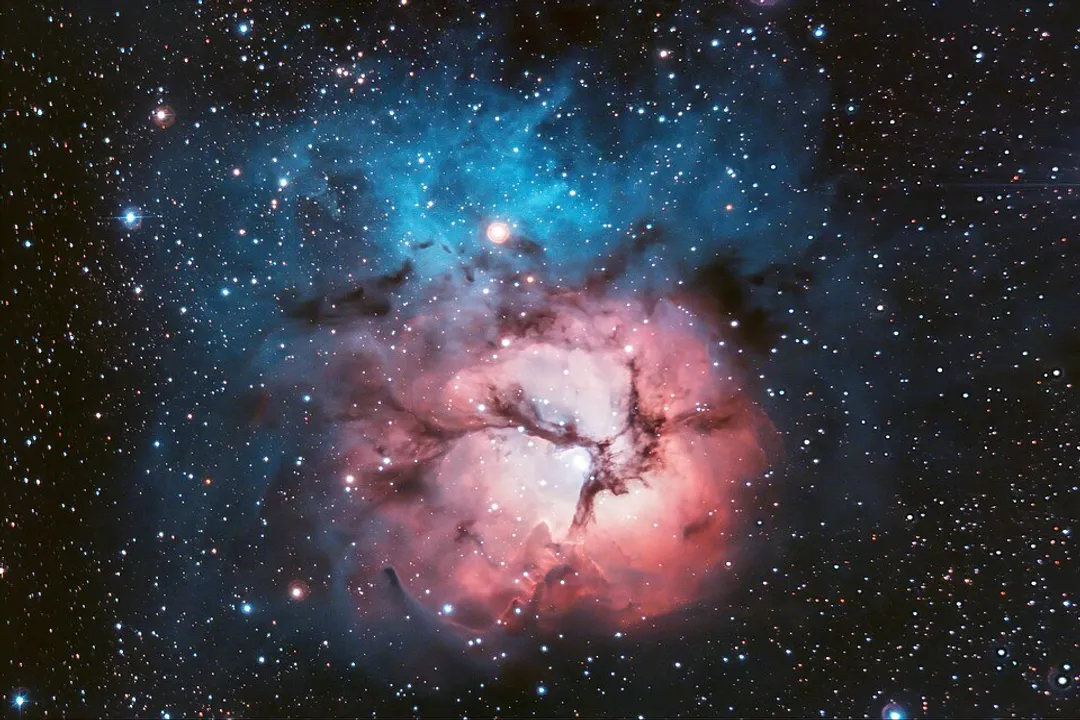
Based on the general astronomical composition data provided for a generic nebula, hydrogen ($ ext{H}$) is quantified as the primary mass component, accounting for approximately 75% of the total mass by weight. This high percentage underscores hydrogen's role as the fuel source for the initial stages of star formation, contrasting sharply with helium, which makes up about 24%, and the heavier elements ("metals") which together account for only about 1% to 2%.
Related Questions
What elements compose the overwhelming majority of any given nebula?What process involving hydrogen results in the characteristic ruddy glow of emission nebulae?What collective term do astronomers use for the heavier elements found in nebulae?What is the primary structural role of heavier dust grains and molecules in a nebula?Why do reflection nebulae primarily appear blue when scattering light from nearby stars?What are the primary components of dark nebulae that cause them to appear as silhouettes?What does the presence of heavier elements in a collapsing cloud reveal about its galactic neighborhood?Approximately what percentage of the elemental mass does hydrogen account for in a young, star-forming nebula?Which analytical process allows astronomers to measure the specific elements and their proportions in a nebula?How do elements typically manifest in the colder, denser regions of a nebula?