What is the specific term astronomers use for the abundance of elements heavier than hydrogen and helium?
Answer
Metallicity
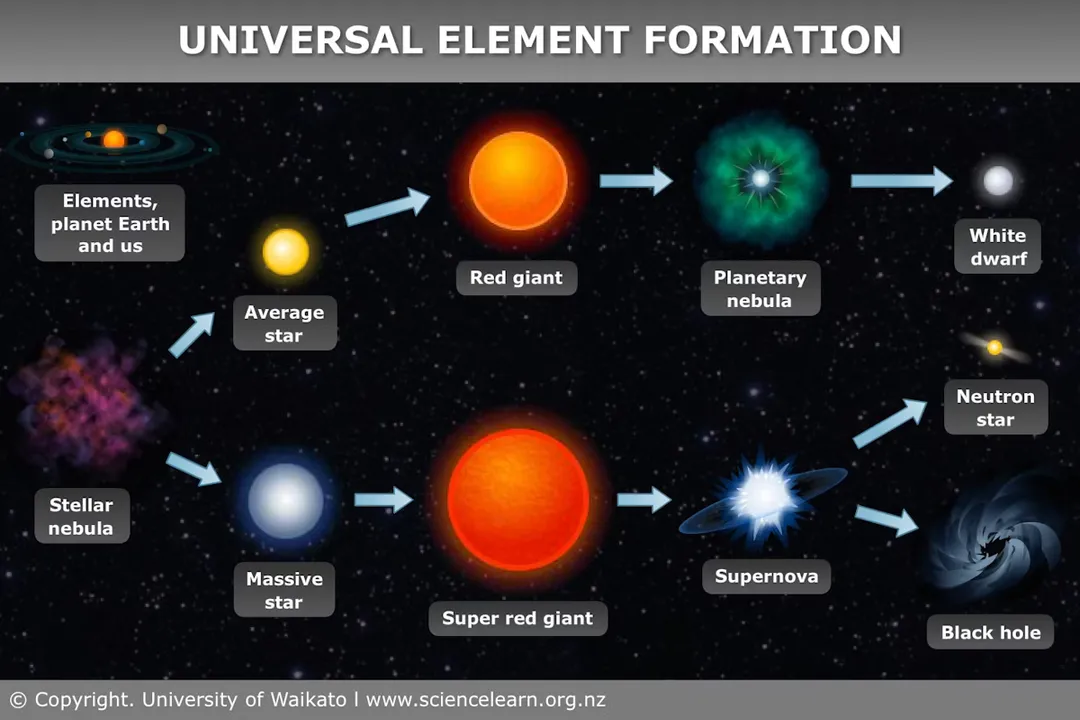
In astronomical terminology, the term 'metallicity' is used specifically to quantify the abundance of all elements present in a cosmic structure that are heavier than the two lightest elements, hydrogen and helium. The injection of these heavier elements back into the galactic environment via material recycling effectively increases the metallicity of the clouds available for subsequent star formation. This gradual enrichment means that newer stellar populations are built from material that has already participated in at least one stellar lifecycle, contributing to the availability of elements necessary for rocky planets.
Related Questions
What two elements dominate the bulk mass of any stellar nebula, forming material or dispersing remnants?What do chemically enriched planetary nebulae primarily display regarding their elemental makeup?What specific process is responsible for creating elements heavier than helium inside a star's interior?What is the resulting product when intermediate-mass stars fuse helium nuclei during the triple-alpha process?If a star's interior composition was significantly altered by the CNO cycle, what enrichment will the resulting nebula show?What is the specific term astronomers use for the abundance of elements heavier than hydrogen and helium?Which elements dominate the material ejected by progenitor stars classified as Low-to-Intermediate Mass?What exposed stellar core causes the surrounding gas in a planetary nebula to glow brightly?What is the chemical consequence when ejected gas and dust from an aging star mix back into the general interstellar medium?What significant implication arises from detecting elements like neon or oxygen in a newly forming stellar nebula?