What governs the transition point where a remnant core collapses into a Black Hole instead of stabilizing as a Neutron Star?
The Tolman-Oppenheimer-Volkoff (TOV) limit.
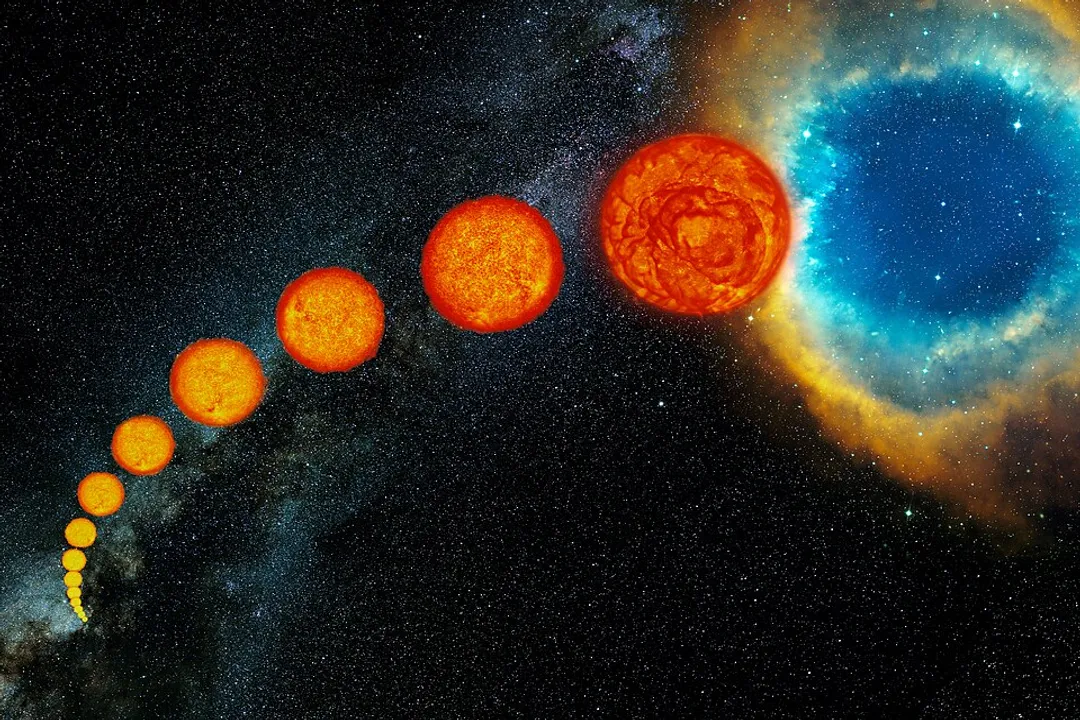
The fate of the compact remnant left behind after a Type II Supernova depends critically on the residual mass of the collapsed core. If this mass falls between approximately 1.4 and 3 solar masses, the extreme density is stabilized by the strong forces between neutrons, forming a Neutron Star. However, if the core mass exceeds a specific threshold, known as the Tolman-Oppenheimer-Volkoff (TOV) limit, even neutron degeneracy pressure is insufficient to withstand the overwhelming gravitational force. When this boundary is crossed, gravity cannot be halted by any known physical force, causing the remnant to collapse completely into a singularity, thus forming a Black Hole where spacetime is so curved that light cannot escape.