Which element's core formation signals the absolute end of energy generation via fusion in massive stars?
Answer
Iron.
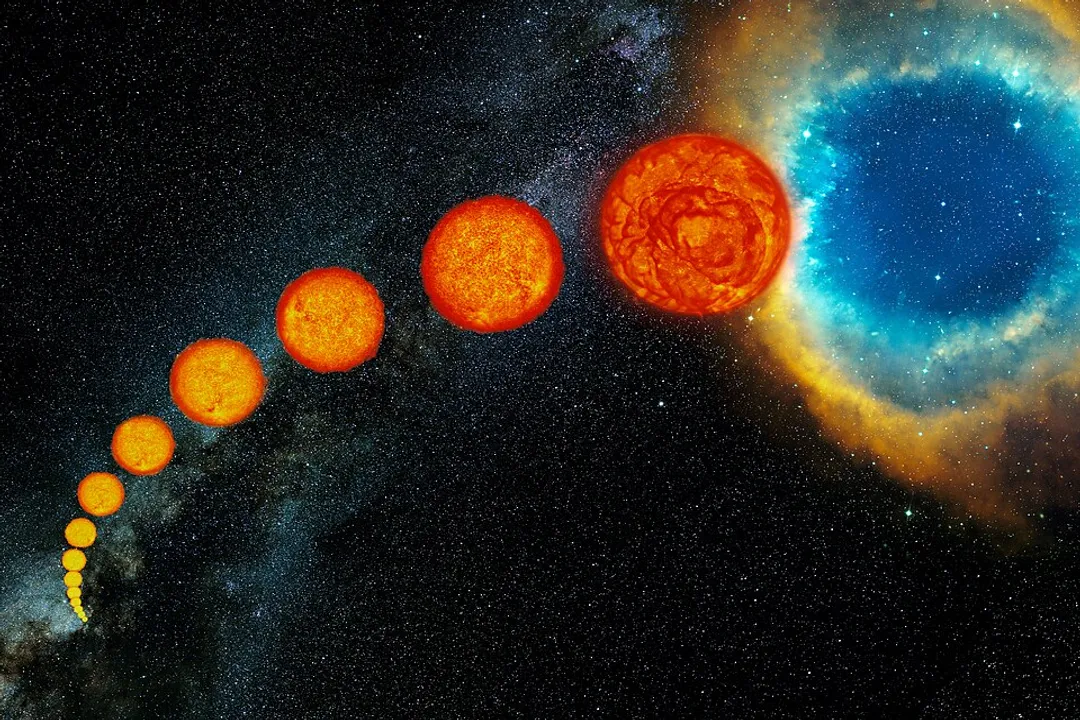
The evolutionary track of a very massive star involves sequentially fusing heavier and heavier elements in nested shells within its core—starting with hydrogen, moving to helium, then carbon, neon, and so on. This process of building heavier elements releases the necessary energy to oppose gravity. However, this chain terminates abruptly upon the creation of an iron core. Fusing iron atoms does not release energy; rather, it consumes energy (requires an input of energy) to proceed. Once the core becomes iron, the star's primary energy source vanishes instantly. With no outward thermal pressure being generated, gravity immediately overcomes all remaining forces, leading to catastrophic core collapse and the violent death explosion.
Related Questions
What prevents a collapsing Protostar from being classified as a true star during its initial phase?What mechanism maintains balance within a star existing on the Main Sequence?Why does a massive 15 $M_{\odot}$ star have a significantly shorter Main Sequence lifetime than the Sun?What process creates a Planetary Nebula around a dying low-mass star?Which element's core formation signals the absolute end of energy generation via fusion in massive stars?What is the remnant supported against collapse by electron degeneracy pressure?What catastrophic explosion occurs when the iron core of a massive star violently rebounds?What is the initial structure where gravity causes slight density fluctuations to collapse, starting star formation?What governs the transition point where a remnant core collapses into a Black Hole instead of stabilizing as a Neutron Star?What celestial object will the Sun eventually become after it sheds its outer layers as a Planetary Nebula?